Artificial intelligence is reshaping software architecture, shifting the engineering bottleneck from raw model training to production deployment, orchestration, and scale. As organizations race to productionize large language models (LLMs), Retrieval-Augmented Generation (RAG) pipelines, and autonomous AI agents, they face a critical operational gap: keeping these non-deterministic, resource-heavy systems stable, secure, and cost-effective.
If you currently work in cloud engineering, site reliability engineering (SRE), or platform engineering, you do not need to start your career from scratch. The core DevOps skills required to build and maintain resilient distributed systems—such as containerization, CI/CD automation, infrastructure as code (IaC), and deep observability—translate directly into the AI engineering stack.
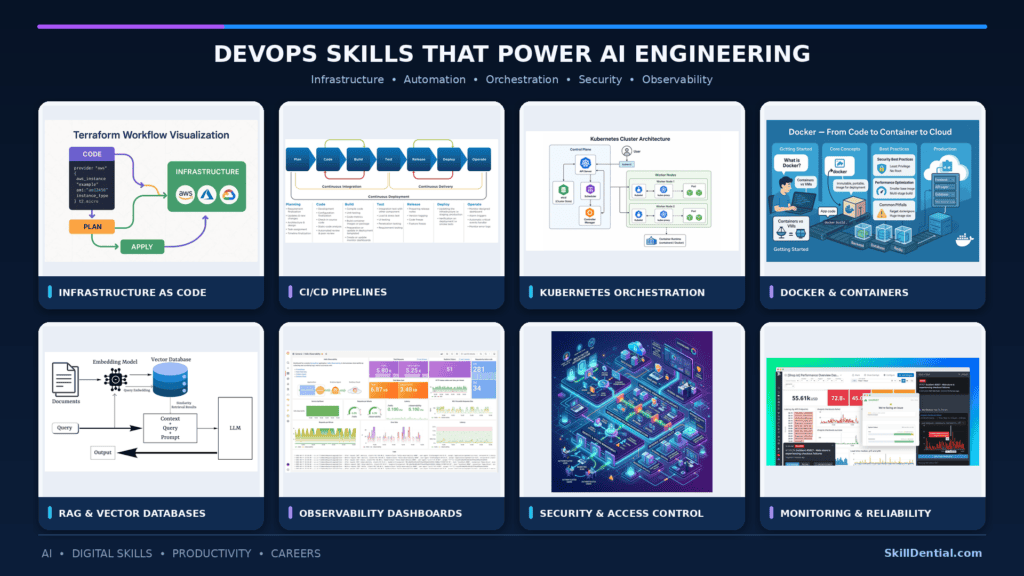
The primary difference lies in operational complexity: AI workloads introduce non-deterministic outputs, GPU resource constraints, high inference latency, token-based cost tracking, and rigorous data pipeline requirements.
In this guide, we break down 11 foundational DevOps skills that transfer directly to AI engineering, analyze how each applies to modern AI systems, and outline the exact extensions needed to bridge the gap into artificial intelligence.
Containerisation with Docker
Why it matters: Docker packages applications and their dependencies into portable containers, ensuring consistent environments across development, staging, and production. In AI engineering, this same principle applies to packaging non-deterministic AI workloads, model-serving APIs, and complex multi-service architectures.
How Your DevOps Skills Transfer
In traditional infrastructure, you rely on DevOps skills like containerizing microservices, managing base images, and ensuring environment parity. In an AI engineering stack, the core containerization concepts remain identical, but the contents of your containers change to support AI-specific runtimes and pipelines:
- LLM-powered applications: Packaging custom orchestration logic and agent runtimes.
- Machine learning inference services: Encapsulating frameworks like vLLM, Triton Inference Server, or Hugging Face TGI.
- Embedding generation APIs: Running lightweight models locally for vector conversion.
- RAG application backends: Combining application servers with local embedding libraries.
- Model-serving frameworks: Managing heavyweight Python dependencies (PyTorch, CUDA, Transformers).
- Data processing services: Executing deterministic preprocessing and cleaning pipelines before inference.
For example, a production Retrieval-Augmented Generation (RAG) system often requires a Python application backend, a vector database, and a dedicated model inference endpoint. Using Docker, you can isolate each component while maintaining predictable networking and configuration management.
What to Learn Next
To fully adapt your containerization workflow for artificial intelligence, focus on these next-step competencies:
- Containerizing Python-based AI applications and managing complex dependency trees (Poetry, pipenv).
- Building lean, efficient Docker images for machine learning workloads (leveraging multi-stage builds to strip out unnecessary build tools).
- Handling persistent storage and large model artifacts without bloating image sizes.
- Managing environment variables and model configurations securely.
- Deploying GPU-enabled containers using the NVIDIA Container Toolkit to pass physical GPU acceleration directly into the container runtime.
Hands-On AI Engineering Application
Build and deploy a containerised RAG application using Docker Compose. Create a multi-container architecture featuring separate services for your application backend, a vector database (such as Qdrant or Milvus), and an optimized model inference endpoint.
Kubernetes and Container Orchestration
Why it matters: Kubernetes automates the deployment, scaling, and management of containerized workloads across distributed node clusters. In AI engineering, it forms the bedrock for scalable model-serving infrastructure, high-throughput inference pipelines, and specialized hardware provisioning.
How Your DevOps Skills Transfer
If you already understand Kubernetes deployments, services, pods, namespaces, configuration management, and horizontal scaling, you possess essential DevOps skills for orchestrating complex AI architectures.
In traditional cloud systems, Kubernetes manages stateless microservices and web servers. In an AI engineering stack, the core orchestration principles remain identical, but the resource profiles and operational constraints shift significantly:
- Deploying model inference services: Exposing high-concurrency LLM and embedding endpoints via robust Kubernetes Services and Ingress controllers.
- Scaling AI application backends: Managing API gateways, agent orchestrators, and retrieval layers under heavy concurrent user loads.
- Managing distributed workloads: Orchestrating parallel data preprocessing jobs, chunking pipelines, and batch vector embedding generations.
- Scheduling GPU-enabled workloads: Utilizing device plugins to map physical hardware accelerators directly to pods that require high-performance computation.
- Running multi-service AI architectures: Isolating resource-intensive components—such as vector databases, caching layers, and inference pods—within dedicated namespaces.
- Managing service availability during updates: Configuring custom liveness and readiness probes to prevent traffic routing to pods while heavy model weights are still loading into memory.
A critical convergence point is GPU orchestration. Kubernetes supports advanced hardware acceleration through device plugins and NVIDIA GPU operators, allowing you to partition GPUs, allocate specific memory limits, and schedule workloads efficiently across heterogeneous node pools.
What to Learn Next
To adapt your container orchestration expertise specifically for artificial intelligence, focus on these advanced competencies:
- Advanced GPU scheduling: Implementing taints, tolerations, and node selectors to route GPU-heavy workloads to specialized node types (e.g., A100, H100, or L4 clusters).
- Inference-specific autoscaling: Moving beyond CPU/memory metrics to event-driven autoscaling (using tools like KEDA) based on request queue length, concurrency, or token throughput.
- Model-serving frameworks on K8s: Integrating production runtimes like vLLM, Triton Inference Server, or Hugging Face Text Generation Inference (TGI) into your cluster architecture.
- Kubernetes operators for AI: Managing distributed training and inference clusters using specialized operators (such as Ray on Kubernetes or Kubeflow).
Hands-On AI Engineering Application
Deploy a containerised LLM inference service on Kubernetes using an optimized serving engine (like vLLM). Configure explicit GPU resource limits and requests, write custom startup and readiness probes that account for model loading latency, and establish horizontal autoscaling policies based on traffic load.
CI/CD Pipelines and Deployment Automation
Why it matters: AI applications require reliable release workflows just like conventional software. However, traditional passing unit tests and green compilation builds do not mean an AI system is production-ready.
AI deployment pipelines introduce complex evaluation gates—such as checking model response quality, token consumption, retrieval accuracy, and safety constraints.
How Your DevOps Skills Transfer
If you already manage CI/CD pipelines using GitHub Actions, GitLab CI, Jenkins, or Azure DevOps, you understand how to automate software builds, environment promotion, and release management. These core DevOps skills translate directly into AI engineering, but the scope of automation expands to handle the lifecycle of non-deterministic systems:
- Automating AI application builds: Packaging containerized inference engines and application logic.
- Testing model-serving APIs: Running automated integration tests against endpoint schemas and payload structures.
- Deploying new model versions: Managing blue-green or canary rollouts for large weight files or updated fine-tuned checkpoints.
- Managing prompt and configuration changes: Treating system prompts, retrieval parameters, and hyperparameter configs as version-controlled code.
- Running automated evaluation tests: Executing regression tests against predefined evaluation datasets to catch silent capability regressions.
- Rolling back problematic deployments: Triggering automatic rollbacks if live inference error rates spike or evaluation metrics plummet.
A major shift in AI deployment pipelines is the integration of evaluation-gated releases. Unlike deterministic applications where code correctness dictates success, an AI pipeline must programmatically validate output quality, latency profiles, cost boundaries, and security filters before promoting a build to production.
What to Learn Next
To adapt your pipeline automation expertise for artificial intelligence, focus on these advanced competencies:
- Evaluation-gated deployments: Integrating automated LLM evaluation frameworks (like DeepEval, Ragas, or Promptfoo) directly into your CI/CD workflow as mandatory pass/fail checks.
- Automated testing for RAG pipelines: Scripting end-to-end evaluations that test chunk retrieval relevance, context precision, and hallucination rates against golden datasets.
- Model and prompt version management: Linking Git commits cleanly to model registry artifacts and prompt versions to maintain complete auditability.
- Advanced deployment strategies: Implementing canary and shadow deployments tailored for high-latency, compute-heavy inference endpoints.
Hands-On AI Engineering Application
Build a GitHub Actions pipeline that tests an AI application, runs a predefined evaluation dataset against the model endpoint, and deploys the system to your cloud environment only when all accuracy, latency, and safety checks pass.
Infrastructure as Code (IaC)
Why it matters: AI applications depend on complex, heterogeneous infrastructure that must be provisioned, configured, and maintained consistently. Manual setup introduces drift, deployment friction, and environment inconsistencies.
Your experience with Infrastructure as Code (IaC) eliminates these bottlenecks by enabling reproducible, version-controlled environments for AI experimentation, testing, and production.
How Your DevOps Skills Transfer
If you already use tools like Terraform, OpenTofu, Ansible, or CloudFormation, you possess the core DevOps skills required to build and manage robust AI infrastructure.
In traditional cloud systems, IaC automates web servers, databases, and microservice networks. In an AI engineering stack, the tooling remains identical, but the resource footprint expands to accommodate specialized compute, massive storage buckets, and high-performance databases:
- Cloud compute instances: Spinning up scalable API gateways and backend orchestration nodes.
- GPU-enabled virtual machines: Provisioning specialized GPU hardware (such as NVIDIA A100, H100, or L4 instances) across cloud providers.
- Object storage: Configuring high-throughput storage buckets (like AWS S3 or Google Cloud Storage) to hold massive training datasets, raw text corpora, and large model weight artifacts.
- Managed databases: Setting up relational databases for application state, user management, and session logs.
- Networking and security: Establishing secure VPCs, private subnets, IAM roles, and security groups around sensitive internal endpoints.
- Kubernetes clusters: Provisioning auto-scaling node pools tailored for containerized workloads.
- Vector database infrastructure: Deploying and scaling specialized vector storage backends (such as Pinecone, Qdrant, Milvus, or pgvector) designed for similarity search and RAG pipelines.
What to Learn Next
To adapt your infrastructure provisioning expertise specifically for artificial intelligence, focus on these advanced competencies:
- Provisioning GPU-enabled cloud infrastructure: Writing modular Terraform configurations that request specific GPU instance types, attach appropriate drivers, and integrate with container runtimes.
- Automating AI development environments: Creating standardized, reproducible cloud development workspaces (using tools like Terraform or devcontainers) pre-configured with Python, CUDA, and essential ML libraries.
- Managing vector database infrastructure: Codifying the deployment of scalable vector search clusters with optimized memory, storage, and indexing parameters.
- Infrastructure cost control: Implementing lifecycle policies and resource scheduling in code to spin down expensive GPU environments during off-hours.
Hands-On AI Engineering Application
Use Terraform to provision the cloud infrastructure for an AI application. Write a modular configuration that provisions a secure VPC, a managed Kubernetes cluster with GPU node pools, an object storage bucket for model artifacts, and a dedicated vector database instance.
Cloud Computing and Architecture
Why it matters: Modern AI applications depend heavily on enterprise cloud infrastructure for high-performance computing, large-scale storage, low-latency networking, and resilient model hosting. Your existing expertise in major cloud ecosystems provides a head start in designing and operating scalable AI architectures.
How Your DevOps Skills Transfer
If you already work extensively with AWS, Microsoft Azure, or Google Cloud, you understand the foundational building blocks required to deploy software at scale. These core DevOps skills apply directly to the AI engineering stack, shifting focus toward specialized compute and heavy data pipelines:
- Hosting AI-powered applications: Deploying resilient, containerized web interfaces and API gateways that communicate with model endpoints.
- Deploying managed machine learning services: Leveraging platform-native offerings (such as AWS Bedrock, Google Vertex AI, or Azure OpenAI Service) to bypass manual model weight hosting when appropriate.
- Running model inference workloads: Configuring auto-scaling instance groups for high-concurrency model execution.
- Managing datasets and model artifacts: Structuring secure object storage buckets with strict version control and lifecycle management policies.
- Connecting applications to AI APIs: Establishing secure egress/ingress traffic rules, managing API rate limits, and handling external LLM provider connections safely.
- Building scalable backend infrastructure: Designing distributed backends capable of handling real-time streaming tokens and asynchronous agent workloads.
While a conventional web application primarily balances CPU, memory, and database I/O, an AI architecture introduces entirely new infrastructure dimensions. You must account for specialized GPU quotas, massive high-bandwidth memory (HBM) requirements, rapid cross-node data movement, and proactive management of inference capacity limits.
What to Learn Next
To adapt your cloud architecture expertise specifically for artificial intelligence, focus on these advanced competencies:
- Managed AI services: Integrating serverless and fully managed LLM gateways, vector search services, and fine-tuning pipelines.
- GPU-enabled cloud instances: Mastering the nuances of various GPU families (e.g., NVIDIA T4, L4, A100, H100) and understanding price-to-performance tradeoffs for training versus inference.
- Model-serving infrastructure: Designing low-latency network topologies that position inference endpoints close to vector databases and application servers to minimize round-trip times.
- Cloud networking for AI: Optimizing Virtual Private Clouds (VPCs), configuring VPC endpoints, and managing high-throughput data transfer for multi-gigabyte model weights and embedding batches.
Hands-On AI Engineering Application
Design a comprehensive cloud architecture for an AI-powered application. Draft a reference architecture diagram and infrastructure blueprint that securely connects a public frontend, an API backend cluster, an optimized GPU model inference endpoint, and a managed vector database within an isolated VPC.
Monitoring and Observability
Why it matters: Deploying an AI application is only the starting line. Because large language models and multi-step agents are non-deterministic, static uptime checks are insufficient. You must track how the system behaves under live production loads, accounting for performance bottlenecks, silent failures, and financial costs.
How Your DevOps Skills Transfer
If you already manage monitoring, logging, metrics, distributed tracing, and alerting using tools like Prometheus, Grafana, Datadog, or OpenTelemetry, you possess the core DevOps skills required to build robust AI observability pipelines.
In a traditional microservices architecture, you monitor system health through standard infrastructure signals. In an AI engineering stack, these foundational metrics must be extended to track non-deterministic model behaviors and specialized hardware utilization:
| Traditional Monitoring | AI-Specific Monitoring |
| CPU and Memory Usage | GPU Utilization, HBM (High Bandwidth Memory), and VRAM saturation |
| HTTP Response Time | Model inference latency and Time to First Token (TTFT) |
| Application Errors | Model hallucination, parsing failures, and generation errors |
| Request Volume | Token consumption rates (prompt vs. completion tokens) |
| Service Availability | Model endpoint availability and upstream provider quotas |
| System Performance | Response quality, retrieval precision, and evaluation scores |
For advanced LLM-powered applications, your observability stack must also track fine-grained operational metrics, including input/output token counts, generation latency, retrieval relevance (RAG precision), prompt failure rates, cost per request, and runtime model drift.
OpenTelemetry serves as an ideal vendor-neutral foundation for this instrumentation, allowing you to capture traces and metrics across complex pipelines without locking into a single observability vendor.
What to Learn Next
To adapt your observability and monitoring expertise specifically for artificial intelligence, focus on these advanced competencies:
- LLM observability platforms: Mastering specialized monitoring and evaluation tools (such as Phoenix, Arize, LangSmith, or OpenInference integrations).
- Distributed tracing for AI agents: Tracking multi-step agent execution paths, tool calls, and vector database lookups using OpenTelemetry semantic conventions for LLMs.
- Token and cost telemetry: Implementing real-time tracking of token expenditure per user, session, or feature to prevent unexpected API cost spikes.
- Retrieval and response-quality monitoring: Automating continuous evaluation loops to measure retrieval performance and output relevance in production.
Hands-On AI Engineering Application
Build a comprehensive observability dashboard using OpenTelemetry, Prometheus, and Grafana. Configure custom metrics and traces that track live AI request volume, token consumption rates, p95/p99 latency, model inference errors, and cost-per-request analytics.
Python and Automation Scripting
Why it matters: Python is the undisputed lingua franca of the AI ecosystem, powering model training, data processing pipelines, vector database integrations, and application runtimes. While DevOps professionals are often fluent in Bash, Go, or PowerShell, leveling up Python expertise is essential for bridging infrastructure operations with AI application logic.
How Your DevOps Skills Transfer
If you already write automation scripts, configure deployment tools, and manage execution environments, you possess a strong programming foundation. You already understand core software concepts like variables, loops, error handling, process execution, and environment management.
These DevOps skills translate directly into AI engineering, but the objective shifts from managing operating systems to orchestrating intelligent workflows:
- Integrating AI APIs: Interfacing programmatically with foundational model providers (OpenAI, Anthropic, local open-source models).
- Building backend services: Constructing robust API layers to expose AI capabilities to web and mobile frontends.
- Automating data processing: Writing cleaning, chunking, and transformation scripts for massive unstructured text or media datasets.
- Developing model-serving applications: Wrapping inference engines and custom Python runtimes into manageable web services.
- Connecting to vector databases: Querying similarity search indexes programmatically to feed retrieved context into language models.
- Implementing RAG workflows: Orchestrating the end-to-end flow of query embedding, vector lookup, context assembly, and prompt generation.
- Creating evaluation scripts: Scripting automated test suites that score model outputs against golden datasets.
- Automating deployment tasks: Scripting custom post-deployment health checks and model registration workflows.
While infrastructure scripting focuses heavily on system states, file manipulation, and shell commands, AI engineering requires you to build structured, asynchronous applications that interact with non-deterministic models, manage streaming data, and expose clean programmatic interfaces.
What to Learn Next
To adapt your scripting expertise specifically for artificial intelligence application development, focus on these next-step competencies:
- FastAPI: Mastering high-performance, asynchronous web frameworks to build lightning-fast model-serving APIs and endpoints.
- Asynchronous programming (
asyncio): Handling concurrent LLM requests, streaming token responses, and multi-step agent tool calls without blocking execution. - AI and LLM SDKs: Working natively with modern client libraries, structured output parsers, and function-calling schemas.
- Data manipulation libraries: Utilizing tools like Pandas and Polars for efficient data loading, token-budget calculations, and preprocessing.
- Python-based evaluation scripts: Writing programmatic test harnesses to measure model accuracy and latency in CI/CD pipelines.
Hands-On AI Engineering Application
Build a Python API using FastAPI that accepts user questions, queries a vector database for relevant background context, constructs a contextualized prompt, and sends an asynchronous request to an LLM endpoint, streaming the response back to the user.
Security and DevSecOps
Why it matters: AI applications introduce complex security attack surfaces that extend far beyond conventional web application vulnerabilities. Your existing expertise in identity and access management (IAM), secrets management, network security, encryption, and vulnerability scanning provides a vital foundation for securing intelligent systems.
How Your DevOps Skills Transfer
If you already practice DevSecOps by securing CI/CD pipelines, managing infrastructure permissions, and enforcing compliance guardrails, you possess essential DevOps skills for protecting AI deployments.
In traditional enterprise software, you secure application code, databases, and network perimeters. In an AI engineering stack, these core security responsibilities expand to cover sensitive training data, proprietary model artifacts, and non-deterministic application inputs:
- Protecting API keys and model credentials: Securing high-privilege connections to external LLM providers and internal model registries.
- Restricting access to AI infrastructure: Locking down GPU clusters, orchestrators, and internal tooling access.
- Securing model endpoints: Implementing robust rate-limiting, authentication, and Web Application Firewalls (WAFs) in front of expensive inference APIs.
- Protecting datasets and vector databases: Ensuring massive document stores and similarity search indexes are encrypted at rest and in transit.
- Preventing unauthorized data access: Guarding against data exfiltration and maintaining strict perimeter controls.
- Managing container and dependency vulnerabilities: Scanning complex Python dependency trees, base images, and machine learning runtime libraries for CVEs.
- Monitoring suspicious application activity: Tracking anomalous API usage, abnormal token consumption spikes, and unauthorized prompt patterns.
A critical shift in AI security is understanding novel, model-specific threat vectors. For instance, prompt injection attacks can manipulate an LLM into bypassing safety guidelines, ignoring system instructions, or executing unintended tool calls.
Similarly, in Retrieval-Augmented Generation (RAG) architectures, failing to enforce strict document-level permissions can lead to data leaks—where users retrieve sensitive corporate documents they are not authorized to view.
What to Learn Next
To adapt your security expertise specifically for artificial intelligence and LLM deployments, focus on these advanced competencies:
- AI application security standards: Studying the OWASP Top 10 for Large Language Model Applications to understand vulnerabilities like insecure output handling, training data poisoning, and model denial-of-service.
- Prompt injection defense: Implementing dual-LLM guardrails, input sanitization layers, structural delimiters, and intent classification filters to neutralize malicious prompts.
- Secure RAG architecture: Designing retrieval pipelines that map user identity and Role-Based Access Control (RBAC) directly into vector database metadata filters.
- Secrets management for AI: Integrating dynamic secret injection tools (such as HashiCorp Vault or cloud native secret managers) to handle third-party AI provider credentials securely.
- AI-specific threat modeling: Adapting STRIDE threat models to account for the unique failure modes of probabilistic, autonomous systems.
Hands-On AI Engineering Application
Build a secure RAG application that enforces user authentication, maps document-level access control lists (ACLs) directly into vector database metadata filters during similarity queries, and securely injects protected API credentials from a managed secrets store.
Networking and Distributed Systems
Why it matters: AI applications rarely operate as isolated monoliths. They function as intricate distributed systems that must coordinate synchronous and asynchronous communication across APIs, vector databases, model inference endpoints, object storage, and external LLM providers.
How Your DevOps Skills Transfer
If you already manage networking, DNS, load balancing, service discovery, TLS encryption, and distributed systems architecture, you possess core DevOps skills that are vital for building scalable AI platforms.
In traditional enterprise applications, network traffic flows predictably between web servers, application layers, and relational databases. In an AI engineering stack, these foundational networking concepts apply directly, but they must handle unique constraints such as massive payload sizes, long-running streaming responses, and high-concurrency request spikes:
- AI application backends: Designing robust service-to-service communication layers.
- Distributed inference services: Routing traffic efficiently across sharded or multi-node GPU clusters.
- Microservices-based AI platforms: Decoupling ingestion, embedding generation, vector search, and response synthesis into specialized services.
- RAG architectures: Orchestrating low-latency queries between application servers, embedding models, and remote vector databases.
- AI agent systems: Managing complex, multi-turn tool calls, HTTP requests, and state synchronization across asynchronous agent loops.
- High-availability model endpoints: Implementing resilient load balancing and failover mechanisms for mission-critical AI services.
Consider a modern AI-powered customer support application: a single user prompt can trigger an authentication check, a vector database similarity search, an external LLM API call, and an asynchronous logging pipeline.
If any single hop experiences network jitter, timeout issues, or rate-limiting, the entire user experience degrades. Mastery of distributed systems principles enables you to diagnose bottlenecks, manage cascading failures, and design fault-tolerant architectures.
What to Learn Next
To adapt your networking and distributed systems expertise specifically for artificial intelligence, focus on these advanced competencies:
- AI API integration patterns: Mastering resilient communication patterns for handling variable latency, rate limits, and upstream downtime from third-party model providers (e.g., OpenAI, Anthropic).
- Asynchronous request processing: Implementing non-blocking architecture using event loops and workers to handle heavy, long-running AI computations.
- Message queues and event-driven systems: Integrating tools like RabbitMQ, Apache Kafka, or Redis Streams to manage high-throughput document ingestion, batch embedding, and asynchronous task queues.
- Distributed inference architecture: Designing cluster-level request routers (such as vLLM routing or Triton proxy setups) that optimize token throughput and GPU utilization.
- API gateways and rate limiting: Deploying intelligent edge proxies to enforce per-user token quotas, cost ceilings, and request throttling.
- Handling timeouts and retries: Establishing sophisticated retry logic with exponential backoff and circuit breakers tailored for flaky inference endpoints and unstable token streams.
Hands-On AI Engineering Application
Design an asynchronous AI application architecture utilizing a message queue (such as Redis or RabbitMQ). Build a backend workflow where user requests are pushed to a queue for background processing, picked up by a retrieval service to query a vector database, sent to an external model endpoint, and returned asynchronously to the user without blocking the main API thread.
Reliability Engineering and Incident Response
Why it matters: AI applications must remain dependable even when foundational models, external APIs, specialized hardware, or supporting infrastructure experience degradation. Your existing expertise in incident management, service-level objectives (SLOs), error budgets, and failure analysis provides a robust foundation for AI reliability engineering.
How Your DevOps Skills Transfer
If you already practice Site Reliability Engineering (SRE) by defining error budgets, managing on-call rotations, and conducting post-mortems, you possess core DevOps skills that translate directly into maintaining reliable AI systems.
In traditional distributed systems, you monitor uptime, CPU thresholds, and network connectivity. In an AI engineering stack, these operational principles apply directly, but you must account for unique failure modes and non-deterministic breakdown patterns:
- Model provider outages: Managing unexpected downtime from third-party LLM providers (e.g., OpenAI, Anthropic) or regional cloud AI APIs.
- API rate limits: Handling strict tokens-per-minute (TPM) or requests-per-minute (RPM) ceilings enforced by upstream providers.
- Increased inference latency: Diagnosing sluggish model response times caused by heavy token generation loads or network congestion.
- GPU resource exhaustion: Responding to out-of-memory (OOM) errors on specialized hardware clusters.
- Failed retrieval operations: Mitigating downtime or timeouts in vector database lookups that break RAG pipelines.
- Unexpected model responses: Detecting hallucinations, formatting breakage, or refusal spikes in live production traffic.
- Excessive token consumption: Catching runaway agent loops or infinite tool-calling cascades before they incur massive financial costs.
- Unavailable external dependencies: Managing failures when AI agents lose access to external tools, APIs, or databases.
A vital distinction in AI reliability engineering is that technical uptime does not equal functional correctness. A model-serving endpoint can return a pristine HTTP 200 OK response with zero latency while generating incorrect, toxic, or completely irrelevant answers. Your reliability framework must extend beyond infrastructure health to incorporate semantic validation.
What to Learn Next
To adapt your reliability and incident response expertise specifically for artificial intelligence, focus on these advanced competencies:
- AI service-level objectives (SLOs): Defining metrics that combine traditional availability with AI-specific constraints, such as Time to First Token (TTFT), retrieval precision, and semantic correctness error budgets.
- Model endpoint failover: Implementing automated routing strategies that switch requests from a primary LLM provider to a secondary or local backup model during outages.
- Fallback and graceful degradation strategies: Designing fallback mechanisms (such as falling back from a heavyweight frontier model to a faster, cheaper model, or returning cached static responses) when primary inference calls fail.
- AI evaluation and regression testing: Building automated canary evaluation suites that run post-incident to verify that model performance has recovered.
- Reliability testing for AI agents: Simulating complex failure scenarios (e.g., tool timeouts, malformed API outputs) to test how autonomous agent loops handle unexpected errors.
Hands-On AI Engineering Application
Design and implement an AI service failover mechanism that detects upstream provider failures or high latency, automatically switches requests to a pre-configured fallback model, and logs detailed error telemetry for post-incident investigation.
Performance Optimisation and Cost Management
Why it matters: AI workloads are computationally expensive and economically unforgiving. Poor infrastructure decisions, over-provisioned GPU clusters, or unoptimized model deployments can skyrocket operating costs, introduce sluggish latencies, and waste valuable computing resources.
How Your DevOps Skills Transfer
If you already manage resource allocation, capacity planning, performance tuning, and infrastructure cost optimization, you possess core DevOps skills that are critical for controlling AI expenditure.
In traditional enterprise systems, cost management focuses on right-sizing CPU instances, tuning database queries, and managing cloud storage tiers. In an AI engineering stack, these optimization principles apply directly, but the financial stakes are magnified by the high cost of specialized hardware and token-based pricing:
- GPU utilisation: Ensuring expensive accelerators (like NVIDIA A100s or H100s) operate at high saturation rather than sitting idle.
- CPU and memory allocation: Balancing host system memory with VRAM to prevent thrashing and out-of-memory crashes.
- Model selection: Matching the right model size to the task—avoiding heavy frontier models for simple classification or intent-parsing jobs.
- Model quantisation: Reducing the precision of model weights (e.g., from FP16 to INT8 or INT4) to drastically cut memory footprint and accelerate inference speed with minimal quality loss.
- Batching and concurrency: Grouping concurrent inference requests into dynamic batches to maximize hardware throughput.
- Caching repeated requests: Implementing semantic or exact-match caching to bypass expensive model re-computation for frequent queries.
- Token consumption: Monitoring prompt and completion token volumes to prevent runaway API costs.
- Inference latency: Optimizing request paths and serving runtimes to meet strict real-time user experience SLAs.
- Autoscaling policies: Scaling inference pods up or down based on request queue length and GPU availability.
A fundamental distinction in AI cost management is understanding the operational differences between training and inference. Training is a compute-heavy, batch-oriented process focused on throughput and gradient updates, whereas inference is a latency-sensitive, real-time workload focused on fast time-to-first-token and low concurrency costs. Their infrastructure requirements and optimization strategies diverge significantly.
What to Learn Next
To adapt your performance and cost optimization expertise specifically for artificial intelligence, focus on these advanced competencies:
- GPU resource management: Mastering multi-instance GPU (MIG) partitioning and time-slicing to pack multiple smaller models onto a single physical hardware accelerator.
- Inference optimization runtimes: Deploying high-performance serving engines (such as vLLM, TensorRT-LLM, or Ollama) that utilizePagedAttention and optimized CUDA kernels.
- Model quantization techniques: Implementing post-training quantization (PTQ) and GGUF/AWQ formats to run large models efficiently on leaner hardware.
- Request batching strategies: Configuring continuous dynamic batching to maximize hardware saturation without violating latency SLAs.
- Semantic and response caching: Building vector-based semantic caches (using Redis or GPTCache) to instantly serve responses for semantically similar user queries.
- AI workload capacity planning: Projecting token volumes, peak concurrent users, and hardware requirements for enterprise-scale deployments.
- Cost monitoring for LLM APIs: Setting up real-time telemetry and budget alerts for third-party LLM provider expenditures.
Hands-On AI Engineering Application
Compare two distinct model-serving configurations (e.g., running an unquantized model on an A100 instance versus an INT4-quantized version of the same model on an L4 instance). Measure and evaluate their response quality, p95/p99 inference latency, GPU memory utilization, and cost-per-thousand-tokens to determine the optimal production setup.
How DevOps Skills Map to AI Engineering
The following table summarizes how your existing technical capabilities translate directly into the AI engineering stack:
| Existing DevOps Skill | AI Engineering Application |
| Docker | Containerised AI applications and model runtimes |
| Kubernetes | Scalable model serving and GPU orchestration |
| CI/CD | Automated AI testing, evaluation, and deployment gates |
| Infrastructure as Code | Reproducible AI infrastructure and vector database provisioning |
| Cloud Computing | Enterprise AI hosting, storage, and cloud infrastructure |
| Monitoring | AI observability, token tracking, and model monitoring |
| Python Scripting | AI API integration, backend services, and workflow automation |
| DevSecOps | AI application security and prompt injection defense |
| Networking | Distributed AI architectures and agent communication loops |
| SRE | AI reliability engineering and model failover management |
| Performance Optimisation | Inference performance tuning, quantization, and cost control |
Your existing DevOps knowledge does not become obsolete when transitioning to artificial intelligence. Rather, it forms the critical operational bedrock required to build, scale, and secure production-grade AI systems.
Which AI Engineering Roles Can You Transition Into?
You do not necessarily need to target a generic AI Engineer position right away. Your existing systems and infrastructure background often aligns much more closely with specialized roles dedicated to deploying, scaling, and operating AI systems reliably.
| Career Path | Primary Responsibility |
| AI Infrastructure Engineer | Builds and maintains high-performance compute infrastructure for AI workloads |
| MLOps Engineer | Automates machine learning development, model training, and deployment workflows |
| LLMOps Engineer | Manages the deployment, monitoring, and operation of LLM and RAG applications |
| AI Platform Engineer | Builds internal platforms and developer tools that support AI engineering teams |
| AI Reliability Engineer | Improves the reliability, fault tolerance, and availability of production AI systems |
| ML Platform Engineer | Develops underlying infrastructure for model training, serving, and model registries |
These titles are not interchangeable, and daily responsibilities vary significantly across organizations:
- An MLOps Engineer typically works extensively with machine learning training pipelines, experiment tracking, feature stores, and model registries.
- An LLMOps Engineer focuses heavily on prompt management, RAG evaluation, inference latency monitoring, token cost tracking, and LLM application deployment.
- An AI Infrastructure Engineer spends more time managing specialized GPU clusters, high-throughput networking, massive object storage, and compute capacity planning.
Strategic Recommendation: Start by exploring AI Infrastructure Engineering, MLOps, and LLMOps. These represent the most natural, high-leverage career transitions for professionals whose core strengths lie in production systems, cloud infrastructure, and automation.
What AI-Specific Skills Should You Learn Next?
While your existing DevOps skills provide an unbeatable operational foundation, they do not automatically cover the nuances of building and operating intelligent systems. To successfully transition into AI engineering, you need to layer on a focused set of AI-specific capabilities.
| AI-Specific Skill | Why You Need It |
| LLM APIs | To connect backend applications programmatically to foundation model providers. |
| Retrieval-Augmented Generation (RAG) | To build applications that retrieve external enterprise data before generating grounded responses. |
| Vector Databases | To store, index, and perform high-speed similarity search on embedding representations. |
| Model Evaluation | To measure and score model output quality, relevance, and accuracy programmatically. |
| Prompt Management | To version-control, test, and manage system prompts and template iterations. |
| Inference Optimisation | To improve model performance, throughput, and hardware efficiency via quantization and specialized runtimes. |
| AI Observability | To monitor non-deterministic model behavior, output quality, latency profiles, and token costs. |
The ML Foundation You Actually Need
You should also develop a working understanding of core machine learning fundamentals—including training, validation, inference, evaluation metrics, and inherent model limitations.
You do not need to become an ML researcher or train foundational models from scratch to succeed in AI infrastructure or LLMOps. However, understanding how models behave under load, why they hallucinate, and how data flows through a pipeline is vital when designing resilient production systems.
A Practical Roadmap: How to Move from DevOps to AI Engineering
Knowing that your skills transfer is only half the battle; having a structured execution plan is what separates a passive career shift from a successful transition. You can approach this journey in five pragmatic stages without abandoning your existing technical experience:
- Stage 1: Audit your existing DevOps skills
- Identify your strongest areas, including Docker, Kubernetes, CI/CD, Terraform, cloud architecture, Python, monitoring, and security.
- Determine which competencies you can immediately apply to AI infrastructure and model serving.
- Stage 2: Learn the AI application fundamentals
- Understand LLM APIs, embeddings, Retrieval-Augmented Generation (RAG), vector databases, model inference runtimes, and AI evaluation frameworks.
- Focus on how AI applications work in production rather than trying to master academic machine learning disciplines or training foundation models.
- Stage 3: Build an AI-powered application
- Create a practical project, such as a document-question-answering application using RAG.
- Use Python for the application backend, a vector database for similarity search, and an LLM API for response generation.
- Stage 4: Apply your DevOps knowledge
- Containerize the application, automate its testing and deployment pipelines, configure comprehensive observability, and implement strict security controls.
- Add evaluation tests to check response quality and catch regressions before deploying changes to production.
- Stage 5: Build your AI engineering portfolio
- Document your architecture, deployment pipeline, monitoring configuration, evaluation results, and key infrastructure design decisions.
- Update your CV, GitHub portfolio, and professional profiles to highlight your specialized AI infrastructure capabilities.
A Practical Portfolio Project: Production-Ready RAG Application
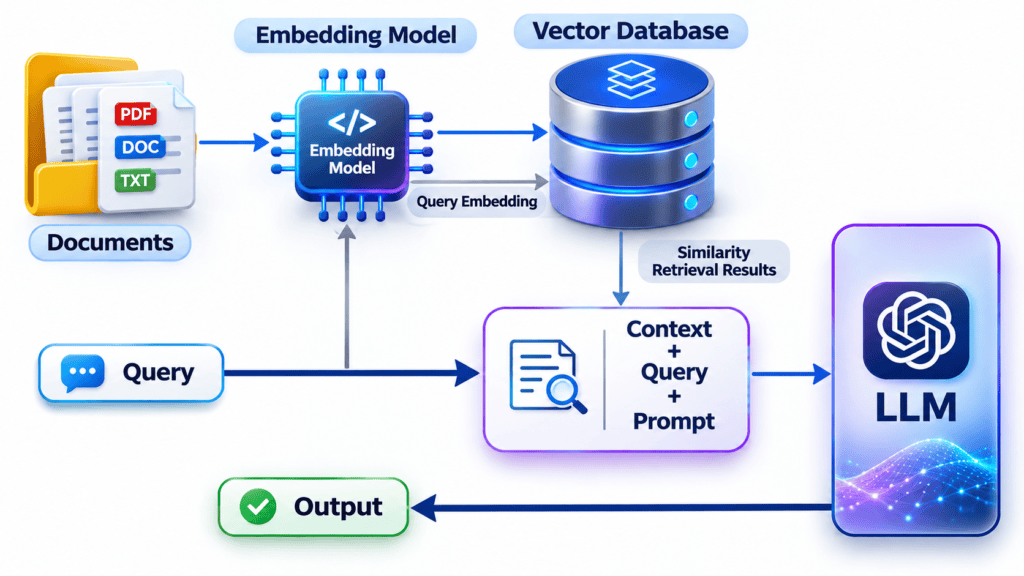
This hands-on capstone project allows you to combine your transferable DevOps skills into a single, cohesive architecture that proves you can operate AI systems at scale:
| Component | Suggested Technology |
| Backend | Python and FastAPI |
| LLM Integration | OpenAI, Anthropic, or local open-source LLM API |
| Embeddings | Hugging Face or OpenAI embedding models |
| Vector Database | PostgreSQL with pgvector or Qdrant |
| Containerisation | Docker and Docker Compose |
| Infrastructure | Terraform / OpenTofu |
| Orchestration | Kubernetes with GPU device plugins |
| CI/CD | GitHub Actions with evaluation gates |
| Monitoring | OpenTelemetry, Prometheus, and Grafana |
| Evaluation | DeepEval, Ragas, or Promptfoo |
Project Execution Checklist
Your completed project should successfully demonstrate:
- Automated document ingestion, chunking, and vector retrieval.
- Secure API integration with proper credential management.
- Containerized multi-service deployment.
- Automated testing, evaluation gates, and deployment pipelines.
- Infrastructure provisioning via code.
- Real-time application monitoring and telemetry.
- Granular latency, token consumption, and cost tracking.
Pro-Tip
Do not try to wire up every single tool on day one. Start with a working local prototype, then incrementally layer on containerization, infrastructure provisioning, CI/CD automation, and observability as your project evolves.
The ultimate goal of this roadmap is to prove that you can take an AI application out of a static development notebook and operate it as a reliable, scalable, and secure production service.
Can a DevOps engineer become an AI engineer?
Yes. A DevOps engineer can transition into AI engineering by building on existing knowledge of cloud infrastructure, automation, containers, deployment pipelines, and production reliability.
Layering on additional AI-specific competencies—such as LLM APIs, RAG, vector databases, model evaluation, and inference optimization—makes the transition natural and highly achievable.
Is DevOps knowledge enough to become an AI engineer?
No. DevOps provides an essential operational foundation, but AI engineering also requires an understanding of non-deterministic models, specialized data pipelines, inference mechanics, evaluation metrics, and AI application development. The amount of additional upskilling required depends on the specific role you target.
Is MLOps the same as DevOps?
No. Traditional DevOps focuses on general software development and infrastructure operations, whereas MLOps extends those principles to machine learning systems.
MLOps introduces specialized workflows, including data validation, model training pipelines, experiment tracking, continuous training, and model registry management.
Do AI engineers need to know Kubernetes?
Not every AI engineer needs deep Kubernetes expertise. However, Kubernetes is critical for professionals working on AI infrastructure, platform engineering, distributed model serving, and GPU resource orchestration.
Should DevOps engineers learn Python before moving into AI engineering?
Yes. Developing practical Python skills is a vital priority. While DevOps professionals may already be comfortable with Bash, Go, or PowerShell, Python is the universal language of the AI ecosystem, powering application development, API integrations, data preprocessing, and automation scripts.
What is the difference between MLOps and LLMOps?
MLOps focuses primarily on the operational lifecycle of machine learning systems, covering data ingestion pipelines, model training, hyperparameter tuning, experiment tracking, and continuous training.
LLMOps focuses on operating production applications built around large language models, managing prompt versioning, retrieval-augmented generation (RAG) pipelines, model evaluation, distributed tracing, and real-time token-cost monitoring.
While the two disciplines share conceptual overlap, their operational workflows, tooling, and technical requirements differ significantly.
In Conclusion
Transitioning into AI engineering does not mean throwing out your hard-earned systems experience. Your background in Docker, Kubernetes, CI/CD, cloud architecture, Infrastructure as Code, observability, security, and site reliability already solves the most difficult production challenges facing modern AI teams.
The path forward is not about starting from scratch; it is about extending your existing engineering foundation with specialized AI capabilities—such as LLM integrations, RAG pipelines, vector databases, model evaluation, and inference optimization.
Your Immediate Action Plan
Do not waste time collecting another endless list of online courses. Choose one core DevOps skill you already master—whether that is containerization with Docker, orchestration with Kubernetes, or pipeline automation with GitHub Actions—and use it today to deploy your first working AI application.