How to Create an AI Adoption Plan for a Non-Technical Team
Giving employees access to an AI tool is not the same as implementing a sustainable AI adoption plan. Too many organizations hand out software licenses and hope for organic transformation, only to watch usage plateau and investments stall.
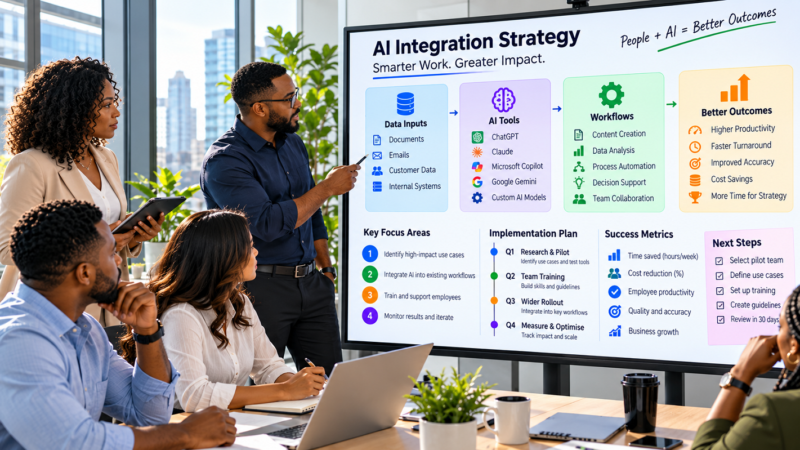
A successful AI adoption plan bridges the gap between raw technology and daily execution by connecting specific business problems to appropriate tools, targeted training, data safeguards, workflow redesigns, and measurable key performance indicators.

This framework is built for managers, business owners, operations professionals, project leaders, HR teams, and department heads who need to orchestrate change without requiring technical skills or coding knowledge from their teams.
By following this strategic AI adoption plan, you will learn how to:
- Assess organizational readiness and cultural maturity
- Identify high-impact use cases that drive immediate operational leverage
- Select and vet non-technical AI tools for your stack
- Design and execute a controlled pilot program
- Train employees on effective human-AI collaboration
- Govern data privacy, security, and risk management
- Establish long-term governance to build sustainable AI habits
Defining AI Adoption
AI adoption is the systematic integration of artificial intelligence into daily operational workflows, ensuring teams utilize the technology safely, consistently, and effectively. True adoption transcends simple software procurement and licensing. A comprehensive AI adoption plan encompasses seven core pillars:
- Strategic Alignment: The specific business bottlenecks or operational inefficiencies AI is expected to resolve.
- Workflow Integration: The exact tasks and processes where AI intersects with human labor.
- Accountability: The personnel responsible for operating AI tools and rigorously reviewing their outputs.
- Infrastructure: The necessary software stack, data inputs, access controls, and system integrations.
- Enablement: Structured training programs, internal communication, and ongoing support.
- Governance: Robust controls covering quality assurance, data privacy, security, and regulatory compliance.
- Measurement: Quantitative and qualitative metrics to evaluate ROI and operational value.
The Practical Difference: Access vs. Adoption
A customer support team does not achieve AI adoption merely by being granted access to a generative chatbot.
True adoption occurs when agents systematically rely on an approved assistant to draft ticket responses, adhere to strict human-in-the-loop review processes, safeguard sensitive customer data, measure ticket resolution times, and refine the underlying workflows based on performance data.
The Risk of Unmanaged Experimentation
Failing to implement a structured AI adoption plan leaves organizations vulnerable to fragmented tool stacks, inconsistent outputs, privacy violations, and employee fatigue.
Market research highlights the urgency of this structure: Microsoft and LinkedIn’s 2024 global workplace study revealed that 78% of AI users were bringing their own AI tools to work (BYOA). While this self-driven experimentation signals high employee demand for productivity, an unmanaged approach exposes enterprises to severe data security risks and operational silos.
Assessing Team Readiness
Building an effective AI adoption plan begins with the people, not the software. A thorough readiness assessment determines whether employees possess the necessary knowledge, confidence, time, data access, and management support to integrate AI into their daily routines safely.
The Five Readiness Areas
Evaluating organizational baseline requires examining five key dimensions, gathering specific evidence for each:
| Area | Questions to Ask | Evidence to Collect |
| Business Goals | Which outcomes matter most this quarter? | Strategic priorities and department targets |
| Workflows | Which activities are repetitive or slow? | Process maps, task logs, cycle times |
| Skills | What do employees already know about AI? | Anonymous survey or short assessment |
| Data | What information would AI handle? | Data classification and access review |
| Culture | What concerns or incentives exist? | Interviews, workshops, manager feedback |
Direct Employee Discovery
To uncover operational bottlenecks and psychological barriers, consult employees directly using these targeting prompts:
- Which tasks consume time without requiring much human judgment?
- Where do operational delays or repeated errors occur?
- Which documents, messages, or reports are created most frequently?
- What specific tasks would employees like AI to help them execute?
- What concerns do they have regarding job security, surveillance, accuracy, or privacy?
- Which unofficial AI tools are employees already using independently?
Management Note
Do not mistake low employee confidence for active resistance. Hesitation typically stems from ambiguity—employees worry because they lack clarity on permissible usage, evaluation metrics, or output trustworthiness.
The Readiness Scorecard
Quantify your baseline by evaluating these seven categories on a 1-to-5 scale:
- Leadership commitment and strategic alignment
- Employee AI literacy and baseline confidence
- Process clarity and workflow documentation
- Data quality, hygiene, and classification
- Tool access and technical infrastructure
- Security, privacy, and compliance controls
- Measurement capability and tracking mechanisms
A low score across any metric does not mean the initiative should be shelved. Instead, the scorecard highlights the foundational gaps that must be fortified before scaling your AI adoption plan organization-wide.
Identifying Practical AI Use Cases
Selecting where to deploy artificial intelligence within your AI adoption plan should be driven by business value and risk profile, not technological novelty. The most effective starting points focus on frequent, repeatable tasks where human oversight is straightforward and errors carry low operational consequences.
High-Impact, Low-Risk Early Applications
For a non-technical team, the ideal initial use cases act as collaborative accelerators rather than autonomous decision-makers. Focus your early efforts on workflows such as:
- Drafting internal emails, communications, and company announcements
- Summarizing meeting transcripts and extracting clear action items
- Converting rough notes into structured project documentation
- Classifying, sorting, and routing routine incoming requests
- Creating preliminary drafts of FAQs and internal knowledge-base articles
- Rewriting existing text for different target audiences or reading levels
- Generating initial interview-question frameworks or training materials
- Analyzing qualitative themes in customer or employee feedback (with strict handling of sensitive data)
- Producing project-status summaries compiled from approved source materials
- Generating first-pass drafts for external reports, proposals, or social media content
Why These Applications Work
These specific use cases succeed because they augment human effort instead of executing irreversible, high-stakes decisions. By keeping a human firmly in the loop to review, refine, and approve the output, teams build confidence while eliminating the friction of blank-page syndrome.
Using a Use-Case Scoring Matrix
To avoid chasing technological novelty, evaluate candidate processes objectively. A structured scoring matrix ensures your AI adoption plan prioritizes workflows that deliver maximum operational leverage with minimal operational risk.
The Scoring Criteria
Score each candidate workflow from 1 to 5 across seven critical dimensions:
| Criterion | Low Score (1) | High Score (5) |
| Frequency | Rare task | Daily or repeated task |
| Time Consumed | Minimal effort | Significant manual effort |
| Business Value | Limited benefit | Clear effect on cost, speed, revenue, or quality |
| Output Measurability | Difficult to evaluate | Easy to compare with a baseline |
| Reversibility | Hard to undo | Easy for a human to review or correct |
| Data Risk | Sensitive or regulated data | Low-risk business information |
| Workflow Fit | Requires major redesign | Fits an existing process seamlessly |
Prioritization Principles
When finalizing your initial rollout targets within your AI adoption plan, prioritize use cases featuring high frequency, clear measurable value, low data risk, and straightforward human-in-the-loop review.
- Ideal First Pilot: “Turn weekly project notes into a standard status update.” (High frequency, low risk, easy to review, fits existing routines).
- Poor First Pilot: “Automatically approve employee benefits claims.” (High data risk, hard to reverse, and impacts individuals’ rights, requiring rigorous compliance controls before automation).
Defining the Job Before Choosing the Tool
Before evaluating software vendors, you must define the exact problem you are solving. Vague objectives like “use AI to improve productivity” lead to scattershot tool adoption and untrackable results.
Every initiative in your AI adoption plan should follow a precise problem-definition format before a single tool is tested or procured.
The Use-Case Definition Formula
Write out your chosen use cases using this fill-in-the-blank structure:
We want to use AI to help [team] with [task] so that we improve [measurable outcome], while a human remains responsible for [review or decision].
Concrete Example
- Vague Goal:“Use AI to help account managers communicate better.”
- Structured Definition: “We want to use AI to help the operations team draft weekly client updates so that preparation time falls from three hours to one hour, while the account manager remains responsible for checking facts and approving the final message.”
By locking down this formula, your AI adoption plan ensures that tools are chosen to serve specific operational bottlenecks, and accountability remains firmly planted with the human operator.
Choosing Tools Systematically
Avoid selecting software solely because it dominates industry headlines. A successful AI adoption plan evaluates potential tools against your team’s actual workflows, budget limitations, risk appetite, and organizational capacity for change.
The Tool-Selection Checklist
Run every prospective application through this 12-point evaluation framework before procurement:
- Task Fit: Does the tool directly solve the specific problem defined in your use-case statement?
- Ease of Use: Can non-technical employees master the core workflow quickly without extensive engineering support?
- Output Quality: Can the team reliably verify and audit the generated results?
- Data Handling: What exact policies govern user prompts, uploaded files, and generated content?
- Access Controls: Are enterprise-grade user roles, permission groupings, and central account administration available?
- Integration: Does the application fit seamlessly into the software stack your team already uses?
- Reliability: Is service uptime and stability sufficient for daily operational workflows?
- Cost: What is the true total cost of ownership, factoring in licenses, training time, administration, and migration?
- Portability: Can the organization easily export its data and configured workflows if you switch providers?
- Support: Are robust documentation, user training, and customer support accessible?
- Accessibility: Can employees with diverse physical and cognitive abilities use the tool effectively?
- Vendor Transparency: Does the provider clearly outline security measures, data retention timelines, subprocessors, and model training practices?
Mitigating Tool Sprawl
For smaller organizations, begin with one approved tool applied to a single, narrowly defined use case. Allowing tool sprawl drives up costs, fragments organizational knowledge, complicates employee training, and multiplies data security blind spots.
Critical Safety Rule
Never enter confidential, personal, financial, health, client, or proprietary information into an AI tool until its data practices have been formally reviewed and approved. The correct governance threshold depends on your jurisdiction, legal contracts, industry sector, and internal compliance policy.
Building the AI Adoption Plan
A practical AI adoption plan must move through controlled, sequential stages rather than attempting an abrupt, organization-wide transformation.
Stage 1: Define the Objective
Before deploying any technology, establish clear parameters to anchor your initiative. Explicitly state:
- The specific operational problem to solve
- The exact team affected
- The current performance baseline
- The expected quantifiable benefit
- The core risks that must be controlled
- The named individual accountable for the result
Example Objective
Reduce the time required to prepare weekly operational reports by 30% within eight weeks, without reducing factual accuracy or management visibility.
Stage 2: Establish Basic Governance
Before employees begin experimenting, publish a concise, accessible AI usage policy. It should explicitly outline:
- Which software tools are officially approved
- Which categories of information must never be entered
- When AI utilization must be disclosed to colleagues or clients
- Which outputs strictly require human review and sign-off
- Who owns final decision-making authority
- How employees should report errors, hallucinations, or security incidents
- How AI-generated content must be stored, tracked, and labelled
- Which high-risk use cases require prior compliance approval
For a more robust governance structure, reference established industry standards:
- NIST AI Risk Management Framework: Organizes risk mitigation around four core functions: Govern, Map, Measure, and Manage, helping organizations build trustworthiness into the deployment lifecycle.
- ISO/IEC 42001:2023: Specifies formal international requirements for establishing, implementing, maintaining, and continually improving an organizational AI management system.
Stage 3: Run a Limited Pilot
Keep your initial implementation tightly scoped. Select:
- One specific department or team
- One or two defined use cases
- One approved tool
- A fixed pilot timeline (e.g., four to six weeks)
- A named pilot owner responsible for oversight
- A small cohort of enthusiastic volunteer users
- A quantitative baseline for direct comparison
Provide pilot participants with clear instructions and a dedicated feedback channel. The primary objective is not to prove that AI is infallible; it is to discover where the tool accelerates work, where it fails, and what underlying process changes are required.
Stage 4: Improve the Workflow
Artificial intelligence delivers maximum value when human workflows are intentionally redesigned around it. A typical collaborative workflow looks like this:
- Input: Employee gathers approved source information and context.
- Generation: AI produces a structured draft, summary, or analysis.
- Verification: Employee rigorously checks facts, tone, completeness, and confidentiality.
- Approval: A responsible manager reviews and signs off on high-impact outputs.
- Storage: The finalized asset is stored in standard business repositories.
- Feedback: Errors, prompt patterns, and time savings are recorded for continuous improvement.
Risk Proportionality
The human review step must scale with risk. A draft internal announcement requires only a quick editorial check. Conversely, outputs affecting employment, finance, legal standing, or regulatory compliance require stringent review and may be entirely inappropriate for AI generation.
Stage 5: Decide Whether to Scale
At the conclusion of the pilot, evaluate your performance data against your baseline. Scale the initiative only when the use case demonstrates undeniable value, acceptable quality, managed risk, and positive employee usability.
Your evaluation will yield one of five decisions:
- Scale the use case to the wider team or department.
- Continue the pilot with modified workflows or prompts.
- Limit the use case to specific controlled sub-tasks.
- Replace the tool with a more suitable alternative.
- Stop the use case entirely.
Governance Note: Stopping a low-value or unsafe use case is a successful governance decision, not a failed experiment.
Training Non-Technical Employees
Building AI literacy among non-technical staff does not require teaching programming or machine learning theory. Instead, it requires cultivating the practical judgment needed to use AI effectively, recognize its boundaries, protect sensitive data, and apply rigorous human oversight.
Core Training Curriculum
A robust training program within your AI adoption plan should equip employees with nine essential competencies:
- What the approved AI tool can and cannot do reliably
- How to articulate a task and supply relevant context
- How to provide the tool with concrete examples, constraints, and formatting rules
- How to systematically review facts, logic, tone, and completeness
- How to spot fabricated information (hallucinations) and unsupported claims
- What categories of information are strictly prohibited or restricted
- When and how AI assistance must be disclosed to stakeholders
- How to escalate uncertain, biased, or harmful outputs
- How AI integrates cleanly into the team’s established daily workflows
The Effective Prompt Structure
To ensure consistent, high-quality results without requiring complex prompting tricks, teach your team the Role, Task, Context, Constraints, Quality Check (RTCQC) framework:
- Role: Tell the AI what professional persona or function it should perform.
- Task: State the precise work required.
- Context: Provide necessary background and approved source materials.
- Constraints: Specify target audience, tone, length, format, and boundaries.
- Quality Check: Ask the AI to flag its own assumptions, missing information, or areas of uncertainty.
Practical Prompt Example
Role: Act as an operations editor.
Task: Turn the approved meeting notes below into a weekly status report for senior management.
Context: [Insert raw meeting notes]
Constraints: Use clear headings for progress, risks, decisions, and next actions. Do not invent owners, dates, or metrics.
Quality Check: Mark any missing information explicitly as “Not provided” and list any assumptions made during summarization.
Training Best Practices
- Use Real Workflows: Base training exercises on actual tasks your team performs weekly, using safe, non-confidential sample data. Generic product demonstrations are significantly less effective than hands-on practice that solves real operational bottlenecks.
- Compliance Alignment: Design your training to support regulatory standards. For instance, the European Union AI Act introduces explicit AI literacy obligations for organizations deploying AI systems, requiring measures that account for staff experience, training context, and operational roles without demanding uniform technical expertise.
Managing Resistance and Risks
Resistance to change typically diminishes when employees clearly understand the purpose, operational boundaries, and practical benefits of an AI adoption plan. Proactively addressing concerns and implementing robust risk controls ensures sustainable, secure implementation.
Addressing Common Employee Concerns
| Concern | Practical Response |
| “AI will replace my role.” | Clarify which repetitive tasks are evolving, emphasize that critical judgment remains human, and outline professional growth opportunities. |
| “I do not know how to use it.” | Provide role-specific training, practical templates, drop-in office hours, and internal peer support networks. |
| “The output is often wrong.” | Mandate verification protocols and clearly define which outputs require formal managerial sign-off. |
| “My data may be exposed.” | Publish transparent prohibited-data rules and ensure tools are only deployed after formal security review. |
| “This adds extra work.” | Streamline operations by removing redundant reporting steps or legacy manual tasks rather than piling AI on top of existing workloads. |
| “The tool is monitoring me.” | Communicate clearly regarding what administrative usage data is collected and how performance will—and will not—be evaluated. |
Controlling Core Operational Risks
- Inaccurate Outputs (Hallucinations): AI can generate plausible-sounding falsehoods. Enforce strict source-checking, cross-referencing with authoritative records, and human verification for all material claims.
- Confidentiality and Privacy: Classify enterprise data before deployment. Never assume a consumer tool is secure simply because it is popular. Review data retention, model training policies, contractual terms, and deletion options.
- Bias and Unfairness: Exercise extreme caution if AI influences personnel decisions, performance reviews, customer eligibility, pricing, or rights-affecting outcomes. Audit outputs regularly and maintain clear human appeal routes.
- Security Vulnerabilities: Treat prompts, uploaded files, generated code, and API integrations as part of your organization’s attack surface. Implement least-privilege access, robust account controls, and thorough vendor assessments.
Guidance Reference: CISA and international cybersecurity partners provide specialized guidelines for organizations deploying external AI systems securely. - Over-Reliance and Loss of Agency: AI must never dilute human accountability. Assign a named human owner to every production use case and define precise triggers for when employees must pause and escalate.
- Copyright and IP Ownership: Review legal rights governing input materials and generated outputs, particularly regarding commercial publishing, client-facing deliverables, training data, and brand assets.
- Accessibility: Ensure your AI-enhanced workflows remain fully usable for employees utilizing assistive technologies or requiring alternative formats.
Measuring Adoption and Business Value
True success requires measuring both operational usage and tangible business outcomes. High software activity or login frequency does not automatically prove that your AI adoption plan is creating genuine business value.
Recommended KPIs and Metrics
Track a balanced scorecard across seven key performance categories:
| Category | Example Metric |
| Adoption | Percentage of intended users actively completing approved AI workflows |
| Engagement | Weekly active users (WAU) or total completed AI-assisted tasks |
| Efficiency | Average time required per task before and after adoption |
| Quality | Error rate, rework rate, editorial review scores, or customer satisfaction |
| Business Impact | Cost avoided, turnaround speed, increased operational capacity, or revenue contribution |
| Learning | Training completion rates and post-assessment competency scores |
| Trust and Safety | Reported security incidents, policy violations, and escalation frequency |
| Employee Experience | Self-reported confidence, perceived usefulness, workload impact, and job satisfaction scores |
Calculating Efficiency Gains
Always anchor your metrics against a pre-established baseline. For example, if a weekly operational report previously required 120 minutes to produce and drops to 80 minutes post-implementation, calculate your time reduction percentage using the standard formula:
$$\frac{120 – 80}{120} \times 100 = 33.3\%$$
This quantitative improvement is meaningful only if output quality remains uncompromised and the saved time is successfully redirected toward higher-leverage strategic work.
Cautionary Note
Always monitor for unintended negative consequences. A workflow may appear faster on paper while secretly driving up downstream fact-checking overhead, managerial correction cycles, customer complaints, or employee burnout.
Making Adoption Sustainable
Successful implementation of an AI adoption plan is an ongoing management system, not a one-time workshop or software rollout. Long-term success requires establishing a lightweight, repeatable operating rhythm to maintain alignment, security, and quality.
The Long-Term Operating Rhythm
- Review Use Cases: Evaluate approved workflows monthly during the initial pilot phase, transitioning to quarterly reviews after stabilization.
- Maintain Guardrails: Keep your inventory of approved tools, restricted data categories, and prohibited uses current and accessible.
- Iterate Training: Update educational materials, prompts, and compliance guidelines whenever software vendors or internal policies change.
- Empower AI Champions: Nominate internal champions to assist colleagues, surface feedback, and identify safe, practical workflow improvements.
- Curate Shared Knowledge: Maintain an internal repository of high-performing prompts, successful workflows, and verified templates.
- Track Incidents Transparently: Record operational errors and near-misses systematically without fostering a punitive blame culture.
- Audit Vendors: Periodically re-verify vendor terms of service, data retention practices, model training policies, and user access permissions.
- Prune Low-Value Tools: Actively retire software licenses, tools, and workflows that no longer deliver sufficient operational value.
Operational Note
AI champions should never be treated as unpaid, informal help desks. Equip them with clearly defined responsibilities, dedicated time carved into their schedules, advanced training, and a direct escalation path to management.
The Ultimate Objective
The true goal of a mature AI adoption plan is not maximizing raw AI usage metrics across the board. The objective is better work: faster where speed matters, more consistent where quality matters, and firmly anchored in human accountability.
Transforming how a non-technical team interacts with artificial intelligence requires discipline, clear guardrails, and continuous human oversight. By starting with team readiness, choosing tools systematically through structured pilots, and embedding rigorous quality checks, your organization can capture the benefits of AI while protecting its people and data.
Common Mistakes to Avoid
When executing your AI adoption plan, avoiding predictable missteps saves time, prevents security exposure, and protects employee trust. Watch out for these ten common pitfalls:
- Starting with a tool instead of a business problem: Procuring software before defining the operational bottleneck it solves.
- Launching too many tools at once: Creating tool sprawl that fractures knowledge, confuses staff, and inflates costs.
- Treating AI training as a single presentation: Relying on a one-off workshop rather than ongoing, practical enablement.
- Assuming employees understand privacy risks: Failing to explicitly communicate data protection rules, resulting in proprietary leaks.
- Measuring logins instead of outcomes: Tracking software activity rather than tangible efficiency, quality, and business impact.
- Automating decisions before testing the underlying process: Removing humans from high-stakes workflows prematurely.
- Allowing personal accounts for company work: Permitting staff to use consumer accounts where chat histories may be harvested for training data.
- Failing to define ownership: Leaving ambiguity over who is accountable for checking, approving, and signing off on AI outputs.
- Ignoring psychological barriers: Disregarding employee anxiety regarding job security, surveillance, or shifting skill sets.
- Scaling without documentation: Expanding a pilot across the organization without auditing what worked, what failed, and why.
AI Adoption Plan Template
Use this one-page template to structure and govern your first pilot initiative under your AI adoption plan:
| Field | Description |
| Business Problem | What specific problem, bottleneck, or inefficiency are we solving? |
| Target Team | Who specifically will use the workflow? |
| Use Case | What exact task will AI support? (Use the problem-definition formula) |
| Approved Tool | Which specific software tool will be used and why? |
| Data Boundary | What information may and may not be entered into the tool? |
| Human Owner | Who is directly accountable for reviewing outputs and making final decisions? |
| Baseline | How is the task performed today, and how much time or effort does it consume? |
| Target | What measurable improvement or percentage gain is expected? |
| Training | What practical competencies will users learn before the launch? |
| Pilot Period | When will the pilot officially start and end? |
| Risk Controls | What checks, managerial approvals, and escalation rules apply? |
| Review Decision | What quantitative and qualitative evidence will determine whether to scale, iterate, or stop? |
Does a non-technical team need an AI specialist?
Not necessarily. A team can successfully launch an AI adoption plan with a designated business owner, an approved software tool, basic AI literacy, clear data boundaries, and access to internal security or legal advice when needed. Specialist technical support becomes crucial only when connecting AI to sensitive internal systems, automating high-impact decisions, or building custom models.
How long should an AI pilot last?
Your pilot should run long enough to cover normal workflow cycles and collect meaningful baseline comparisons. The duration depends entirely on task frequency: daily workflows can yield clear evidence in four to six weeks, whereas monthly reporting cycles require multiple iterations to evaluate accurately.
Should employees be allowed to use any AI tool?
No. Unrestricted software selection creates severe data privacy vulnerabilities, compliance exposures, fragmented knowledge, and unnecessary costs. The recommended governance model is to approve a core set of vetted tools, communicate selection criteria clearly, and establish a straightforward intake process for requesting new software.
What is the best first AI use case?
The ideal starting point is a frequent, measurable, low-risk task where human review is straightforward and tied directly to a real business priority. Common examples include drafting communications, summarizing meetings, classifying routine requests, and organizing internal knowledge bases.
How can managers avoid replacing judgment with AI?
Protect human agency by explicitly defining which decisions require human sign-off, mandating verification steps for all material claims, documenting strict accountability, and evaluating output quality alongside speed. AI should serve strictly as an assistive accelerator unless the organization has undergone formal risk assessment and compliance review for autonomous operations.
In Conclusion
A successful AI adoption plan for a non-technical team is not about adopting as many AI tools as possible. It is about identifying where AI can create measurable value while managing risks, protecting sensitive information, and keeping people accountable.
An effective AI adoption strategy should:
- Start with a business problem, not a fashionable AI tool. Identify specific challenges, inefficiencies, and repetitive tasks before deciding which technology to use.
- Assess your team’s AI readiness. Evaluate people, processes, data, organizational culture, infrastructure, and governance to understand what needs to be addressed before implementation.
- Prioritize low-risk, measurable use cases. Begin with tasks where AI can deliver clear benefits without creating significant operational, privacy, or compliance risks.
- Train employees for practical AI use. Teach team members how to write effective prompts, verify AI-generated information, protect sensitive data, recognize limitations, and know when to escalate an AI-assisted task to a human.
- Keep humans accountable for important decisions. AI should support employees rather than replace human judgment, particularly when decisions affect customers, employees, finances, compliance, or organizational outcomes.
- Measure AI adoption beyond tool usage. Track meaningful indicators such as time saved, productivity, output quality, employee adoption, user experience, error rates, and operational risk.
- Continuously improve AI-enabled workflows. AI adoption should be treated as an ongoing process of testing, learning, measuring, and improving—not a one-time software implementation.
Practical Next Step
Start small. Ask your team to identify five repetitive or time-consuming tasks they perform regularly. Score each task based on business value, feasibility, and risk, then select one low-risk, high-value task for your first controlled AI pilot. Document the results, gather feedback from employees, measure the impact, and use what you learn to determine the next AI use case.
The goal is not simply to introduce AI to your team. The goal is to build a team that knows when, where, and how to use AI effectively and responsibly.