Complete Microsoft Azure AI Fundamentals Certification Guide
The Microsoft Azure AI Fundamentals Certification validates foundational knowledge of artificial intelligence workloads and cloud services on Azure. It covers core machine learning principles, computer vision, natural language processing (NLP), and generative AI on Microsoft Azure.
While older preparation guides reference the legacy AI-900 exam—which officially retired on June 30, 2026—the current requirement to earn this credential is the updated AI-901 exam. Availability and exam details may vary depending on region and update cycles.
Designed for tech professionals, career changers, and beginners, the Microsoft Azure AI Fundamentals Certification provides a structured path to build technical credibility. Microsoft positions it as an essential entry-level credential for candidates launching careers in cloud AI solution development, with exam objectives emphasizing responsible AI practices, basic machine learning pipelines, and Azure-native AI tools.
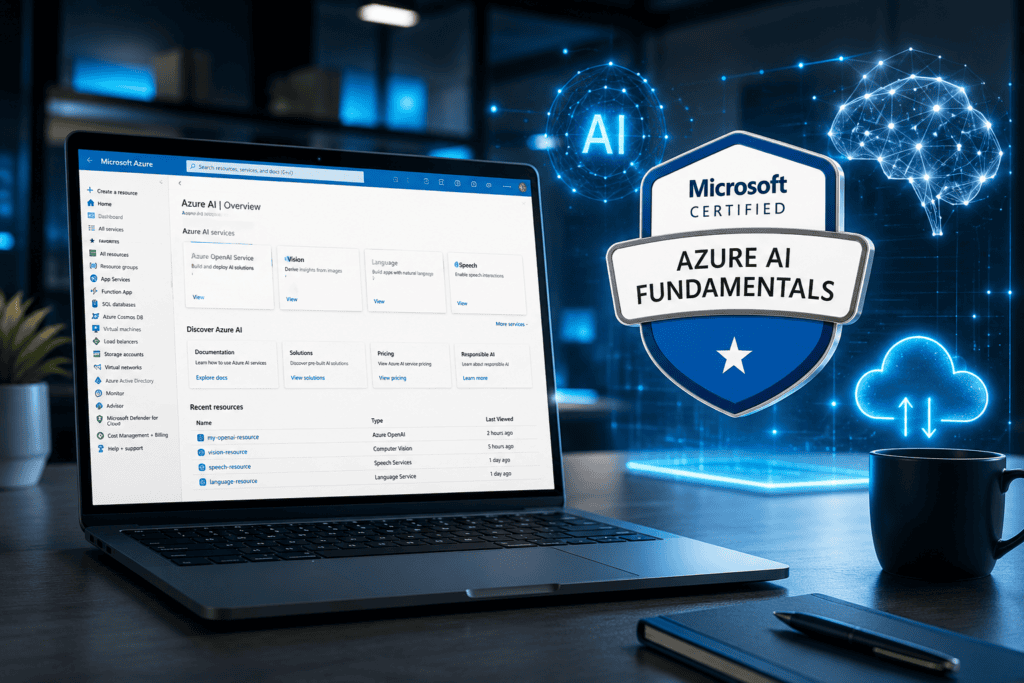
This guide breaks down everything you need to know about pursuing the Microsoft Azure AI Fundamentals Certification, including target candidates, core exam objectives, effective preparation strategies, and long-term career value. It is structured to give students, developers, and IT professionals a clear, practical roadmap before registering for the exam.
What is Microsoft Azure AI Fundamentals?
The Microsoft Azure AI Fundamentals Certification is Microsoft’s foundational credential designed to validate conceptual knowledge of artificial intelligence and core cloud services. To earn this certification, candidates must demonstrate a solid understanding of common AI workloads and show familiarity with the native Azure resources used to build, deploy, and manage AI solutions.
Official Microsoft Learn documentation positions the Microsoft Azure AI Fundamentals Certification as the foundational building block within the Azure learning path. It serves as a practical entry point for professionals entering cloud computing or preparing for advanced role-based credentials, such as the Azure AI Engineer Associate certification.
Who should take the Microsoft Azure AI Fundamentals Certification?
The Microsoft Azure AI Fundamentals Certification is designed for beginners, students, career changers, and non-technical professionals seeking a credible introduction to cloud-based artificial intelligence. According to Microsoft Learn, candidates do not need extensive background experience in data science or software engineering, though a basic understanding of cloud concepts and simple Python syntax is helpful for hands-on exercises.
Pursuing the Microsoft Azure AI Fundamentals Certification is an ideal choice if you want to:
- Start an AI or Cloud Career: Establish validated credibility at an entry level without prior engineering experience.
- Build a Credential Foundation: Add an official Microsoft certification to your resume before targeting intermediate roles.
- Understand Core Azure AI Services: Learn how Microsoft Azure handles computer vision, natural language processing (NLP), machine learning, and generative AI workloads.
- Prepare for Role-Based Paths: Create a smooth transition path toward associate-level qualifications like the Azure AI Engineer Associate.
What does the exam cover?
To earn the Microsoft Azure AI Fundamentals Certification, candidates must pass the official exam, which evaluates core competency across five key technical domains. Recent updates to the official Microsoft Learn study guide reflect an increased focus on practical AI applications, with generative AI holding the highest weighting on the test.
| Skill Area | Exam Weight |
| Artificial Intelligence Workloads & Considerations | 15–20% |
| Fundamental Principles of Machine Learning on Azure | 15–20% |
| Computer Vision Workloads on Azure | 15–20% |
| Natural Language Processing (NLP) Workloads on Azure | 15–20% |
| Generative AI Workloads on Azure | 20–25% |
Microsoft notes that exam questions primarily target Generally Available (GA) features. However, candidates preparing for the Microsoft Azure AI Fundamentals Certification should also be familiar with widely used preview features, as high-adoption tools may occasionally appear in scenario questions.
Is the Microsoft Azure AI Fundamentals Certification worth it?
Determining whether the Microsoft Azure AI Fundamentals Certification is worth your time depends entirely on your current technical background and immediate career goals:
- High ROI for Beginners & Non-Engineers: If you are new to artificial intelligence or cloud computing, this credential is worth pursuing. Microsoft positions it as the official foundational step on the Azure learning path, making it ideal for validating core AI concepts, understanding responsible AI principles, and demonstrating baseline cloud competency to employers without taking on a complex technical exam.
- Low ROI for Experienced Practitioners: If you already build, train, or deploy AI models hands-on, the Microsoft Azure AI Fundamentals Certification offers limited marginal value. Because it assesses high-level conceptual knowledge rather than practical implementation, experienced developers and data scientists should skip it and target role-based qualifications instead, such as the Azure AI Engineer Associate.
Ultimately, the Microsoft Azure AI Fundamentals Certification serves its exact purpose: a low-friction, high-credibility springboard for candidates building initial technical authority in cloud AI.
How should you prepare?
Preparing for the Microsoft Azure AI Fundamentals Certification requires a balanced combination of theoretical study, official practice assessments, and practical exposure to Azure services.
Step-by-Step Preparation Roadmap
- Review the Official Study Guide: Step 1- Download the latest Microsoft Learn study guide to review tested skills, technical domain weightings, and exam objectives.
- Complete the Microsoft Learn Learning Paths: Step 2 – Work through the free self-paced learning modules on Microsoft Learn covering AI concepts, machine learning basics, computer vision, NLP, and generative AI.
- Gain Hands-On Azure Exposure: Step 3 – Create a free Azure account to explore the Azure AI Foundry, Vision, and Language portals firsthand, solidifying how theoretical concepts apply in practice.
- Take the Official Practice Assessment: Step 4 – Gauge your readiness by taking the free practice assessment on the Microsoft AI Skills Navigator. Aim for consistent scores above 80% before scheduling.
How much does it cost?
The standard registration fee for the Microsoft Azure AI Fundamentals Certification is $99 USD in the United States. However, Microsoft applies localized geographical pricing based on where the exam is proctored, meaning exact costs vary globally (for example, approximately £69 GBP in the UK or ₹3,696 INR in India before local taxes).
Key Pricing Factors to Keep in Mind:
- Taxes & Regional Adjustment: Listed prices exclude local taxes (such as state sales tax or VAT) and promotional discounts.
- Student & Institutional Discounts: Students verified through a valid
.eduemail or Microsoft Learn profile often qualify for discounted exam pricing. - Retake Policy: The standard exam fee covers a single attempt. If you do not pass, retakes require paying the full exam fee again unless you purchase an official “Exam Replay” bundle.
Pro Tip: Because Microsoft frequently updates regional pricing tiers without prior notice, always verify the exact fee within the Pearson VUE or Microsoft Learn booking flow for your specific location prior to scheduling.
What should you study?
When preparing for the Microsoft Azure AI Fundamentals Certification, avoid trying to memorize every service across the cloud catalog. Instead, align your study plan directly with the core technical objectives measured by Microsoft:
Key Focus Areas to Study
- AI Concepts & Responsible AI: Core principles, ethical considerations (fairness, transparency, privacy), and practical governance frameworks.
- Machine Learning Fundamentals: Supervised vs. unsupervised models (regression, classification, clustering), feature/label identification, and automated ML capabilities within Azure Machine Learning.
- Computer Vision Workloads: Optical Character Recognition (OCR), image classification, object detection, and facial detection using Azure AI Vision services.
- Natural Language Processing (NLP) & Speech: Sentiment analysis, text analytics, language models, speech synthesis, and real-time speech-to-text translation.
- Generative AI & Agentic Systems: Large language models (LLMs), prompt engineering fundamentals, building AI agents, and deploying models via Azure AI Foundry and Azure OpenAI Service.
Recommended Study Resources
- Official Exam AI-901 / Certification Page: Primary hub for exam details, localized scheduling, and prerequisites.
- Microsoft Learn AI-901 Study Guide: The definitive skills checklist mapping out exact domain weightings and recent updates.
- Official Microsoft Learn Training Paths: Self-paced interactive learning modules covering hands-on labs for Microsoft Foundry and AI workloads.
- Microsoft Practice Assessment (AI Skills Navigator): Free practice tests to measure benchmark scoring and identify knowledge gaps before test day.
- Microsoft Azure Training & Certifications Guide: Path documentation showing how fundamentals fit into broader role-based career progression.
Is the Microsoft Azure AI Fundamentals Certification the Right Choice for You?
Deciding to pursue the Microsoft Azure AI Fundamentals Certification comes down to your current technical depth and primary career goals. Microsoft positions this credential within its “get the right foundations” learning track, making it a low-risk, high-reward entry point for validating core conceptual understanding before tackling technical, implementation-heavy certifications.
Who Should Pursue This Certification?
- Beginners & Students: Anyone building a foundational portfolio who needs a credible, industry-recognized entry credential in AI and cloud computing.
- Career Changers: Professionals transitioning into the tech sector who need a structured framework to learn responsible AI principles, computer vision, NLP, and generative AI.
- IT Professionals & Managers: Technical leads, system administrators, and project managers who need to understand native Azure AI capability limits without writing production-level code.
Who Should Skip This Certification?
- Experienced AI Engineers: Developers who already design, build, and deploy production ML models and need a credential to validate advanced hands-on engineering skills.
- Coding-First Specialists: Candidates seeking a purely code-focused qualification testing deep Python frameworks or custom model architecture creation.
Final Recommendation: If your goal is to validate broad conceptual literacy across Azure-native AI tools, the Microsoft Azure AI Fundamentals Certification is the ideal choice. If you already manage production-level AI workloads hands-on, bypass this exam and target the Azure AI Engineer Associate path instead.
Comparing the Microsoft Azure AI Fundamentals Certification vs. Azure AI Engineer Associate
While the Microsoft Azure AI Fundamentals Certification serves as an entry-level introduction to cloud AI, the Azure AI Engineer Associate (AI-102) is a role-based qualification designed for technical practitioners who build, deploy, and manage production AI solutions on Azure.
Microsoft’s official certification roadmap positions AI Fundamentals as the conceptual entry point, while the AI Engineer Associate path validates hands-on execution using REST APIs, SDKs, C#, or Python.
Direct Comparison Matrix
| Comparison Factor | Microsoft Azure AI Fundamentals Certification | Azure AI Engineer Associate (AI-102) |
| Certification Level | Fundamentals (Entry-Level) | Associate (Intermediate / Advanced) |
| Primary Focus | Validating baseline AI concepts and Azure service capabilities | Implementing, optimizing, and deploying AI solutions |
| Coding Depth | Low (Conceptual literacy & basic syntax recognition) | High (SDKs, REST APIs, Python/C# code execution) |
| Target Audience | Beginners, students, career changers, non-technical leads | Cloud developers, AI engineers, and solutions architects |
| Primary Career Value | Initial resume credential and baseline cloud AI literacy | Direct alignment with technical job roles and engineering hiring |
| Prerequisites | None (Basic cloud familiarity recommended) | Hands-on experience developing software or cloud AI tools |
Which Path Should You Choose?
- Choose the Microsoft Azure AI Fundamentals Certification if: You are new to cloud computing or artificial intelligence, work in a non-technical role (such as project management or business analysis), or want to establish structured credibility on Microsoft Learn before tackling complex code.
- Choose Azure AI Engineer Associate if: You are a software developer, data engineer, or cloud specialist who needs to write code, configure REST endpoints, deploy Azure OpenAI models, or build agentic workflows.
What should you study first?
When starting your prep for the Microsoft Azure AI Fundamentals Certification, it is critical to master core principles and workload identification before diving into hands-on configuration. Official Microsoft Learn guidance emphasizes establishing a firm foundation in responsible AI and theoretical frameworks before moving into implementation via Microsoft Azure AI Foundry.
Recommended Study Sequence
- Core AI Concepts & Use Cases: Phase 1 – Master basic terminology, identify common AI workload types, and understand how data fuels predictive and generative models.
- Responsible AI Principles: Phase 2 – Learn Microsoft’s six responsible AI pillars—fairness, reliability/safety, privacy/security, inclusiveness, transparency, and accountability—and how they apply to solution design.
- Machine Learning Fundamentals: Phase 3 – Study supervised vs. unsupervised learning techniques (regression, classification, clustering) and automated ML concepts.
- Computer Vision, NLP & Speech: Phase 4 – Understand task mappings across vision (OCR, object detection) and language services (sentiment analysis, key phrase extraction, translation).
- Generative AI & Microsoft Azure AI Foundry: Phase 5 – Explore large language model (LLM) deployments, system prompt configuration, basic Python SDK syntax, and building AI agents within Azure AI Foundry.
What is the best preparation strategy?
Preparing for the Microsoft Azure AI Fundamentals Certification requires a balanced combination of active reading, light hands-on Portal exposure, and timed practice assessments. Rather than trying to memorize long service lists, focus on mapping specific business scenarios to the right Azure tools and responsible AI principles.
Optimized 7-Day Study Plan
- Review Study Blueprint & Objectives: Day 1 – Read the official Microsoft Learn study guide to understand the AI-901 domain weightings, focusing on the split between conceptual principles (40–45%) and implementation in Microsoft Azure AI Foundry (55–60%).
- Master Responsible AI & Workloads: Day 2 – Study Microsoft’s six responsible AI principles (fairness, transparency, privacy, safety, inclusiveness, accountability) and learn how to classify core AI workloads.
- Machine Learning & Azure ML Studio: Day 3 – Review basic ML algorithms (regression, classification, clustering), feature/label definitions, and automated ML workflows within Azure.
- Computer Vision Capabilities: Day 4 – Focus on scenario mapping for image classification, object detection, optical character recognition (OCR), and facial analysis using Azure AI Vision.
- NLP, Speech & Translation: Day 5 – Learn how Azure AI Language handles text analytics, sentiment analysis, key phrase extraction, and real-time speech translation.
- Generative AI & Microsoft Azure AI Foundry: Day 6 – Explore large language model deployments, prompt engineering basics, system prompt constraints, and reading basic Python SDK snippets.
- Practice Assessment & Weakness Targeting: Day 7 – Take the official practice assessment via the Microsoft AI Skills Navigator. Review every incorrect answer and revisit targeted Microsoft Learn modules until you consistently score above 80%.
Common Misconceptions to Avoid
- “You need a data science background.” False. The Microsoft Azure AI Fundamentals Certification tests conceptual understanding and practical service mapping, not complex math or model training algorithms.
- “It measures production-level engineering.” False. This credential validates foundational literacy and baseline tool selection; it does not replace role-based engineering exams like AI-102.
- “Memorizing service names is enough.” False. Modern exam questions focus on scenario analysis (e.g., choosing when to use Azure AI Document Intelligence versus Content Understanding).
- “Generative AI is a minor topic.” False. Generative AI, prompt structure, and Azure AI Foundry now represent the largest single focus on the current exam blueprint.
What Career Opportunities Can It Support?
The Microsoft Azure AI Fundamentals Certification acts as an entry-level signal to employers that you understand core cloud capabilities, responsible AI frameworks, and Azure-native AI tools. Microsoft explicitly frames this credential as the initial stepping stone for candidates beginning a career in AI solution development, making it valuable when combined with practical portfolio projects, GitHub repos, or internships.
Key Roles Supported by This Credential
- Junior Cloud & AI Support Specialists: Validate your ability to troubleshoot, categorize, and explain Azure AI workloads to technical teams and client organizations.
- Technical & Business Analysts: Bridge the gap between non-technical business leaders and engineering teams by evaluating where computer vision, NLP, or generative AI models add operational value.
- Pre-Sales & Solutions Consultants: Demonstrate concrete cloud literacy to help clients understand Azure AI capabilities during discovery calls and solution proposals.
- Aspiring AI Engineers & Developers: Establish a recognized credential baseline while building toward specialized implementation roles like the Azure AI Engineer Associate.
Decision Matrix: Is the Microsoft Azure AI Fundamentals Certification Right for You?
Use this quick decision framework to determine whether you should begin with the Microsoft Azure AI Fundamentals Certification or skip directly to advanced role-based credentials:
| Your Current Situation | Recommended Track | Primary Strategic Reason |
| New to AI and Microsoft Azure | Microsoft Azure AI Fundamentals Certification | Offers the lowest barrier to entry with a strong focus on baseline AI concepts. |
| Need an entry credential for your résumé | Microsoft Azure AI Fundamentals Certification | Establishes immediate, verified credibility for beginners and career changers. |
| Already building production AI solutions | Azure AI Engineer Associate (AI-102) | Better aligns with active engineering capabilities and hands-on code execution. |
| Require code-heavy validation & API integration | Azure AI Engineer Associate (AI-102) | Focuses deeply on practical deployment, REST APIs, SDKs, and custom app integration. |
| Want a structured, beginner-friendly starting point | Microsoft Azure AI Fundamentals Certification | Builds a broad foundation before committing to specialized technical tracks. |
Is the AI-900 exam still available?
No. Microsoft officially retired the AI-900 exam on June 30, 2026. To earn the Microsoft Azure AI Fundamentals Certification, candidates must now take and pass the updated AI-901 exam, which focuses on modern generative AI capabilities, agentic workflows, and Microsoft Azure AI Foundry implementation.
Do I need prior programming experience?
Not strictly, but basic code literacy is helpful. While the Microsoft Azure AI Fundamentals Certification remains open to both non-technical and technical candidates, the current AI-901 exam objectives require candidates to recognize basic Python syntax and understand how Azure AI resources and SDKs are structured.
Is this certification good for beginners?
Yes. Microsoft explicitly designs the Microsoft Azure AI Fundamentals Certification for individuals who are starting their cloud and AI learning path. Advanced data science or software engineering backgrounds are not required to prepare for or pass the exam.
What is the passing score for the exam?
The passing score for the Microsoft Azure AI Fundamentals Certification exam is 700 out of 1,000 points. Microsoft calculates results using scaled scoring, meaning the total score is based on overall question difficulty rather than a flat percentage of correct answers.
What should I do after earning this certification?
After achieving your Microsoft Azure AI Fundamentals Certification, the most logical next step is to target role-based associate credentials. Candidates moving into development and deployment typically pursue the Azure AI Engineer Associate path to build deep implementation skills across computer vision, NLP, and agentic solutions.
In Conclusion
The Microsoft Azure AI Fundamentals Certification remains one of the highest-signal entry points for establishing verified credibility across artificial intelligence and Microsoft Azure cloud services. Following the retirement of the legacy AI-900 exam on June 30, 2026, Microsoft officially transitioned the requirement to the updated AI-901 exam, embedding heavy emphasis on generative AI workloads, prompt capabilities, and Microsoft Azure AI Foundry implementation.
Summary Recommendations
- Start Here if You Are New: Pursue the Microsoft Azure AI Fundamentals Certification if you are a beginner, student, non-technical manager, or career changer seeking a structured, conceptual foundation without writing production code.
- Skip Ahead if You Have Experience: Bypass this exam and move directly to the Azure AI Engineer Associate path if you already build, configure, and deploy production ML models or REST API-integrated solutions.
Microsoft’s official learning path supports a clear progression: build your foundation with this credential, then specialize as your hands-on engineering skills expand.