Animal Physiology Careers in the AI Era: 15 Skills You Need
Animal physiology careers are undergoing a fundamental transformation. For decades, the discipline was defined by the laboratory bench and clinical practice. Today, that definition has expanded to include data-centric roles in precision livestock farming, digital health, and high-tech AgriTech. As AI-powered monitoring systems and predictive analytics become the new standard for tracking health, behavior, and productivity at scale, the expectations for professionals in the field have shifted.
Employers now demand a hybrid skillset: a foundation of deep biological expertise augmented by rigorous data handling and evidence-based digital fluency. If you are a researcher, veterinarian, or animal scientist, AI is no longer a peripheral interest; it is the new infrastructure of your profession. Whether you are optimizing productivity or managing complex animal health interventions, the ability to leverage digital tools is the primary differentiator between those who simply keep pace and those who lead.
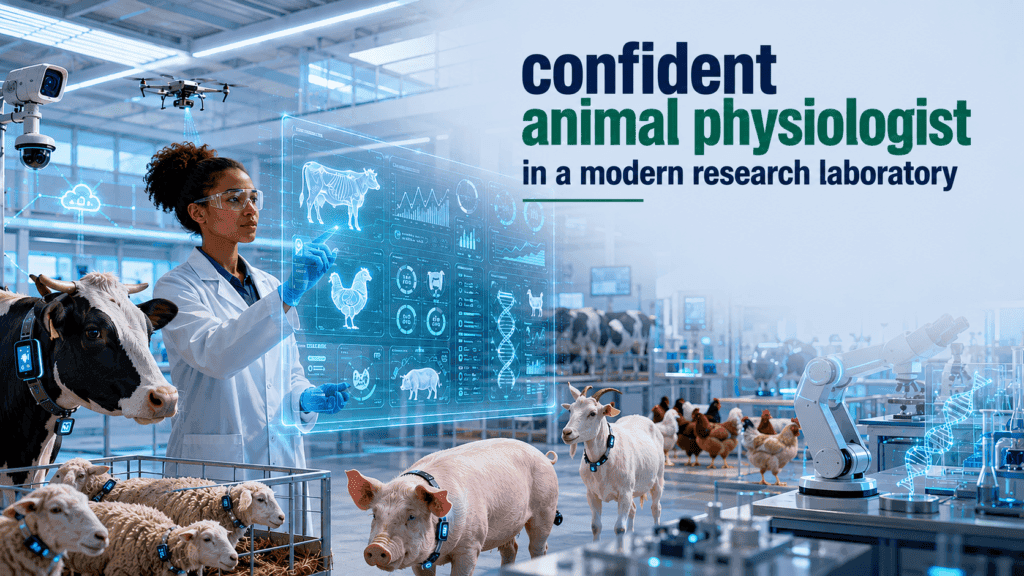
This guide is for the early-to-mid career professional and the ambitious graduate student seeking a concrete roadmap to future-proof their trajectory. You will learn how animal physiology careers are evolving, the three core pillars of AI-era competence, and a 15-skill taxonomy designed to help you audit and upgrade your capabilities.
Each skill includes a “How to Start Today” action—moving you immediately from strategic insight to technical execution. The following pages cover the foundational shifts in the sector, a framework for mastering AI-integrated decision-making, and a curated guide to the tools that will support your transition into the future of biological science.
What are animal physiology careers in the AI era?
In the AI era, animal physiology careers are transitioning from purely descriptive, observation-heavy roles to data-driven, predictive, and automation-integrated professions.
The fundamental shift is the move from manual monitoring (periodic physical checks) to continuous digital oversight (real-time data analysis). This evolution is creating a new class of “hybrid professionals” who bridge the gap between biological expertise and technical systems.
Key Career Evolutions
The integration of AI has birthed several specialized, high-leverage roles:
- Precision Livestock Technologist: Replaces traditional manual observational labor with real-time data from drones, IoT sensors, and computer vision. They manage automated feeding, health, and welfare systems rather than performing manual spot checks.
- Animal Data Scientist: Leverages machine learning, statistical modeling, and programming to interpret biological datasets—such as genomic markers, behavior patterns, or environmental stressors—to predict health outcomes and optimize production.
- Robotics Engineer in Animal Care: Combines mechanical and software engineering with animal husbandry knowledge to maintain and optimize automated systems like robotic milking parlors or automated delivery systems.
- AI-Driven Wildlife Conservationist: Uses remote sensing, image recognition, and predictive AI models to track endangered populations, forecast habitat changes, and automate conservation strategies that were previously reliant on labor-intensive field tracking.
The New Skill Paradigm
Employers no longer seek solely “physiological experts.” The most competitive candidates now possess a “tri-fold” skill set:
| Pillar | Focus | Why it Matters |
| Domain Expertise | Physiology, Anatomy, Husbandry | Provides the “ground truth” that AI models must interpret. |
| Technical Literacy | Sensor deployment, IoT, Data handling | Enables the collection and management of high-quality digital input. |
| Analytical Fluency | Machine Learning, Statistics, Automation | Allows for the interpretation of data and the ability to act on predictive insights. |
How AI Is Changing Daily Work
- From “Testing” to “Simulation”: In drug discovery and toxicology, AI is increasingly replacing animal models with in silico (computer-generated) simulations. This shifts the physiologist’s role from conducting the experiment to designing, managing, and validating the AI-driven simulations.
- Real-Time Diagnostics: Veterinary medicine is moving toward predictive health. AI tools analyze medical images and biological markers to identify diseases before clinical symptoms appear, shifting the professional focus from reactive treatment to proactive health management.
- Efficiency at Scale: Whether it is optimizing feed formulation to reduce methane emissions or monitoring herd behavior for early-onset illness, AI tools allow professionals to manage larger systems with higher precision than traditional methods permitted.
Strategic Implications for Career Growth
For professionals in this space, the “AI era” is a competitive advantage. Professionals who can translate biological insight into measurable digital outcomes are seeing increased demand in sectors like AgriTech, Biotech, and Sustainability consulting.
The goal is no longer just to understand animal health, but to build the digital systems that ensure animal health and productivity in a resource-constrained, technologically complex world.
How is AI changing animal health and livestock monitoring?
In 2026, the integration of AI into animal health and livestock monitoring marks a shift from reactive, manual observation to proactive, autonomous management. This transition is defined by the move toward “continuous digital oversight,” where AI systems act as a 24/7 extension of the veterinarian or farm manager.
The Core Technological Pillars
AI-driven livestock monitoring relies on a synthesis of three hardware and software layers:
- Data Acquisition (The “Senses”):
- Wearables & IoT Sensors: Collars, ear tags, and boluses track heart rate, body temperature, rumination, and movement patterns in real time.
- Computer Vision (CV): AI-powered smart cameras and 3D imaging systems monitor herds to identify behavioral nuances—such as lameness, changes in posture, or subtle decreases in movement—that indicate early-stage illness.
- Acoustic & Environmental Sensors: Monitoring sound frequencies (e.g., cough detection in swine) and environmental stressors (e.g., heat stress via thermal imaging) to predict welfare risks before they manifest as clinical outbreaks.
- Analysis & Intelligence (The “Brain”):
- Predictive Modeling: Deep learning architectures (like CNNs and RNNs) process continuous streams of data to establish a “baseline” for each animal or herd. When real-time data deviates from this baseline, the system issues an anomaly alert.
- Individualized Nutrition & Health: Unlike traditional population-average models, AI systems optimize feed intake, breeding timing, and health interventions for individual animals, maximizing production while minimizing waste and methane emissions.
- Operational Execution (The “Action”):
- Autonomous Systems: Robotic milking parlors and automated feeders are now integrated with AI decision-making. These systems adjust feed formulation or identify animals for health checks without human intervention.
- Virtual Fencing: GPS-enabled collars allow for pasture management through benign acoustic signals, reducing the need for physical infrastructure and allowing for dynamic grazing patterns that optimize land health.
How the Professional Role is Changing
The “AI-ready” professional in 2026 is no longer just a subject-matter expert in animal physiology; they are an orchestrator of digital systems.
| Shift | Traditional Practice | AI-Era Practice |
| Observation | Periodic, manual visual checks. | Continuous, sensor-based, 24/7 digital monitoring. |
| Diagnostics | Reactive (treating after symptoms). | Predictive (intervening based on anomalies). |
| Decision-Making | Based on population averages/experience. | Based on individual-specific data patterns. |
| Core Value | Physical intervention and labor. | Data interpretation and system oversight. |
Key Market Trends (2026)
- Rapid Growth: The market for AI in precision livestock farming is projected to grow significantly in 2026, driven by an urgent need for efficiency in the face of rising global food demand and labor shortages.
- Predictive Disease Detection: This is the highest-value application today. Systems are now able to detect contagious diseases (like African Swine Fever or mastitis) days before clinical signs become visible to the human eye, drastically reducing mortality and treatment costs.
- The “Human-in-the-Loop” Challenge: Despite automation, the industry is increasingly aware of the risk of “depersonalized care.” There is a growing premium on professionals who can combine technical data output with the “gut instinct” and empathy of a traditional biologist to ensure AI decisions remain ethical and welfare-positive.
Pillar 1: Technical Foundation Skills (Data Collection)
These five skills anchor your ability to capture high-quality data from biological systems in a format that AI can ingest, analyze, and optimize.
Applied Data Literacy
- The Skill: Moving beyond theory to the practical understanding of variables, experimental design, and statistical inference. It is the ability to bridge the gap between biological observations and quantifiable data points.
- Why it matters: AI models are only as good as the data they consume. Data-literate professionals design experiments that minimize bias and ensure “ground truth” data is clean, structured, and ready for analysis.
- How to Start Today: Access an open repository like Kaggle or USDA NASS, download a livestock dataset, and perform a basic exploratory data analysis (EDA) to identify outliers and trends.
Advanced Spreadsheet Proficiency
- The Skill: Moving past simple data entry to master table structures, conditional logic, pivot tables, and data validation rules.
- Why it matters: Spreadsheets are the “lingua franca” of agricultural and research data. Mastery ensures that data is machine-readable and reproducible, preventing the “data silos” that often break downstream AI integrations.
- How to Start Today: Take an existing project dataset and apply “tidy data” principles (every variable a column, every observation a row). Create an automated dashboard using pivot tables to visualize key performance indicators (KPIs).
Basic Scripting for Biology (Python or R)
- The Skill: Using code not to become a software engineer, but to automate the “grunt work” of data cleaning, aggregation, and repetitive reporting.
- Why it matters: Manual data manipulation is a major bottleneck. A basic Python or R script can process thousands of sensor readings in seconds, allowing you to focus on the biological interpretation rather than the spreadsheet navigation.
- How to Start Today: Follow a tutorial on “Python for Data Analysis” or “R for Data Science.” Start by writing a script to automate the calculation of a standard physiological index (e.g., body condition score changes over time).
Sensor & IoT Integration Awareness
- The Skill: Understanding the “Digital Nervous System” of modern agriculture—how wearables, cameras, and environmental probes capture data and transmit it to the cloud.
- Why it matters: You don’t need to build the hardware, but you must know its limitations (e.g., battery life, connectivity, latency, and signal noise) to make informed decisions about deployment and data reliability.
- How to Start Today: Choose one commercial precision livestock system (e.g., CowManager or Allflex) and analyze its technical specification sheet. Map what it measures (e.g., rumination vs. motion) against the physiological markers you actually need to monitor.
Systematic Digital Workflows
- The Skill: Standardizing documentation through Electronic Lab Notebooks (ELNs) or integrated Herd Management Software.
- Why it matters: Data without context is noise. Systematic digital workflows ensure that interventions, environmental variables, and outcomes are linked, creating the high-quality, longitudinal data required to train or fine-tune AI models.
- How to Start Today: Audit your current workflow. If you are still using paper logs, migrate one specific project to an ELN (e.g., Notion, LabArchives, or an industry-specific CRM). Create a standardized input template that forces consistent data entry for all future events.
Pillar 2: AI & Analytical Skills (Data Interpretation)
These five skills bridge the gap between “having data” and “making high-leverage decisions.” You are shifting from observing the animal to interpreting the digital signal.
Statistical and Predictive Modeling
- The Skill: Understanding the mechanics of regression, classification, and anomaly detection. It is the ability to interpret a risk score or probability output, not just blindly follow it.
- Why it matters: AI models are probabilistic, not deterministic. To remain an authority, you must understand the assumptions and limitations of the models you use to make animal health interventions.
- How to Start Today: Use an open-source tool like Orange Data Mining or Weka to run a simple classification model on an existing dataset (e.g., classifying healthy vs. sick based on activity levels).
Applied Computer Vision (CV)
- The Skill: Evaluating how AI “sees” animals. This involves understanding how cameras and pose-estimation algorithms convert pixels into behavioral metrics like gait, posture, or social interaction.
- Why it matters: CV systems are prone to “environmental bias” (e.g., lighting changes, shadows, or background noise). You must know how to audit these tools to ensure the data informing your welfare decisions is accurate.
- How to Start Today: Explore Google’s Teachable Machine. Upload images of specific animal postures (e.g., lying down vs. standing) to build a basic classifier. This demonstrates how a machine learns to distinguish behaviors.
Time-Series Analysis
- The Skill: Identifying trends, seasonality, and “drift” in continuous data streams. This is the ability to spot when a behavior change is a normal diurnal rhythm versus a pre-clinical health anomaly.
- Why it matters: Most physiological data is temporal. The ability to visualize and interpret these sequences is what allows you to move from “reactive” to “proactive” management.
- How to Start Today: Use an Excel or R plotting function to visualize 48 hours of sensor data from an animal. Annotate the “normal” baseline vs. “anomalous” peaks to train your own eye to see what the AI detects.
No-Code AI Workflow Automation
- The Skill: Assembling modular AI tools (e.g., Zapier, Make, or custom GPTs) to build semi-automated decision frameworks without writing custom software.
- Why it matters: The bottleneck in animal physiology careers is often administrative. No-code tools allow you to build custom alerts or reporting dashboards that distill high-volume data into concise summaries for stakeholders.
- How to Start Today: Build a simple automated flow: trigger a summary of daily herd sensor alerts and have it automatically drafted into a weekly progress report email via an AI assistant.
Precision Prompt Engineering
- The Skill: Structuring the context, persona, and output format for generative AI. It is the art of turning a “black box” into a specialized domain collaborator.
- Why it matters: Generic AI provides generic advice. High-leverage professionals provide AI with specific constraints, known biological standards, and clear objectives to generate bespoke protocols or research summaries.
- How to Start Today: Create a “System Prompt” for your AI assistant that establishes it as an “Animal Physiology Consultant.” Use this persona to review one of your recent protocols for potential gaps or inefficiencies, and iterate the prompt until the output reaches expert-level quality.
Strategic Note: By mastering these five skills, you transform yourself from a user of technology into a systems architect of animal health.
Pillar 3: Strategic & Human Skills (Operational Output)
Technology is a tool; it is your capacity for judgment, ethics, and systems integration that defines your value in animal physiology careers.
Ethical AI Oversight & Governance
- The Skill: Moving from “can we use this AI?” to “should we?” This involves balancing efficiency with animal welfare, data privacy, and the inherent risks of automated diagnosis.
- Why it matters: As automation scales, so do the risks of systemic bias and welfare neglect. You are the final ethical safeguard in the loop, ensuring that data-driven decisions never supersede biological reality or humane practice.
- How to Start Today: Conduct a “Pre-Mortem” on an AI system you plan to deploy. Ask: If this system fails or gives a biased recommendation, what is the worst-case scenario for the animal, and how will I intervene manually?
Complex Problem-Solving (CPS)
- The Skill: The ability to synthesize multi-dimensional variables—biological, technological, and economic—to solve problems that don’t have a single “right” answer.
- Why it matters: AI provides data, not solutions. You must be able to triangulate sensor alerts with clinical observation and economic constraints to execute interventions that actually work at scale.
- How to Start Today: Apply the First-Principles Thinking framework to a recurring bottleneck. Break the problem down into its fundamental physical and biological components before adding digital “solutions” to the mix.
Systems Thinking
- The Skill: Mapping the “entire ecosystem.” You are no longer just looking at the animal; you are looking at the flow of data, the capacity of the workforce, and the integration of hardware.
- Why it matters: Many AI implementations fail because they ignore the human or operational friction they introduce. A systems thinker anticipates these friction points and builds for resilience.
- How to Start Today: Draw a “Systems Map” of your lab or farm. Connect the nodes: Data Input → AI Analysis → Human Intervention → Biological Outcome. Identify which link is the most fragile.
Cross-Disciplinary Leadership
- The Skill: Serving as the “translator” between the biological bench and the software stack. You need to communicate the nuances of animal physiology to engineers and the capabilities of AI to farm staff.
- Why it matters: The best technical solution is useless if it’s not adopted by the frontline. Your success depends on your ability to build consensus and alignment across disparate departments.
- How to Start Today: Lead a “Cross-Functional Review” session. Present an AI-monitoring pilot to a group that includes both a data analyst and a boots-on-the-ground technician. Focus on aligning their definitions of “success.”
Strategic Learning & Career Longevity
- The Skill: The ability to filter the “noise” of the tech market. It is the practice of investing only in high-leverage skills (e.g., prompt engineering, systems architecture) rather than chasing every new gadget.
- Why it matters: The technology stack will evolve every 18 months. Your ability to curate your own learning path is the ultimate hedge against career obsolescence.
- How to Start Today: Perform an 80/20 Skill Audit. Identify the 3 skills from this 15-point list that will give you 80% of your career leverage over the next two years. Create a quarterly learning sprint to master those specific areas.
Skills and Pillars Decision Matrix
Use this framework to align your learning path with your professional trajectory. Prioritize based on the “Pillar” most critical to your current career stage.
| Role / Professional Goal | Primary Priority | Top 3 Skills to Master First |
| Research/Academic | AI & Analytical | (6) Predictive Modeling, (8) Time-Series Analysis, (3) Basic Coding |
| Veterinary Clinician | Technical Foundation | (1) Data Literacy, (4) Sensor/IoT Awareness, (5) Digital Records |
| Livestock/Farm Manager | Tech + Operational | (2) Spreadsheet Competence, (9) No-Code AI, (8) Behavioral Analysis |
| AgriTech/Biotech Pivot | AI & Strategic | (3) Basic Coding, (7) Computer Vision, (13) Systems Thinking |
| Leadership/Policy | Strategic & Human | (11) Ethical AI Oversight, (14) Cross-Disciplinary Leadership, (15) Continuous Strategy |
How to Use This Matrix Effectively
- Identify Your “Anchor Pillar”: Don’t try to learn all 15 skills at once. Find the row that matches your current role or next-level ambition and focus exclusively on that Primary Priority pillar.
- The 80/20 Rule: 80% of your professional leverage will come from the “Top 3 Skills” listed for your path. Treat these as your “Minimum Viable Skillset” (MVS) for the next 6–12 months.
- Cross-Pollinate: Once you master your primary pillar, look at the skills in the adjacent pillars. For example, if you are a Researcher (AI & Analytical focus), your next growth step should be Strategic/Human skills to ensure your research has real-world operational impact.
Strategic Note for Your Readers
This matrix is not a static document—it is a dynamic roadmap. Revisit this every six months. As you adopt new technologies and your responsibilities shift (e.g., moving from a technical researcher to a project leader), your primary priority pillar should shift with you.
Product Guide: AI Tools for Animal Physiology Careers
Modern animal physiology careers now require a curated digital toolkit. These tools are categorized by their function within the research, clinical, and livestock management pipelines.
Note: Models, pricing, and availability change rapidly. Always verify current regional compliance and technical specs before implementation.
Tool Spotlight: Livestock Wearable Sensor Systems
For professionals in animal physiology careers, these sensors are the “frontline” data collectors. They convert biological events—such as the onset of fever or the subtle changes in rumination patterns—into actionable digital signals.
| Feature | Specification / Requirement |
| Primary Function | Continuous tracking of temperature, heart rate, activity, rumination, and location. |
| AI Integration | Automated health alerts, predictive fertility/calving modeling, and anomaly detection. |
| Integration Needs | Compatibility with existing farm management software and cloud-based dashboards. |
| Maintenance Factor | High: Requires battery management and rigorous attachment protocols to ensure data integrity. |
Strategic Value for Your Career
- For the Researcher: Provides the high-fidelity, longitudinal time-series data necessary for building robust predictive health models.
- For the Livestock Manager: Shifts operations from reactive “fire-fighting” (treating overt clinical symptoms) to proactive management (intervening at the first sign of behavioral deviation).
The “Skilldential” Verdict
Wearable sensors are the essential backbone of data-intensive animal physiology careers. They are not merely “gadgets”; they are foundational infrastructure.
Pro-Tip for Implementation: When presenting these to stakeholders, do not focus on the hardware specs alone. Focus on the ROI of early intervention. Calculate the cost-savings of detecting a single case of mastitis or reproductive failure 48 hours earlier versus the cost of the sensor fleet. This is how you win “buy-in” for digital transformation.
Critical Evaluation Checklist
Before investing in these systems for your project or facility, verify the following:
- Data Portability: Can I export my raw data (CSV, JSON, API access) for my own modeling, or am I locked into the vendor’s proprietary dashboard?
- Environmental Resilience: Is the IP rating (waterproofing/dustproofing) suitable for your specific climate and housing environment?
- Actionability: Does the system provide a “noise filter,” or will it overwhelm your team with false-positive alerts?
Strategic Next Step: This structure works perfectly. Would you like me to apply this same format to the remaining categories (e.g., AI Diagnostic Suites or Research Data Platforms) to complete the “Product Guide” section of your article?
Tool Spotlight: Computer Vision (CV) Platforms
In animal physiology careers, computer vision serves as the “non-invasive eye.” It provides high-resolution behavioral and physical data without the stress or logistical overhead of attaching hardware to individual animals.
| Feature | Specification / Requirement |
| Primary Function | Automated analysis of gait, body condition (BCS), posture, and social dynamics. |
| AI Integration | Deep learning architectures (CNNs, Transformers) for real-time behavior classification. |
| Infrastructure Needs | Robust networking, edge computing for local processing, and high-quality optical hardware (RGB/Depth). |
| Maintenance Factor | Moderate: Requires physical positioning, lens cleaning, and lighting calibration. |
Strategic Value for Your Career
- For the Researcher: Enables “Digital Phenotyping”—the ability to track growth trajectories (e.g., BCS) and behavior objectively, removing the subjectivity of human observational scoring.
- For the Livestock Manager: Acts as a 24/7 supervisor, alerting the team to lameness, social aggression, or decreased feeding duration long before they manifest as clinical health crises.
The “Skilldential” Verdict
CV is the most scalable data collection pillar for large-scale operations. While wearable sensors offer the highest individual precision, CV platforms excel in environments where you need to track group dynamics and physical morphology continuously.
Pro-Tip for Implementation: The greatest challenge to CV adoption in 2026 is generalizability. Before deployment, verify if the vendor’s model was trained on your specific housing environment (e.g., pen layout, light conditions) or if it requires a “fine-tuning” period to achieve acceptable accuracy.
Critical Evaluation Checklist
When assessing a CV platform for your facility, filter it through these three criteria:
- Identity Persistence: Does the system use robust multi-object tracking (MOT) to keep track of individual animals when they overlap, or does it lose identity in crowded pens?
- Multimodal Integration: Can the vision system “talk” to your existing environmental sensors? The true power of CV is realized when combined with humidity and temperature data.
- Data Sovereignty: Ensure that your visual data—which may contain proprietary images of your facility and staff—is stored securely with explicit, restrictive usage clauses.
Tool Spotlight: Farm Management Software (FMS) with AI Integration
For professionals in animal physiology careers, Farm Management Software (FMS) functions as the “operating system” of the operation. While wearable sensors and computer vision capture the data, FMS provides the infrastructure where that data is stored, synthesized, and transformed into actionable management decisions.
| Feature | Specification / Requirement |
| Primary Function | Centralized digital record-keeping (health, breeding, performance) and resource oversight. |
| AI Integration | Predictive forecasting (e.g., yield/growth), automated reporting, and decision-support dashboards. |
| Integration Needs | API-first architecture to pull in data from IoT sensors, wearables, and accounting software. |
| Maintenance Factor | Low (Software-as-a-Service), but requires high “Data Discipline” from staff. |
Strategic Value for Your Career
- For the Livestock Manager: Shifts the burden of proof from memory-based management to evidence-based management, ensuring compliance and traceability in an increasingly regulated industry.
- For the Researcher: Provides the “ground truth” longitudinal dataset (historical records of medical interventions, feed intake, and breeding history) required to train and validate AI models.
The “Skilldential” Verdict
FMS is the foundational layer for AI-ready physiology work. Without a structured FMS, your sensor data remains “siloed noise.” If you want to build a career in precision livestock farming, your ability to manage, clean, and extract value from these platforms is a top-tier skill.
Pro-Tip for Implementation: When selecting an FMS, prioritize interoperability over feature density. A platform that integrates seamlessly with your existing IoT devices and allows raw data export for your own analysis (e.g., into Python or R) is significantly more valuable than an “all-in-one” platform that keeps your data locked in a proprietary “black box.”
Critical Evaluation Checklist
Before committing to an FMS, audit the platform against these criteria:
- API Capability: Does the vendor provide a documented API or clear export functionality (CSV/JSON/XML) so you can programmatically access your data for external analysis?
- Scalability of Modules: Can you start with basic herd records and scale into advanced AI-driven predictive modules as your facility matures?
- Data Discipline Requirements: Does the platform enforce standardized data entry (e.g., drop-downs, validation rules), or does it allow for “messy” free-text inputs that will break your downstream AI analytics?
Tool Spotlight: Data Analytics & Visualization Platforms
For experts in animal physiology careers, these tools are the “lens” through which you convert raw sensor signals—like temperature fluctuations or activity peaks—into meaningful biological insights. They bridge the gap between complex datasets and high-leverage decision-making.
| Feature | Specification / Requirement |
| Primary Function | Exploratory Data Analysis (EDA), statistical modeling, and dashboarding. |
| AI Integration | Built-in AutoML (Automated Machine Learning) and AI-assisted data cleansing. |
| Integration Needs | Native connectors for CSV, SQL, JSON, and APIs from FMS (Farm Management Software). |
| Maintenance Factor | Low; focus is on “Data Hygiene” and reproducible scripting. |
Strategic Value for Your Career
- For the Researcher: Enables complex longitudinal studies by automating data cleaning and visualization, moving you from manual spreadsheet “tinkering” to reproducible research pipelines.
- For the Data-Driven Clinician: Allows you to build custom dashboards that alert you to deviations in herd health patterns, making you more efficient at managing large-scale animal populations.
The “Skilldential” Verdict
These tools are the bridge to leadership in the AI era. Professionals who can analyze their own data are no longer dependent on external IT support to validate their hypotheses. Mastering these platforms allows you to own the entire “insight loop”—from data ingestion to final recommendation.
Pro-Tip for Implementation: Don’t default to the most complex tool. Start with the platform that fits your current data architecture. If you are a Python/R coder, prioritize Plotly or Jupyter Notebooks. If you are a manager who needs fast visual communication, lean toward Power BI or Tableau for their “AI-assisted reporting” capabilities.
Critical Evaluation Checklist
When adopting an analytics platform for your physiology work, audit it against these criteria:
- Scientific Integrity: Does the tool support complex statistical modeling, or is it strictly for business intelligence? (Ensure the tool handles biological distribution models correctly).
- AI Interop: Can the platform integrate AI-generated insights (e.g., predicted disease probability) into its visual dashboards?
- Reproducibility: Does the platform allow for “scripted” analysis (e.g., Python/R/SQL code), or is it strictly “drag-and-drop”? For scientific research, scripted workflows are non-negotiable to ensure results can be validated by peers.
Tool Spotlight: Generative AI & No-Code Platforms
In the modern landscape of animal physiology careers, these tools function as your personal “force multipliers.” They allow you to automate the administrative burden of research and clinical practice, freeing up your time for high-level strategy, biological interpretation, and complex decision-making.
| Feature | Specification / Requirement |
| Primary Function | Workflow automation, rapid document drafting, and rapid prototyping of data dashboards. |
| AI Integration | Large Language Models (LLMs) for reasoning, logic flow builders (e.g., Make, Zapier). |
| Integration Needs | Broad connectivity to existing software APIs and cloud storage services. |
| Maintenance Factor | Low (SaaS-based); main requirement is ongoing “Prompt Hygiene” and validation of outputs. |
Strategic Value for Your Career
- For the Early-to-Mid Career Professional: Drastically reduces the time spent on manual documentation (SOAP notes, protocol checklists, literature synthesis), allowing you to focus on high-value scientific output.
- For the Student/Researcher: Enables you to prototype new research workflows or data-collection systems in hours rather than weeks, helping you move from hypothesis to data gathering faster.
The “Skilldential” Verdict
These tools represent the “Democratization of Engineering.” You no longer need to be a software developer to build the tools that make your professional life more efficient. Mastery of these platforms is the fastest way to showcase your ability to scale operations in animal physiology careers.
Pro-Tip for Implementation: Treat Generative AI as an “Expert Intern.” It is fast and productive, but it requires clear instructions and consistent verification. Always use the “Human-in-the-Loop” approach: use AI to draft your protocols or data summaries, but perform a rigorous expert review to ensure biological accuracy and regulatory compliance.
Critical Evaluation Checklist
Before integrating AI and no-code tools into your daily workflow, audit them against these criteria:
- Data Security Policy: Does the tool allow for “Opt-Out” of data training? Never input sensitive research data or proprietary patient information into a model that uses your inputs to train its public-facing AI.
- Modularity: Can the automation workflow you build today be easily updated or swapped out as your needs evolve, or are you creating “technical debt” by building complex, brittle automations?
- Domain Alignment: Does the tool allow for custom knowledge bases? (e.g., uploading your own veterinary guidelines or specific research protocols to act as the “source of truth” for the AI).
You have now reached the end of the technical and strategic framework for animal physiology careers in the AI era. To summarize your path to success:
- Audit Your Skillset: Use the 15-Skill Taxonomy to identify your specific gaps across the Technical, AI/Analytical, and Strategic pillars.
- Start Small, Scale Fast: Use the Tool Spotlights to select the foundational software (Sensors, CV, FMS, or Automation) that solves your biggest current bottleneck.
- Execute the 90-Day Sprint:
- Month 1 (Pillar 1): Stabilize your data collection. Clean your spreadsheets and digitize your workflows.
- Month 2 (Pillar 2): Introduce AI/Analytics. Run your first predictive model or automate one reporting task.
- Month 3 (Pillar 3): Focus on Strategy. Conduct an ethical review of your tools and lead a cross-functional project that demonstrates the value of your new integrated workflow.
The future of animal physiology is not “AI versus Human”—it is “Human + AI versus Old Methods.” By positioning yourself at this intersection, you are ensuring not only your professional longevity but your status as a leader in the next generation of biological science
Product Evaluation Checklist for Animal Physiology Careers
Use this table to audit any tool before procurement. Prioritize criteria based on your specific Pillar focus.
| Criterion | Wearable Sensors | Vision Platforms | Farm Management Software (FMS) | Analytics Tools | Gen AI & No-Code |
| AI Focus | Health/Event Prediction | Behavior/Welfare Analytics | Forecasting/Dashboards | ML & Statistical Modeling | Workflow/Text Gen |
| Ease of Use | Moderate (Hardware) | Moderate (Setup) | Varies (UI/Modules) | Moderate to Advanced | High (Basic Tasks) |
| Productivity | Monitoring Automation | Behavior/Welfare Scale | Operational Oversight | Modeling Speed | Doc/Workflow Speed |
| Compatibility | FMS Integrations | Export/API Options | IoT/Accounting Links | Cross-System Imports | App/Software Connectors |
| Privacy | Ownership/Security | Visual Data Governance | Access Control | Data Anonymization | Vendor Data Policies |
| Value | High (Early Detection) | High (Welfare Scope) | High (Complexity Mgt) | High (Data Research) | High (Productivity) |
Strategic Implementation Advice
- The “Weighting” Method: Do not treat every row in this table with equal importance.
- If you are a Researcher, weigh “Compatibility” (for data ingestion) and “Analytics Tools” functionality higher.
- If you are a Livestock Manager, weigh “Ease of Use” and “Productivity” highest to ensure team adoption.
- The “Lock-in” Warning: Pay special attention to the Compatibility and Privacy rows. In the AI era, the greatest risk to your career leverage is “Data Lock-in”—where your hard-earned biological data is trapped in a proprietary system that doesn’t allow for external AI analysis.
- Review Cycle: Your technological needs will evolve. Re-audit your selected tools against this table every 12 months. If a tool that once offered high productivity now restricts your ability to integrate newer AI models, it is time to sunset that tool and upgrade to a more interoperable solution.
Buying Guide: Selecting AI Tools for Animal Physiology Careers
The most common mistake in animal physiology careers is viewing AI tools as “plug-and-play” solutions. They are not. They are complex assets that require a clear business case and operational readiness to deliver ROI. Use this guide to ensure your investments scale with your career.
The Decision Filter: Who Should Buy?
Before committing capital, honestly assess your operational readiness.
- You are ready to buy if:
- You have a defined use case (e.g., reducing pre-clinical disease latency or improving reproductive outcomes).
- You have the data infrastructure in place to store and organize the incoming stream.
- Your team possesses the foundational data literacy (Pillar 1) to interpret the outputs and act on them.
- You should avoid/delay if:
- You are a small operation without the capacity to maintain hardware or manage the data flow.
- You lack digitized record-keeping; adding AI to a paper-based system will only create a “data bottleneck.”
- You are looking for a “magic bullet” to fix deep-seated management issues rather than optimizing an already functional process.
Essential vs. Nice-to-Have Features
Distinguish between features that drive value and those that add noise.
| Essential (Non-Negotiable) | Nice-to-Have (Optimized) |
| Data Integrity: Reliable collection & secure storage. | Advanced Modeling: AI scenario forecasting. |
| Actionable Dashboards: Alerts tied to welfare/productivity KPIs. | Offline Capability: Mobile-first access for remote fieldwork. |
| Interoperability: Documented APIs or raw data export. | Customization: Bespoke templates for specific species. |
The “Hidden” Costs of Ownership
A common pitfall in animal physiology careers is focusing only on the sticker price. Calculate the Total Cost of Ownership (TCO), including:
- Recurring Fees: Monthly/annual software subscriptions (SaaS).
- Operational Drag: The “Hidden Tax” of training staff and managing device maintenance/replacement.
- The Integration Tax: The time required to get your new tool to “talk” to your existing FMS or research database.
The Privacy & Sovereignty Audit
In the era of precision livestock farming, your data is your competitive advantage. Before signing any contract:
- Data Rights: Explicitly define who owns the data. If you are a researcher, ensure the vendor cannot use your proprietary trial data to train their commercial models without explicit, compensated agreement.
- Security Architecture: Verify where data is stored (Cloud vs. Local). If you are working on sensitive wildlife conservation or proprietary biotech research, prioritize local-storage-first or highly restricted cloud environments.
- Access Control: Ensure the platform offers robust role-based access control (RBAC) so that only authorized personnel can modify records or access sensitive datasets.
Ecosystem Compatibility: Avoiding “Data Silos”
Your goal is a unified digital nervous system.
- API-First Rule: If a vendor cannot provide documentation for their API, consider it a closed system. Avoid them if you plan on integrating your physiology data with broader analytics platforms later.
- Vendor Longevity: In a rapidly evolving AgriTech market, prioritize vendors with a proven track record, clear update cycles, and a commitment to open data standards.
Buying the right tool is only 50% of the battle. The other 50% is data discipline. The most sophisticated AI tool on the market will fail if your team treats it as a peripheral task.
Implement this mantra: Start with the tool that solves your most painful bottleneck, master its outputs, and only then expand your digital ecosystem.
What are the most important AI tools for animal physiology careers?
Prioritize tools that solve your specific operational bottlenecks. For most, this means a three-layered stack: wearable sensors for high-fidelity individual data, Farm Management Software (FMS) for operational central nervous systems, and Generative AI for automating documentation and literature synthesis. Always start with the tool that directly addresses your primary “Pain Point”—whether that is disease latency or administrative overload.
Can animal physiology professionals use AI without learning to code?
Yes. The current “No-Code” revolution allows you to build sophisticated workflows using platforms like Make, Zapier, or custom GPTs. While you don’t need to be a software engineer, developing “Technical Literacy” (Pillar 1) is non-negotiable. Knowing how data is structured and how to prompt an AI effectively will differentiate you from peers who remain passive users.
How does AI improve animal welfare in livestock systems?
AI shifts welfare management from reactive (waiting for visible illness) to proactive (detecting behavioral deviations). By continuously monitoring markers like rumination, activity levels, and gait, AI allows veterinarians to intervene days before clinical symptoms appear, significantly reducing animal suffering and treatment costs.
Are wearable sensors or camera-based systems better?
It is a trade-off between precision and scale. Wearable sensors (ear tags, collars) provide the highest-fidelity physiological data for individual-level research and high-value livestock. Camera-based systems (Computer Vision) are superior for scaling welfare monitoring across large groups without the logistical overhead of attaching hardware to every animal.
What skills should graduate students prioritize to enter AgriTech roles?
Focus on the “Triad of Competence”: Data Literacy (cleaning and validating datasets), Applied Statistics (understanding what models can and cannot do), and Systems Thinking (understanding how a piece of technology impacts the entire farm or lab environment).
How often should AI tools and data models be updated?
Treat your digital infrastructure as you would a biological protocol: perform a “Model Audit” whenever your management practices change, your herd composition shifts, or your environmental conditions evolve. Software should be updated continuously, but models require periodic validation against “Ground Truth” data to prevent performance drift.
What are common mistakes when adopting AI in livestock monitoring?
The most frequent failure is “Data Overload”—deploying sensors without a workflow for acting on the data. Other common mistakes include under-investing in staff training, ignoring the necessity of human verification for AI alerts, and failing to plan for long-term data interoperability.
How can small farms start with AI without large budgets?
Adopt a “Lean Pilot” approach. Identify one high-leverage metric (e.g., reproductive cycles) and implement a low-cost, targeted wearable solution. Use open-source analytics tools (like R or free-tier BI dashboards) to process the data before scaling into full-suite commercial platforms.
Do AI tools replace veterinarians and animal physiologists?
AI acts as an intelligence multiplier, not a replacement. While AI excels at pattern recognition and continuous surveillance, the role of the physiologist is to provide the Ethical and Biological Oversight—validating the AI’s recommendations, identifying edge cases, and making high-level decisions that account for welfare and ethics.
What is the market outlook for animal health wearables?
The sector is in a phase of robust, double-digit growth (CAGR 10-17% through 2035). As pets and livestock are increasingly “humanized,” demand for sophisticated, preventive, and data-driven health monitoring is moving from niche to mainstream. This expansion creates a widening gap for professionals who possess the dual expertise to manage both the biological health of the animal and the digital infrastructure of the monitoring system.
In Conclusion
The transition of animal physiology careers into the AI era is not merely a change in tooling—it is a fundamental shift in the professional mandate. You are no longer just a biological expert; you are an architect of digital health and productivity.
The foundation of your success rests on the three-pillar competency framework:
- Technical Foundation: Securing high-quality data through literacy, sensors, and structured digital workflows.
- AI & Analytical Skills: Converting raw data into predictive insights using modeling, computer vision, and prompt engineering.
- Strategic & Human Skills: Applying ethical oversight, systems thinking, and cross-disciplinary leadership to ensure technology serves welfare and productivity goals.
Your Actionable Path Forward: The transition is not instant. Start by addressing your highest-value bottleneck:
- Audit: Use the 15-skill taxonomy to identify your current gaps.
- Layer: Implement tools systematically—first, solidify your digital record-keeping; second, layer in sensors or vision systems; third, apply analytical and AI tools to interpret the output.
- Govern: Maintain “Data Discipline.” As you scale, ensure your data sovereignty and ethical oversight remain robust, treating your digital infrastructure with the same rigor you apply to your biological protocols.
The trade-offs—cost, complexity, and governance—are real, but the rewards are significant. By mastering this nexus of biology and data, you ensure your professional longevity and position yourself as a leader in the next generation of precision animal science.
Final Thought: The future of this field does not belong to the AI alone, nor to the human working in isolation. It belongs to the hybrid professional who understands the why of animal physiology and the how of the AI-ready systems that support it. Start your first 90-day sprint today—your career trajectory will thank you.