How to Use ChatGPT to Prepare for a Job Interview
You can use ChatGPT to prepare for a job interview by analyzing the job description, identifying likely questions, practicing behavioral and technical responses, conducting mock interviews, and receiving feedback on your answers. The most effective approach is not to memorize AI-generated responses, but to use ChatGPT as an interactive interview coach that helps you practice communicating your real experience clearly.
Preparing for an interview can feel unpredictable. You may know your profession well but struggle to explain your achievements under pressure. You may be unsure which questions to expect, how much detail to provide, or whether your examples actually demonstrate what an employer wants.
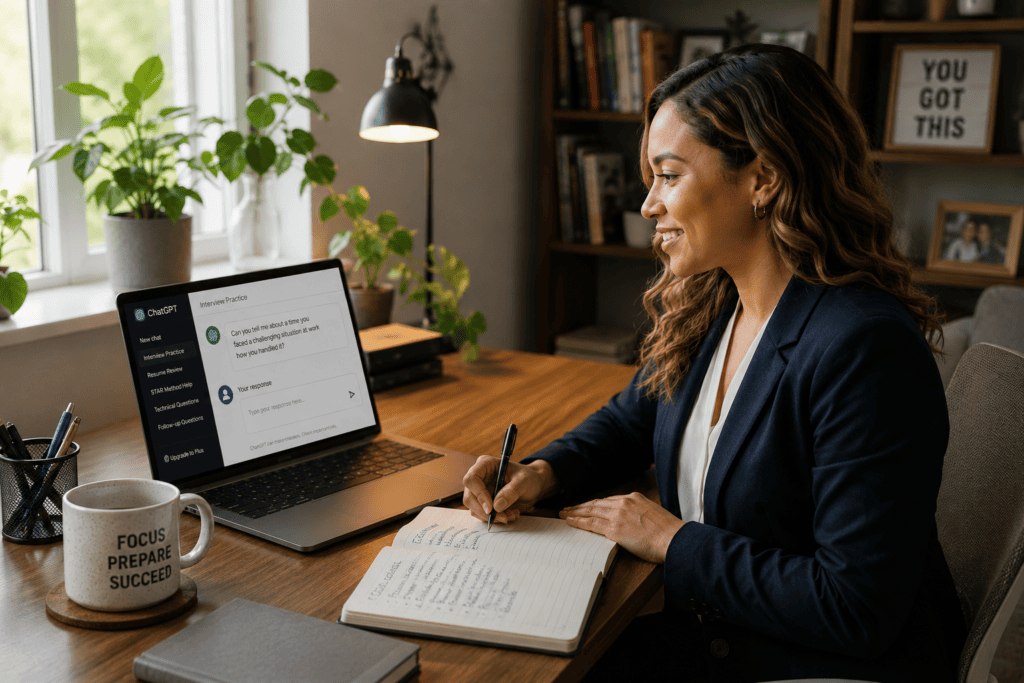
ChatGPT can make that preparation more structured. With the right prompts, you can turn ChatGPT into a
- Job-description analyst,
- Resume reviewer,
- Mock interviewer,
- Knowledge tutor, and
- Interview-feedback coach.
This guide explains how professionals, recent graduates, career switchers, and even people with little AI experience can use ChatGPT to prepare for a job interview step by step.
Why Use ChatGPT to Prepare for a Job Interview?
The main advantage of ChatGPT is that interview preparation can become interactive rather than passive.
Traditional preparation often involves reading lists of common interview questions and mentally imagining answers.
That can help, but an actual interview requires you to formulate answers, explain your reasoning, respond to follow-up questions, and communicate under pressure.
ChatGPT can help you practice those skills.
For example, you can ask it to:
- analyze a job advertisement;
- identify the employer’s likely priorities;
- compare those priorities with your experience;
- generate relevant practice questions;
- conduct a mock interview;
- challenge vague answers;
- help structure behavioral examples;
- test your technical knowledge;
- identify weaknesses in your responses; and
- suggest areas requiring further preparation.
However, ChatGPT cannot know exactly what an interviewer will ask, guarantee that its predictions are correct, or determine whether you will receive a job offer.
Think of it as a practice environment, not a prediction system.
Use the Job Description to Prepare for a Job Interview
The job description should be one of the first resources you use when preparing for an interview.
It tells you what the employer considers important enough to include in the vacancy.
Instead of starting with a generic prompt such as:
Give me interview questions for a project manager.
Give ChatGPT the actual job description.
Prompt to analyze a job description
I am preparing for an interview for the position below.
Analyze this job description and identify:
- The five most important skills or competencies the employer appears to value.
- The main responsibilities I am likely to be questioned about.
- Important terminology, tools, or concepts I should understand.
- Five likely interview questions.
- Areas where the interviewer may ask me to provide examples from my previous experience.
Do not assume requirements that are not stated or reasonably implied by the job description.
Job description:
[Paste the job description]
The resulting analysis gives you a preparation map.
For example, if the vacancy repeatedly refers to stakeholder management, project delivery, reporting, and risk management, those areas deserve more preparation than responsibilities mentioned only briefly.
Important limitation
ChatGPT is predicting likely areas of questioning from the material you provide.
It does not know the interviewer’s confidential question list.
Treat generated questions as practice material rather than guaranteed interview questions.
Compare Your Resume With the Job Requirements
Once ChatGPT understands the position, provide relevant information about your professional background.
This can be your resume, a sanitized version of your resume, or a summary of your experience.
Then ask ChatGPT to compare your background with the role.
Resume analysis prompt
Compare my professional background with this job description.
Identify:
- my strongest qualifications for the position;
- experiences I should emphasize during the interview;
- responsibilities where I have strong evidence;
- requirements where my evidence appears weak;
- achievements I should prepare to discuss;
- five questions an interviewer could reasonably ask based on my background.
Do not invent qualifications, achievements, responsibilities, or experiences that I have not provided.
This can help you answer an important interview-preparation question:
What evidence do I actually have that I can do this job?
Turn claims into evidence
Suppose a job description requires leadership.
Saying:
“I am a good leader.”
provides very little evidence.
A stronger interview response would involve a genuine example of when you:
- led a project;
- coordinated a team;
- solved a team problem;
- trained colleagues;
- managed conflicting priorities;
- took responsibility during a difficult situation; or
- produced a measurable result.
ChatGPT can help you identify these examples, but the experiences themselves should be genuine.
Ask ChatGPT for Likely Interview Questions
Once ChatGPT understands both the job and your background, use it to create a focused question bank.
Avoid generating 50 or 100 questions simply because AI makes it easy.
More questions do not automatically produce better preparation.
Instead, organize them by interview type.
Prompt
Based on the job description and the professional background I have provided, create an interview preparation question bank containing:
- 5 general interview questions;
- 5 behavioral questions;
- 5 role-specific questions;
- 3 questions about possible weaknesses or gaps in my experience;
- 3 difficult follow-up questions.
Rank them from highest to lowest priority based on their apparent relevance to this position.
This helps busy job seekers focus first on the questions most likely to reveal whether they understand the role.
Prepare “Tell Me About Yourself” With ChatGPT
“Tell me about yourself” is one of the most familiar interview questions, yet it can be difficult to answer concisely.
The interviewer normally does not need your complete life history.
A useful professional response usually connects:
your current professional position → relevant experience → strengths → reason for pursuing this opportunity.
Prompt
Help me prepare a 60–90 second response to “Tell me about yourself” for this position.
Base the response only on information I have provided.
Structure it around:
- Where I am professionally now.
- My most relevant previous experience.
- The skills or achievements most relevant to this job.
- Why this position is a logical next step.
Keep the language natural and conversational. Avoid clichés and do not invent information.
Read the draft critically.
If ChatGPT uses phrases you would never naturally say, change them.
Your goal is to know your professional story, not memorize an AI-written speech.
Use the STAR Method to Prepare for Behavioral Interview Questions
Behavioral interview questions ask you to provide specific examples of how you handled situations in the past.
Examples include:
- Tell me about a time you solved a difficult problem.
- Describe a time you disagreed with a colleague.
- Tell me about a project that did not go according to plan.
- Give me an example of when you demonstrated leadership.
- Tell me about a time you worked under pressure.
MIT Career Advising and Professional Development describes behavioral interviewing as using examples of previous behaviors or skills to help assess candidates, and recommends the STAR framework for structuring responses.
STAR means:
| STAR element | Meaning | What you should explain |
|---|---|---|
| S | Situation | What was happening? |
| T | Task | What responsibility or objective did you have? |
| A | Action | What did you personally do? |
| R | Result | What happened because of your actions? |
The Action section deserves particular attention because interviewers generally need to understand your contribution, rather than only what your team accomplished.
ChatGPT STAR evaluation prompt
I am preparing a behavioral interview answer.
Evaluate my response using the STAR framework.
Tell me:
- Whether the Situation provides enough context.
- Whether my Task or responsibility is clear.
- Whether my Action explains what I personally did.
- Whether the Result is specific and credible.
- What information is missing or unnecessary.
Do not rewrite my answer yet. Give me feedback first.
Interview question:
[Insert question]My answer:
[Insert answer]
The phrase “Give me feedback first” is useful because it changes the interaction from simple answer generation to coaching.
Build a STAR Story Bank Before the Interview
One useful way to prepare for a job interview is to create several reusable examples from your career rather than attempting to memorize a separate story for every possible question.
Create examples covering situations such as:
- leadership;
- teamwork;
- problem-solving;
- conflict;
- failure;
- initiative;
- working under pressure;
- managing competing priorities;
- customer or stakeholder management;
- learning something new;
- achieving an important result.
Then ask ChatGPT:
Review these professional experiences and help me organize them into a STAR story bank.
For each experience:
- identify which interview competencies it could demonstrate;
- identify which behavioral questions it could answer;
- point out missing details I should remember;
- suggest possible follow-up questions.
Do not add facts that I have not provided.
One good professional example can sometimes support several different interview questions depending on which part of the experience you emphasize.
Turn ChatGPT Into a Mock Interviewer
This is one of the highest-value ways to use ChatGPT to prepare for a job interview.
Do not ask ChatGPT to display all the questions and ideal answers before you start.
Instead, create an actual simulation.
Complete mock interview prompt
Act as the hiring manager interviewing me for this position.
Conduct a realistic mock job interview using the job description and my professional background.
Follow these rules:
- Ask only one question at a time.
- Wait for my answer before asking the next question.
- Ask realistic follow-up questions when my response is vague or incomplete.
- Do not reveal the ideal answer during the interview.
- Include general, behavioral, situational, and role-specific questions.
- Gradually make the questions more challenging.
- After 10 questions, end the interview.
Then evaluate my performance for:
- relevance;
- clarity;
- specificity;
- evidence;
- conciseness;
- understanding of the role;
- handling of follow-up questions.
Identify my three strongest areas and my three biggest priorities for improvement.
Now you are practicing the interview rather than reading about interviewing.
Make Your Mock Interview More Difficult
Once a standard mock interview feels comfortable, increase the difficulty.
You could use:
Repeat the mock interview, but this time act as a skeptical hiring manager. Whenever I make a broad claim about my skills, ask me for specific evidence.
Or:
Conduct a challenging interview in which you ask follow-up questions whenever my answer lacks evidence, contains an unsupported claim, or fails to answer the question directly.
You can also simulate different interviewers:
- recruiter;
- hiring manager;
- technical specialist;
- senior executive;
- panel interviewer;
- prospective team leader.
These simulations are hypothetical. ChatGPT cannot reproduce the exact personality or interview approach of a real person it has never interacted with.
Practice Follow-Up Questions, Not Just First Answers
A commonly overlooked way to prepare for a job interview is to practice what happens after your initial answer.
Imagine that you say:
“I improved our reporting process.”
The interviewer may respond:
- What exactly did you change?
- Why was the change necessary?
- What was your individual contribution?
- How did you measure the improvement?
- Did anyone resist the change?
- What would you do differently now?
If you memorized only your opening response, follow-up questions can quickly expose that.
Prompt
Ask me one behavioral interview question.
After I answer, stay on the same example and ask 2–3 realistic follow-up questions.
Use the follow-up questions to test:
- whether my example is specific;
- what I personally contributed;
- why I made particular decisions;
- how I measured the result;
- what I learned.
This develops depth rather than superficial preparation.
Ask ChatGPT to Critique Your Interview Answers
After answering a question, ask ChatGPT to assess your response against specific criteria.
Avoid vague instructions such as:
“Is this a good answer?”
Instead, use a structured rubric.
Interview feedback prompt
Evaluate my answer as if you were a hiring manager.
Score it from 1–10 for:
- relevance;
- clarity;
- specificity;
- credibility;
- supporting evidence;
- conciseness.
Then identify:
- The strongest part of the response.
- Anything vague or unnecessary.
- Claims requiring stronger evidence.
- Important information I failed to explain.
- One follow-up question you would ask.
Finally, suggest how I could improve the structure without changing the underlying facts or making the answer sound artificial.
The numeric scores should not be interpreted as scientifically validated interview ratings.
Their main value is to provide a consistent framework for comparing your own practice responses.
Identify Your Knowledge Gaps Before the Interview
Interview preparation is not only about communication.
You may discover that the job description includes concepts, technologies, regulations, methodologies, or terminology that you cannot confidently explain.
Ask ChatGPT to identify them.
Prompt
Analyze this job description and identify the technical concepts, tools, terminology, methodologies, regulations, or industry knowledge that a strong candidate may need to discuss.
Categorize them as:
- Must understand
- Useful to understand
- Helpful background knowledge
Explain why each topic appears relevant to the role.
Do not assume requirements without evidence from the job description.
Use the resulting list as a study plan.
For highly technical, legal, medical, financial, regulatory, or otherwise high-stakes information, verify important facts using appropriate authoritative sources.
ChatGPT can make mistakes.
Use ChatGPT Study Mode to Prepare for a Job Interview
If you discover an important concept you do not fully understand, Study Mode can be useful.
OpenAI describes Study Mode as a learning experience that can guide users through concepts, ask questions, explain ideas step by step, check understanding, and create practice questions. As of August 2026, OpenAI states that Study Mode is available across ChatGPT plans globally on the web, iOS, and Android.
For example, suppose you are interviewing for a project-management role and need to strengthen your understanding of earned value management.
Instead of asking:
Explain earned value management.
try:
I need to understand earned value management well enough to discuss it confidently in a project-management interview.
Teach it progressively.
First test my existing knowledge. Then explain the concept, give me a workplace example, and ask me interview-style questions without showing the answers until I respond.
You can apply the same approach to:
- software concepts;
- financial terminology;
- digital marketing metrics;
- data analysis;
- cybersecurity concepts;
- project management;
- HR terminology;
- industry-specific processes.
The key is to move from recognition (“I have heard of this”) to explanation (“I can explain and apply this”).
Prepare for Technical Interview Questions With ChatGPT
Technical interviews vary widely by profession.
A software engineer may need coding or system-design practice.
A financial analyst may need to explain valuation, financial statements, or modeling.
A digital marketer might need to interpret campaign performance.
A project manager may be asked how they would manage risk, scope changes, delays, or stakeholders.
ChatGPT can simulate these questions.
Prompt
Act as a technical interviewer for a [job title] position.
Give me one realistic technical or scenario-based question at a time.
Do not reveal the solution immediately.
Ask me to explain my reasoning.
If I make an incorrect assumption, challenge the assumption without immediately giving me the complete answer.
At the end, evaluate:
- technical accuracy;
- reasoning;
- communication;
- assumptions;
- areas requiring further study.
Again, verify important specialized information independently.
AI-generated technical feedback should not automatically be treated as authoritative.
Research the Employer Before Your Interview
You should not use ChatGPT as a replacement for direct company research.
Before the interview, investigate:
- what the organization does;
- its products or services;
- target customers;
- organizational mission where relevant;
- recent developments;
- information about the department;
- the advertised role;
- publicly available information about company culture;
- relevant industry developments.
Start with the company’s official website.
For publicly traded companies, investor relations materials may also be helpful.
For recent developments, use current and reputable sources.
Once you have verified information, you can give it to ChatGPT:
I have collected the following verified information about the organization.
Based on this information and the job description:
- Identify what I should understand before the interview.
- Generate five possible questions that could test whether I understand the organization and role.
- Suggest areas where my experience may connect with the organization’s stated priorities.
Company information:
[Insert verified information]
Do not assume ChatGPT’s pre-existing knowledge about an employer is current.
Prepare Questions to Ask the Interviewer
An interview is also your opportunity to evaluate the role and organization.
Instead of relying only on generic questions, generate questions related to the vacancy.
Prompt
Based on this job description, suggest 10 thoughtful questions I could potentially ask the interviewer.
Focus on:
- expectations during the first 90 days;
- how success is measured;
- team structure;
- major challenges;
- priorities for the person entering this position;
- professional development;
- how the role interacts with other departments.
Avoid questions whose answers are already obvious from the job description.
You do not need to ask all of them.
Choose the questions whose answers genuinely matter to you.
Prepare for Difficult Job Interview Questions
Some interview questions feel difficult because they touch on potential weaknesses.
Examples might include questions about:
- employment gaps;
- career changes;
- limited direct experience;
- leaving a previous employer;
- weaknesses;
- failed projects;
- relocation;
- salary expectations;
- missing preferred qualifications.
ChatGPT can help you practice answering these topics without becoming defensive or evasive.
For example:
Act as a recruiter and ask me why I am changing careers.
After I answer, evaluate whether my response:
- answers the question directly;
- remains positive;
- explains my motivation clearly;
- connects my transferable skills with the new profession;
- avoids criticizing previous employers;
- sounds credible rather than rehearsed.
The goal is to improve how you communicate real circumstances, not to create a false explanation.
Practice Salary Questions With ChatGPT
Salary conversations are another area you can rehearse.
For example:
Act as a recruiter and ask me about my salary expectations.
Wait for my response.
Then evaluate whether my answer is clear, professional, and flexible.
Do not invent salary benchmarks. If current market compensation is required, tell me what information I should research separately.
For actual salary benchmarks, use current data that matches your:
- profession;
- country;
- city or region;
- seniority;
- industry; and
- employment arrangement.
Compensation varies too much for a generic AI-generated figure to be automatically reliable.
Use ChatGPT Voice to Prepare for a Job Interview
Typing your answers is useful, but an interview is normally spoken.
A response that looks polished on screen may sound too long, unnatural, or complicated when said aloud.
ChatGPT Voice allows you to speak with ChatGPT and receive spoken responses. OpenAI currently documents Voice support on the web and supported mobile experiences, although available Voice options can depend on plan, workspace settings, region, and app version.
That makes Voice particularly useful for realistic mock-interview practice.
Voice interview prompt
Conduct a spoken mock interview for this position.
Ask one question at a time.
Keep your questions realistic and concise.
Ask follow-up questions whenever my answer is unclear or vague.
Do not give me model answers during the interview.
After the interview, evaluate the structure, clarity, relevance, and conciseness of my responses.
Speaking forces you to retrieve your examples and organize your thoughts in real time.
That is much closer to the actual interview environment.
Create an Interview Preparation Scorecard
After several practice rounds, use ChatGPT to identify patterns.
Prompt
Review my responses from this mock interview and create an interview preparation scorecard.
Rate my performance from 1–10 for:
- understanding of the role;
- relevance of answers;
- quality of examples;
- clarity;
- conciseness;
- STAR structure;
- handling of follow-up questions;
- technical knowledge;
- ability to explain my individual contribution.
For every category below 8, give me one specific practice exercise.
Then identify the three areas I should prioritize before repeating the interview.
Repeat the exercise after another mock interview.
The purpose is not to treat ChatGPT’s score as an objective hiring metric. Instead, use the same criteria consistently to see whether recurring weaknesses are improving.
A Complete Workflow to Prepare for a Job Interview With ChatGPT
You do not need dozens of disconnected prompts.
A repeatable workflow is more useful.
Step 1: Analyze the job description
Identify the skills, responsibilities, terminology, and requirements the employer appears to prioritize.
Step 2: Compare your background with the role
Find the strongest matches, transferable skills, achievements, and potential gaps.
Step 3: Build an evidence bank
Collect real examples demonstrating leadership, teamwork, problem-solving, communication, initiative, resilience, and relevant technical skills.
Step 4: Generate likely questions
Prioritize questions according to the job description instead of practicing hundreds of generic questions.
Step 5: Structure behavioral examples with STAR
Make sure each story clearly explains the Situation, Task, Action, and Result.
Step 6: Conduct a mock interview
Ask ChatGPT to interview you one question at a time without showing ideal answers first.
Step 7: Practice follow-up questions
Make ChatGPT challenge broad or unsupported statements.
Step 8: Review your feedback
Look for recurring weaknesses rather than trying to perfect every sentence.
Step 9: Study knowledge gaps
Review concepts that you cannot explain confidently and verify important technical information.
Step 10: Conduct a harder second interview
Increase the difficulty or use a different interviewer persona.
Step 11: Practice aloud
Use Voice where available, or simply answer the questions aloud without reading from your notes.
Step 12: Do a final review
Review your strongest examples, knowledge of the organization, questions for the interviewer, and practical interview arrangements.
The process can be summarized as:
Analyze → Prepare → Practice → Get Feedback → Improve → Repeat
That is far more useful than simply asking ChatGPT to write “perfect” interview answers.
Common Mistakes When Using ChatGPT to Prepare for a Job Interview
ChatGPT can improve your preparation, but several mistakes can reduce its usefulness.
Memorizing AI-generated answers
A polished response is not automatically a good spoken response.
If you memorize ChatGPT’s wording exactly, you may sound unnatural and struggle when an interviewer asks an unexpected follow-up.
Learn your points and examples, not a script.
Providing too little context
This:
Prepare me for an interview.
gives ChatGPT very little to work with.
This is better:
I am interviewing for this position. Here is the job description and a summary of my experience. Identify the highest-priority areas I should practice and then conduct a mock interview.
Relevant context improves the exercise.
Inventing qualifications
Never use AI to fabricate:
- degrees;
- certifications;
- jobs;
- responsibilities;
- achievements;
- technical skills;
- salary history;
- project results.
Use ChatGPT to communicate your experience more effectively.
Practicing only easy questions
If your practice sessions always feel comfortable, you may not be testing the areas where you need improvement.
Ask for difficult follow-ups.
Reading more than you practice
Interviewing is partly a performance skill.
Reading 50 interview guides cannot fully replace answering questions aloud.
Spend a meaningful portion of your preparation actually responding to questions.
Trusting every ChatGPT answer
ChatGPT can produce inaccurate information.
Verify important factual material, particularly information involving:
- laws;
- regulations;
- current company information;
- technical standards;
- salary figures;
- certifications;
- current software functionality;
- medical or financial information.
Privacy: What Should You Share With ChatGPT?
Privacy deserves attention when you use ChatGPT to prepare for a job interview.
A resume may contain personal information such as:
- full name;
- telephone number;
- personal email address;
- home address or location;
- employer information;
- education history;
- references;
- employment history.
Most interview-preparation prompts do not require all of those details.
Consider removing information that is unnecessary for the task before pasting or uploading a resume.
For example, ChatGPT generally does not need your telephone number or street address to compare your experience against a job description.
OpenAI provides Data Controls that allow users to control whether eligible ChatGPT conversations are used to improve its models. OpenAI also provides Temporary Chat, whose conversations do not appear in chat history, do not create memories, and are not used to improve OpenAI’s models. OpenAI states that Temporary Chats are retained for a limited period for safety purposes before deletion.
Privacy features and product behavior can change, so check OpenAI’s current documentation before sharing sensitive information.
Is ChatGPT Enough to Prepare for a Job Interview?
No. ChatGPT can become a useful part of your interview preparation, but it should complement rather than replace other forms of preparation.
A strong approach combines:
- careful review of the job description;
- research into the employer;
- reflection on your real experience;
- ChatGPT-assisted practice;
- industry-specific preparation;
- technical study where necessary;
- spoken rehearsal;
- practical preparation for the interview itself.
For specialized professions, use authoritative professional sources alongside ChatGPT.
Can ChatGPT help me prepare for a job interview?
Yes. ChatGPT can help you prepare for a job interview by analyzing the job description, generating relevant practice questions, reviewing your answers, conducting mock interviews, challenging vague responses, and helping you identify areas that require more preparation.
It cannot guarantee the actual questions an employer will ask or whether you will get the job.
What is the best ChatGPT prompt to prepare for a job interview?
There is no single best prompt for every candidate because the most useful prompt depends on the job.
A strong starting point is:
I am preparing for an interview for [job title]. I will provide the job description and information about my professional experience. Analyze both and conduct a realistic mock interview. Ask one question at a time, wait for my response, ask appropriate follow-up questions, and give me detailed feedback after the interview.
Adding the real job description makes the practice more relevant.
Can ChatGPT conduct a mock job interview?
Yes.
You can instruct ChatGPT to act as a recruiter, hiring manager, technical interviewer, or other interviewer type and ask questions one at a time.
You can also specify the difficulty, question categories, number of questions, and evaluation criteria.
Can I use ChatGPT Voice for interview practice?
Yes, where Voice is available to you.
OpenAI currently supports ChatGPT Voice on the web and supported mobile experiences. Voice allows you to speak with ChatGPT and hear spoken responses, making it useful for practicing real-time interview communication. Availability and specific Voice options may vary.
Can I upload my resume to ChatGPT?
ChatGPT can work with uploaded files in supported contexts. Before uploading a resume for interview preparation, remove personal information that is unnecessary and review the privacy and Data Control settings relevant to your account.
Can ChatGPT predict my job interview questions?
It can generate plausible questions based on the job description, your profession, and the information you provide.
However, these are predictions for practice.
ChatGPT normally cannot know the confidential questions a particular employer plans to ask.
Should I memorize interview answers created by ChatGPT?
Usually not.
Memorizing AI-generated scripts may make your responses sound unnatural and can leave you unprepared for follow-up questions.
Instead, learn your key points, understand your professional examples, and practice explaining them naturally.
Can ChatGPT help with behavioral interview questions?
Yes.
ChatGPT can help you organize genuine professional experiences using the STAR framework and evaluate whether your examples clearly describe your situation, responsibility, actions, and results.
Can ChatGPT help me prepare for technical interview questions?
Yes, but its usefulness depends on the profession and complexity of the topic.
It can quiz you, create scenarios, ask you to explain your reasoning, and identify possible knowledge gaps.
Important technical information should still be verified using reliable professional or authoritative sources.
How long should I use ChatGPT to prepare for a job interview?
There is no universal amount of time.
The appropriate preparation depends on the seniority and complexity of the position, your familiarity with the role, the type of interview, and the amount of time available.
Prioritize quality of rehearsal over quantity of prompts.
A focused session in which you answer difficult questions, receive feedback, and improve weak responses can be more valuable than generating hundreds of sample questions.
In Conclusion
The best way to use ChatGPT to prepare for a job interview is not to ask it to write answers that you memorize.
Use it to make your preparation interactive.
Start with the job description. Compare the role with your real experience. Build a bank of genuine professional examples. Practice behavioral questions using STAR. Conduct mock interviews. Ask for difficult follow-up questions. Identify your knowledge gaps. Practice your answers aloud. Then repeat the process.
Remember the preparation loop:
Analyze → Prepare → Practice → Feedback → Improve → Repeat
ChatGPT can help provide the structure and repetition.
But the experience, judgment, accomplishments, professional knowledge, and personality you bring to the interview must remain your own.
Your next practical step
Take the job description for the position you want.
Paste it into ChatGPT—after removing anything confidential—and start with this prompt:
I want to prepare for a job interview for the position below. Analyze the job description and tell me the five most important areas I need to prepare for. Explain why each area matters, then create five high-priority interview questions without giving me the answers yet.
Answer those questions yourself.
Then let ChatGPT challenge you.
That is where meaningful interview preparation begins.