Essential Python Backend Development Roadmap for Beginners
A Python Backend Development Roadmap for Beginners provides a structured path from language fundamentals to production-ready applications. Mastering backend engineering requires a systematic progression through core programming, web protocols, database management, API design, security, and deployment. This guide delivers that precise sequence, outlining timeline expectations and portfolio milestones to demonstrate technical competence to employers.
Who This Roadmap Is For
- Complete beginners building a foundational skill set in software engineering.
- Students and recent graduates targeting backend or software development roles.
- Frontend developers transitioning into full-stack engineering.
- Self-taught programmers with basic syntax knowledge seeking a rigorous, production-focused learning path.
- Career changers pursuing entry-level technical roles in tech.
- Aspiring freelancers and remote developers looking to build marketable engineering stacks.
- Junior developers auditing their skill gaps across modern backend ecosystems.
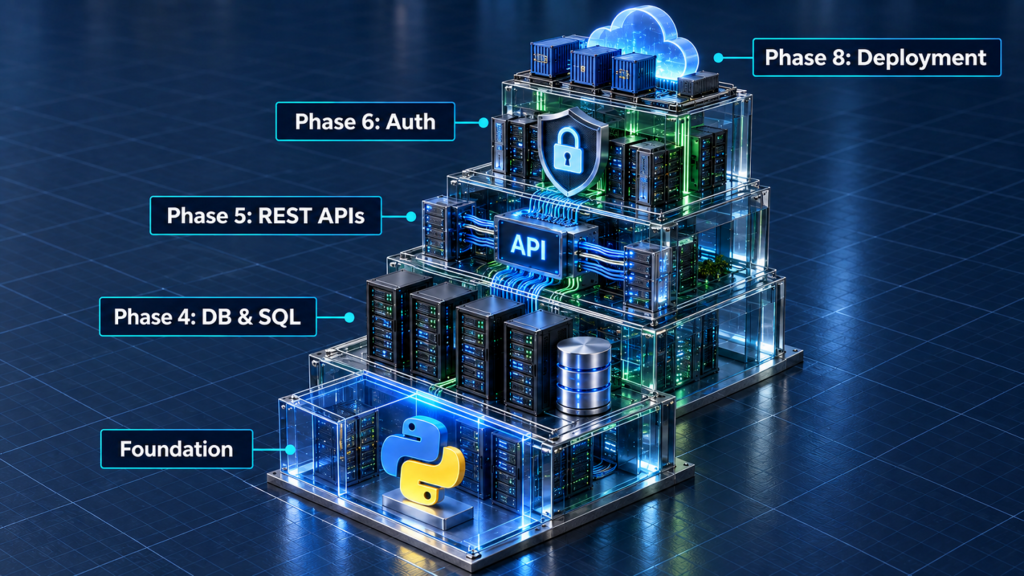
For anyone asking, “What should I learn, and in what order, to become a Python backend developer?”, this roadmap provides the definitive answer.
What Python backend development involves
Backend engineering centers on server-side architecture: building the systems that process business logic, handle client requests, manage data persistence, and expose reliable APIs for frontends and mobile applications.
A production-ready Python backend developer operates across five core technical pillars:
- Core Languages & Frameworks: Python paired with production-grade frameworks like FastAPI for high-performance asynchronous microservices, or Django for robust, batteries-included applications.
- Data Architecture: Relational databases (e.g., PostgreSQL), advanced SQL optimization, and ORM mapping.
- API Design & Protocols: HTTP standards, RESTful architecture, and clean payload design.
- Security & Access Control: Authentication and authorization workflows using JWT, sessions, and OAuth to protect sensitive endpoints against vulnerabilities.
- Infrastructure & Operations: Containerization via Docker, version control, CI/CD pipelines, and cloud environment deployment.
Backend engineering is foundational work. A well-architected system is invisible to the end user—login flows remain secure, data queries scale cleanly to millions of rows without latency spikes, and system uptime remains uncompromised. Mastering these underlying mechanics is what commands high market value and makes a structured path essential.
The Python backend roadmap at a glance
The Python Backend Development Roadmap is divided into nine progressive phases. The timeline estimates assume 10 to 15 hours per week of dedicated, project-based execution.
| Phase | Focus Area | Estimated Duration | Core Deliverable |
| 1 | Python Fundamentals & CLI | 3–5 weeks | CLI automation scripts and clean code architecture |
| 2 | Git & GitHub | 1 week | Version-controlled repository with structured branch history |
| 3 | HTTP & Web Basics | 1–2 weeks | Raw HTTP request/response experiments and client-server notes |
| 4 | Databases & SQL | 3–5 weeks | Normalized database schema and optimized SQL queries |
| 5 | API Development (REST) | 4–6 weeks | CRUD API connected to a persistent database |
| 6 | Authentication & Security | 2–4 weeks | Secure login workflows, role-based access, and rate limiting |
| 7 | Testing, Logging & Docker | 2–4 weeks | Automated test suite, containerized Dockerfile, and CI pipeline |
| 8 | Cloud Deployment | 2–3 weeks | Production deployment with live URL and interactive API docs |
| 9 | Portfolio & Interview Prep | 4–8 weeks | Polished production projects, documentation, and technical resume |
Consistent execution across every stage—building and shipping code at each milestone—brings learners to junior-readiness in 6 to 9 months part-time, or 4 to 6 months full-time.
Phase 1 — Python Fundamentals & Command Line (3–5 Weeks)
Core Objective: Master foundational Python syntax, terminal navigation, and clean script architecture before introducing web frameworks or databases.
Key Technical Competencies
- Syntax & Control Flow: Variables, operators, data types, conditionals (
if/else), and iteration loops (for/while). - Modular Design: Functions, scope, modules, packages, and dependency management using virtual environments (
venv). - Data Structures: Lists, dictionaries, sets, and tuples—optimized for data manipulation and lookups.
- Robustness & I/O: File input/output (CSV, JSON), exception handling (
try/except), and Object-Oriented Programming (classes, inheritance, encapsulation). - Command-Line Proficiency: Directory navigation, script execution, environment variables, and basic shell operations.
Milestone Projects
- Interactive CLI Calculator: A command-line tool with robust input validation and error handling for mathematical operations.
- Persistent Text-Based To-Do List: A script that manages tasks using file storage (JSON or CSV) for data persistence.
- CSV Data Cleaner Script: An automation utility that reads a messy, unstructured CSV file, cleans corrupted records, standardizes formats, and exports a validated output.
What to Avoid at This Stage
Do not touch web frameworks, asynchronous programming, databases, or Docker. Build strict fluency in the language syntax and command-line execution first.
Phase 2 — Git & GitHub (1 Week)
Core Objective: Master version control for professional software engineering workflows, treating Git as a collaboration tool rather than a local backup mechanism.
Key Technical Competencies
- Core Commands: Repository initialization, cloning, staging, committing, pushing, and pulling (
init,clone,add,commit,push,pull). - Branching & Collaboration: Feature branch workflows, merging strategies, pull requests (PRs), and resolving merge conflicts.
- Repository Hygiene: Writing semantic commit messages and configuring
.gitignorefiles to keep secrets and build artifacts out of version control.
Milestone Project
- Repository Migration & PR Workflow: Move your Phase 1 projects into a structured GitHub repository. Practice creating a feature branch, implementing a minor modification, opening a pull request, reviewing the diff, and merging it back into the main branch.
Phase 3 — HTTP & Web Basics (1–2 Weeks)
Core Objective: Understand how data moves across the internet, establishing the network foundation required for building APIs later in this Python Backend Development Roadmap for Beginners.
Key Technical Competencies
- HTTP Methods: Semantic verbs (
GET,POST,PUT,DELETE,PATCH) and their role in RESTful operations. - Status Codes: Interpreting success codes (
200,201), client errors (400,401,403,404), and server failures (500). - Headers & State: Request and response headers, session cookies, and fundamental Cross-Origin Resource Sharing (CORS) principles.
- Client-Server Architecture: The request/response cycle, DNS resolution, and how web servers interpret incoming connections.
Milestone Project
- API Inspection & Request Lifecycle Analysis: Use
curl, Postman, or Insomnia to query public APIs and inspect headers, payloads, and status codes. Write a technical breakdown tracing the exact request/response cycle that occurs when a browser visits a target URL.
Phase 4 — Databases & SQL (3–5 Weeks)
Core Objective: Design structured schemas, write optimized SQL, and master data persistence—a fundamental pillar of the Python Backend Development Roadmap for Beginners.
Key Technical Competencies
- Relational Data Modeling: Entities, tables, primary keys, foreign keys, and enforcing referential integrity (one-to-one, one-to-many, many-to-many).
- SQL Mastery: Data manipulation and definition (
SELECT,INSERT,UPDATE,DELETE), multi-table joins, aggregations (GROUP BY), and query performance indexing. - Database Architecture: Normalization principles (1NF, 2NF, 3NF) and strategic denormalization for read-heavy workloads.
- RDBMS & ORM Stack: Deep focus on PostgreSQL paired with an introduction to Object-Relational Mapping using SQLAlchemy or the built-in Django ORM.
Milestone Project
- E-Commerce or Blog Relational Schema: Design a fully normalized database schema for a complex application (users, products, categories, orders, or posts/comments). Populate it with realistic sample data and write targeted SQL queries to solve complex reporting requirements (e.g., calculating total revenue per user, tracking inventory levels).
Phase 5 — Build APIs with a Python Framework (4–6 Weeks)
Core Objective: Transition from writing standalone scripts to engineering production-ready REST services, a pivotal milestone in the Python Backend Development Roadmap for Beginners.
Framework Selection Strategy
Choose one framework to master initially rather than spreading focus across all three:
- Django: “Batteries-included” ecosystem with built-in admin dashboards, ORM, and authentication; ideal for monolithic web applications.
- Flask: Minimalist, flexible micro-framework that forces you to piece together your own tools, excellent for learning low-level web mechanics.
- FastAPI: Modern, high-performance, asynchronous-first framework featuring automatic OpenAPI documentation; industry standard for high-throughput APIs.
Key Technical Competencies
- Routing & Validation: Defining endpoints, parsing request paths, query parameters, request bodies, and payload validation (using Pydantic or Django serializers).
- Database Persistence: Integrating your chosen framework with your RDBMS using an ORM (SQLAlchemy, Django ORM) or optimized raw SQL queries.
- API Design Patterns: Implementing robust error handling, pagination, filtering, sorting, and API versioning.
- Endpoint Testing: Validating request cycles, headers, and status codes using Postman, Insomnia, or automated test clients.
Milestone Project
- Full CRUD API: Build a complete Create, Read, Update, Delete API for your Phase 4 database schema (e.g., blog posts, inventory management, or e-commerce products) equipped with strict input validation, clean error responses, and interactive documentation.
Phase 6 — Authentication & Security (2–4 Weeks)
Core Objective: Lock down your application against common vulnerabilities and implement robust access control, turning an open demo into a secure milestone within the Python Backend Development Roadmap for Beginners.
Key Technical Competencies
- Authentication vs. Authorization: Differentiating between identity verification (who you are) and permission checks (what you are allowed to do).
- Credential Security: Implementing strong password hashing (
bcryptorargon2) and handling state via secure HTTP-only cookies (sessions) or stateless JSON Web Tokens (JWT). - Access Control: Enforcing Role-Based Access Control (RBAC) to restrict administrative endpoints from standard users.
- Vulnerability Mitigation: Defending against injection attacks (SQLi), Cross-Site Scripting (XSS), and Cross-Site Request Forgery (CSRF).
- Application Hardening: Configuring API rate limiting, strict payload input validation, and secure environment-based secrets management.
Milestone Project
- Secure API Access Layer: Integrate user registration, login endpoints, and token/session validation into your Phase 5 CRUD API. Restrict sensitive mutation endpoints so that only authenticated users and designated roles can execute them.
Phase 7 — Testing, Logging, Docker & CI (2–4 Weeks)
Core Objective: Establish automated quality gates, code reliability, and containerized deployment pipelines, marking an essential operational milestone within the Python Backend Development Roadmap for Beginners.
Key Technical Competencies
- Automated Testing: Writing unit and integration tests using
pytestorunittest, handling fixtures, and mocking external dependencies or database states. - Observability & Logging: Implementing structured, machine-readable JSON logging and setting up error tracking for production environments.
- Containerization: Writing production-ready
Dockerfileconfigurations with multi-stage builds and managing multi-service local environments usingdocker-compose. - Continuous Integration (CI): Configuring GitHub Actions or GitLab CI pipelines to automatically lint code, build images, and run test suites on every push.
Milestone Project
- Containerized Test Suite & CI Pipeline: Write comprehensive integration tests for your API endpoints and models. Containerize your application alongside a database service using Docker, and configure an automated GitHub Actions CI pipeline to run your full test suite on every pull request.
Phase 8 — Deploy to Cloud (2–3 Weeks)
Core Objective: Move your containerized application from local infrastructure to a live, production-ready environment, marking a critical graduation step within the Python Backend Development Roadmap for Beginners.
Key Technical Competencies
- Environment Configuration: Managing sensitive variables and isolating development settings from production secrets using environment variables.
- Deployment Platforms: Deploying via modern Platform-as-a-Service (PaaS) providers (Render, Railway, Fly.io) or configuring cloud virtual machines (AWS EC2, DigitalOcean, GCP).
- Web Servers & Proxies: Running production WSGI/ASGI servers (Gunicorn, Uvicorn) behind a reverse proxy (Nginx) with SSL/TLS encryption for HTTPS.
- Production Observability: Implementing health-check endpoints, tracking server error logs, and monitoring uptime.
Milestone Project
- Live Public Deployment & Documentation: Deploy your tested, containerized, and authenticated API to a public cloud environment with a functioning live URL. Write a professional project
README.mddetailing architectural design, local setup steps, environment variables, and production deployment notes for prospective employers.
Phase 9 — Portfolio Projects & Interview Prep (4–8 Weeks)
Core Objective: Transition from a guided learner to an autonomous, employable software engineer by building production-grade portfolio applications and mastering technical interviews, completing the Python Backend Development Roadmap for Beginners.
High-Impact Portfolio Projects
Build two to three production-grade systems that demonstrate real-world problem-solving rather than following basic tutorials:
- E-Commerce Backend: Product catalog management, shopping cart state, order processing, and mocked third-party payment webhook integration (e.g., Stripe).
- Social Media API: High-throughput user posts, threaded comments, atomic like/favorite increments, and efficient relational querying.
- Booking & Appointment System: Complex date/time range conflict resolution, availability calculation logic, and automated booking concurrency handling.
Portfolio Documentation Standards
For every project deployed to your portfolio, provide:
- Clean Repository Architecture: Hosted on GitHub with a professional
README.mddetailing tech stacks, setup instructions, and environment variables. - Live Deployment: A functional, publicly accessible URL with interactive API documentation (
/docsor/redoc). - Architectural Decisions: Visual database schemas (ERDs) and concise technical notes explaining key engineering trade-offs (e.g., choosing relational models over NoSQL, caching strategies).
Interview Preparation Strategy
- Project Defense: Practice articulating what you built, why you chose specific tools, and the technical hurdles you overcame.
- Backend Fundamentals: Review core data structures (hash maps, arrays, trees, queues) and relational database performance metrics (index lookups, query execution plans, N+1 query problems).
- System Design Basics: Study foundational scalability patterns, including database indexing, application caching (Redis), rate-limiting algorithms, and stateless API design.
Django vs Flask vs FastAPI: Which should a beginner pick?
For a beginner following a Python Backend Development Roadmap for Beginners, choosing your first framework can feel overwhelming. All three—Django, Flask, and FastAPI—are widely used in production, but they serve completely different learning goals.
Framework Comparison Matrix
| Framework | Best Used For | Primary Strengths | Technical Trade-offs |
| Django | Monolithic web applications, admin dashboards, data-heavy CRUD platforms | Full “batteries-included” ecosystem (built-in ORM, auth, admin interface, CSRF protection) | Steeper initial learning curve, monolithic structure, more opinionated “magic” |
| Flask | Microservices, learning web server internals, minimalist micro-APIs | Minimalist, highly explicit, zero enforced architecture, easy to inspect request cycles | Requires manual integration of database ORMs, auth, validation, and documentation plugins |
| FastAPI | High-performance REST APIs, modern microservices, ML/AI model serving | Native async performance, automatic OpenAPI (Swagger) generation, type-hint validation | Requires solid understanding of Python type hints and modern asynchronous programming patterns |
Which Framework Should You Pick? Which Framework Should You Pick?
Choosing the right Python backend framework depends on your experience level, project requirements, and career goals.
- Flask is a good choice for beginners who want to understand backend fundamentals and build small applications with greater flexibility.
- Django is better suited to full-featured web applications because it includes built-in tools for authentication, database management, security, and administration.
- FastAPI is an excellent option for building fast, modern APIs, particularly when working with mobile applications, artificial intelligence tools, or microservices.
Beginners do not need to learn all three frameworks simultaneously. Start with one, build at least two practical projects, and develop a solid understanding of routing, databases, authentication, APIs, testing, and deployment before exploring another. Choose Flask for simplicity and control, Django for complete web applications, or FastAPI for API-focused development.
Choose Django if you want the fastest route to an employable skill set.
If your goal is to land a job quickly, build complex full-stack web platforms, or leverage built-in administrative tools without reinventing authentication, Django is the industry standard. Its strict patterns teach you how production applications structure business logic.
Choose Flask if you want to understand how web backends work under the hood.
If you prefer building systems from scratch to learn architectural mechanics, Flask is ideal. Because it includes only minimal routing and request handling, you will manually connect your database, structure your file directories, and configure authentication libraries.
Choose FastAPI if you want to focus strictly on API design and modern Python.
If your goal is to build microservices, serve AI/machine learning models, or create APIs for single-page applications (React/Vue/Next.js) or mobile apps, FastAPI is the industry-favorite choice. It enforces clean Python type annotations and delivers exceptional execution speed out of the box.
The Verdict
Don’t overthink the choice—the fundamental backend concepts (HTTP request/response lifecycles, SQL query optimization, database relations, dynamic routing, authentication, and deployment) are completely framework-agnostic.
- Pick FastAPI if you are targeting modern API development or AI integration.
- Pick Django if you want an all-in-one web stack with minimal setup required for admin interfaces.
Once you master your first framework, transitioning to another takes a matter of days.
Common Mistakes Beginners Make
Avoid these critical pitfalls to keep your momentum steady throughout the Python Backend Development Roadmap for Beginners:
- Tutorial Hopping: Jumping between a dozen different video series or courses without ever building and deploying an original application from scratch. Finish what you start.
- Skipping Database Fundamentals: Rushing straight into complex web frameworks before understanding how to write raw SQL, design normalized relational schemas, and optimize queries.
- Building Only Toy Projects: Relying on basic “To-Do” lists or simple calculators. A job-ready portfolio requires real-world complexity, such as error handling, pagination, authentication, and structured logging.
- Ignoring Deployment: Treating local execution as the finish line. Code that only runs on
localhostdoes not prove production readiness or environment management skills. - Delaying Interview Preparation: Waiting until the very end to think about technical interviews. Introduce light data structures, algorithmic patterns, and backend system design concepts by Phase 4 or 5.
A Realistic Weekly Study Plan
Consistency trumps intensity when executing the Python Backend Development Roadmap for Beginners. Align your weekly schedule with your available bandwidth to determine your timeline to job readiness:
- 10–12 Hours per Week (Part-Time): Job-ready in approximately 9 to 12 months. Ideal for working professionals or full-time students balancing other commitments.
- 15–20 Hours per Week (Dedicated Part-Time): Job-ready in approximately 6 to 8 months. The optimal pace for steady, deep skill acquisition.
- 30+ Hours per Week (Full-Time Immersion): Job-ready in approximately 4 to 6 months. Best suited for career changers treating skill acquisition like a full-time job.
Sample Weekly Schedule (15 Hours/Week)
- Monday (2 Hours): Core concept study (e.g., reading documentation, studying database normalization or HTTP status codes).
- Tuesday (2 Hours): Hands-on coding and small script implementation for your current phase.
- Wednesday (2 Hours): Working on your ongoing milestone project (building schemas, writing routes, or configuring Docker).
- Thursday (2 Hours): Debugging, writing unit tests, or reviewing version control commits.
- Friday (1 Hour): Light review, refactoring code, or auditing git branch history.
- Saturday (3 Hours): Deep-dive session focused on building complex features or tackling milestone deliverables.
- Sunday (3 Hours): Project deployment, documentation, or catching up on challenging topics.
Prioritize writing code and solving errors daily over cramming marathon sessions on weekends. Small, continuous progress compounds quickly.
Career Paths and Entry-Level Roles
Completing the Python Backend Development Roadmap for Beginners qualifies you to target several distinct entry-level technology roles:
- Junior Python Backend Developer: Designing, building, and scaling server-side business logic, database models, and RESTful endpoints within an engineering team.
- API Developer: Specializing in building, documenting, and optimizing high-throughput APIs for mobile apps, frontend teams, or microservice architectures.
- Full-Stack Developer (Python + Frontend): Managing backend API development while utilizing lightweight frontend frameworks (like React, Vue, or Next.js) to deliver end-to-end features.
- Freelance Backend Contractor: Delivering custom backend systems, database designs, automation scripts, and MVP integrations for small businesses and early-stage startups.
Core Daily Responsibilities
As a junior backend engineer, your day-to-day work involves writing clean code across the entire service lifecycle:
- Designing, querying, and optimizing relational database schemas.
- Building and maintaining robust, version-controlled APIs with proper validation and error handling.
- Implementing secure authentication, authorization, and rate-limiting safeguards.
- Writing unit and integration tests to maintain high code coverage.
- Containerizing applications and managing deployments in cloud environments.
How long does it take to become a Python backend developer?
Most learners reach junior-readiness in 6 to 9 months part-time, or 4 to 6 months full-time, provided they ship a functional project at every phase of the Python Backend Development Roadmap for Beginners. Frontend developers transitioning to backend can often reduce this timeline by a third, as they already understand HTTP mechanics and client-server request cycles.
Do I need a computer science degree?
No. Tech employers hiring junior backend engineers weigh deployed projects, API design choices, and database fluency far more heavily than academic credentials. A portfolio featuring live endpoints, automated tests, and clean documentation carries significantly more weight than a university transcript.
Should I learn Django, Flask, or FastAPI first?
Choose your framework based on your specific career goals: Django for structured full-stack applications and rapid development, Flask for learning web internals with minimal abstraction, or FastAPI for modern, high-performance REST APIs. All three are highly respected in the industry; achieving deep competence in one framework matters far more than sampling all three.
Is backend development harder than frontend?
It is structurally different rather than inherently harder. Backend engineering replaces visual feedback with systems logic, data modeling, concurrency management, and security, which can make early progress feel less immediate. Many developers find backend work more rewarding because the challenges are foundational and architectural.
Will AI replace junior backend developers?
Not based on current industry evidence. While AI coding tools accelerate code generation, human engineers remain responsible for system architecture, database schema design, security hardening, and production debugging. Judgment regarding business logic, edge cases, and failure modes requires human oversight.
In Conclusion
Backend engineering is a discipline built on rigorous fundamentals, clean architecture, and continuous shipping. By mastering language syntax, database design, secure APIs, automated testing, and cloud deployment step by step through a structured Python Backend Development Roadmap for Beginners, you transform from a curious beginner into a capable, job-ready engineer.
The most successful developers are those who build consistently, solve hard problems without shortcutting the basics, and focus on delivering working code at every single phase. Pick your starting framework, build your portfolio, and start shipping.