AI Research Agents for Business: Beyond Prompt Engineering
AI research agents are autonomous software systems that plan, execute, and synthesize multi-step research workflows across multiple information sources—moving business professionals from single-prompt interactions to structured, evidence-based research pipelines.
Unlike ordinary chatbots, AI research agents for business decompose complex objectives, retrieve and validate sources, cross-reference findings, and produce decision-ready reports with citations, enabling faster competitive intelligence, market analysis, and strategic planning.
Who this guide is for
This article is written for business professionals, entrepreneurs, analysts, consultants, researchers, marketers, freelancers, managers, and digital-skills learners who already use AI assistants (ChatGPT, Copilot, Gemini, Claude, Perplexity) and want to progress from basic prompting to agent-assisted research workflows. It is also relevant for team leaders evaluating where AI research agents for business can improve productivity while understanding issues of human oversight, source verification, confidentiality, and responsible AI use.
What you will learn
- What AI research agents for business are and how they differ from chatbots, search engines, and basic prompting
- Why research agents represent a step beyond prompt engineering (multi-step planning, source retrieval, synthesis, structured outputs)
- Practical business applications: market research, competitor analysis, industry and product research, due diligence support, content and customer insights, strategic planning
- How research-agent workflows operate from objective definition through evidence gathering, analysis, synthesis, and reporting
- When agents are useful versus when conventional search or human expertise is preferable
- Tools and platforms offering deep-research capabilities (without a generic “best tools” list)
- Effective human–agent collaboration: setting objectives, providing context, defining constraints, reviewing sources, challenging conclusions, refining outputs
- Limitations and risks: hallucinations, weak sources, incomplete or outdated information, bias, overconfidence
- Business risks and responsible use: confidential information, privacy, intellectual property, compliance, human review for consequential decisions
- Emerging skills professionals need: research orchestration, source evaluation, AI literacy, critical thinking, verification, workflow design, communicating findings.
- Profession-specific applications for marketers, analysts, consultants, entrepreneurs, HR, project managers, and other roles
- How to build a practical research-agent workflow you can start experimenting with today.
The overview above provides a baseline for leveraging Scouts by Yutori Review to evaluate real-time business intelligence tools.
What are AI research agents?
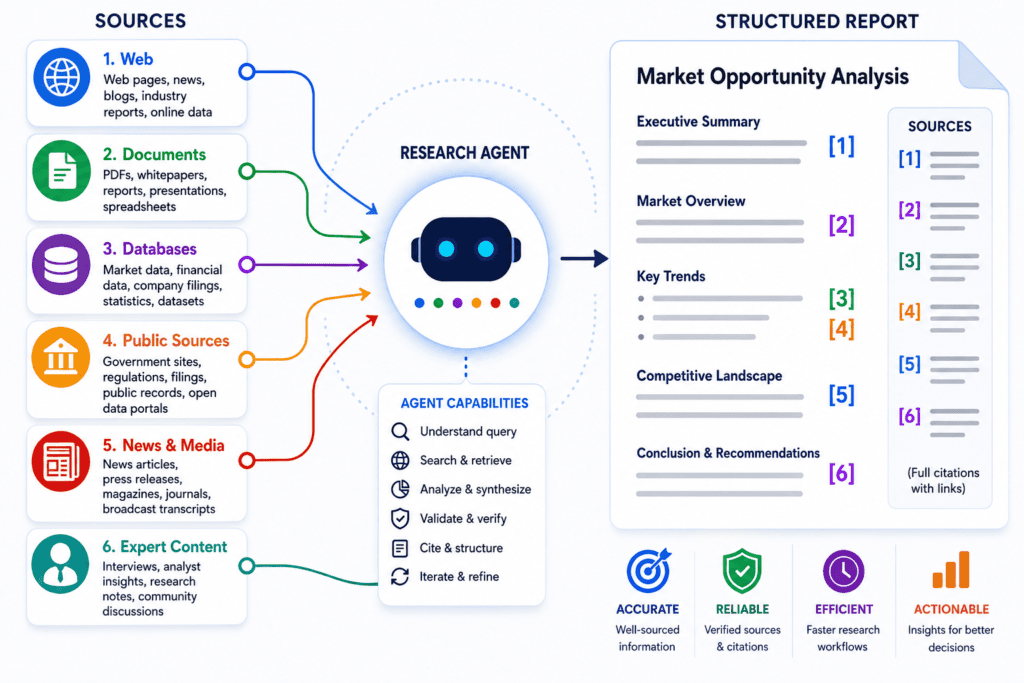
AI research agents are autonomous software systems designed to plan, execute, and synthesize multi-step research workflows across disparate information sources with minimal human intervention.
Unlike traditional AI chatbots or search engines that respond to single-turn prompts or return a static list of links, research agents operate via an iterative execution loop:
- Objective Decomposition: They break a broad, complex research query down into granular sub-tasks and strategic angles.
- Multi-Source Retrieval: They query live web indices, internal databases, academic repositories, or custom APIs in parallel.
- Critical Synthesis: They read, cross-reference, and evaluate the credibility of findings while actively flagging inconsistencies or gaps.
- Structured Reporting: They compile the final output into a coherent, executive-ready format complete with verifiable citations, tables, and structured sections.
Platforms implementing this architecture (such as OpenAI’s Deep Research) utilize advanced reasoning models and tool-use capabilities to autonomously research tasks that traditionally took human analysts hours or days to complete.
Why this is more than “better prompting”
Prompt engineering optimizes a single interaction by refining how instructions are phrased for one model call. In contrast, agentic research requires context engineering—designing and controlling the entire information environment so that an autonomous system consistently accesses the right data, tools, memory, and source metadata across dozens of automated steps.
When deploying AI research agents for business, the operational shift extends far beyond writing clever prompts:
- Multi-Call Orchestration: Agents execute iterative loops, chaining together search queries, code execution, and document parsing across multiple autonomous API calls without human intervention.
- Dynamic Tool Selection: Rather than relying solely on parametric memory, agents decide when to invoke external databases, web scraping tools, or internal knowledge bases based on intermediate findings.
- State Management and Memory: Agents maintain context across multi-hour research tasks, tracking what has been verified, what gaps remain, and which hypotheses need further cross-referencing.
Prompt engineering becomes just one component of a broader operational toolkit. Success with AI research agents for business ultimately relies on research orchestration, rigorous source verification, workflow design, and human strategic judgment.
Why research agents matter for business now
Organizations are rapidly scaling AI across the enterprise, deploying agentic systems capable of acting autonomously across complex workflows. McKinsey’s State of AI survey reports that 40% of large organizations are scaling AI agents, up from 27% the previous year. Furthermore, eight in ten respondents state that AI has improved their individual productivity, while half report better decision-making.
For research-intensive roles in finance, strategy, marketing, and operations, AI research agents for business fundamentally shift work from periodic, manual research to continuous, structured intelligence pipelines. Instead of commissioning expensive, one-off reports, teams can run ongoing tracking of fast-moving markets, competitors, and macroeconomic conditions—freeing analysts to focus entirely on human interpretation and strategic application.
Core Business Applications of AI Research Agents
AI research agents for business deliver the highest ROI on repetitive, structured, and time-consuming workflows that rely on synthesizing large volumes of information from fragmented sources.
Market Research and Industry Analysis
Agents can aggregate and synthesize news coverage, analyst commentary, earnings signals, and sector-level developments to surface directional changes in a market or industry. Deploying AI research agents for business helps teams move from ad hoc, one-off projects to continuous intelligence pipelines, monitoring selected sources and flagging meaningful changes automatically.
Competitor Monitoring and Competitive Intelligence
Agents continuously scan competitor websites, press releases, job postings, product announcements, and social signals to surface changes in positioning, pricing, staffing, and strategy. Analysts receive structured summaries at a defined cadence, enabling faster awareness of competitive moves and better-informed benchmarking.
Prospect and Account Research
Before high-stakes strategic conversations or deal reviews, agents can assemble structured company profiles covering recent performance, market position, leadership changes, and notable developments. This drastically reduces preparation time and ensures account teams enter conversations with current, verified context.
Product and Pricing Research
Agents track pricing movements across competitors, identify positioning gaps, and flag shifts in customer demand or underserved market niches. For product, strategy, and finance teams, this ongoing intelligence supports more responsive product roadmapping and sharper opportunity assessment.
Due Diligence Support (M&A, Partnerships, Investments)
In M&A workflows, agents support early-stage competitive intelligence by tracking peer multiples, scanning for signals of strategic activity, and assembling market maps across target sectors. AI research agents for business can organize publicly available information on targets, identify data gaps, and surface relevant supporting materials from filings, news, and third-party sources. Note: All outputs still require rigorous human review before informing high-consequence corporate decisions.
Content Research and Thought Leadership
Agents gather sources for whitepapers, executive briefs, and reports, summarizing key arguments, supporting evidence, and counterpoints. They help content and communications teams move from manual literature reviews to structured evidence cards and citation-backed drafts.
Customer Insights and Voice-of-Customer Analysis
Agents analyze reviews, support tickets, social mentions, and survey responses to identify underlying themes, sentiment shifts, and emerging customer pain points. This equips product, marketing, and customer success teams with timely, structured insights drawn from unstructured feedback loops.
Strategic Planning and Scenario Analysis
Agents compile internal and external data to support scenario planning, risk assessment, and strategic option evaluation. They help corporate strategy teams explore complex “what if” questions backed by structured evidence rather than intuition alone.
How AI Research-Agent Workflows Work
A typical agent-assisted research workflow follows a repeatable, multi-step sequence designed to maximize accuracy and minimize hallucinations.
- Define the Research Objective: Start with a clear, specific goal: “Map the competitive landscape for enterprise AI automation in Western Europe, focusing on pricing, positioning, and recent product launches in the last 12 months.” Well-framed objectives enable AI research agents for business to decompose the task into effective subtasks.
- Provide Context and Constraints: Supply relevant background: target segments, geographies, timeframes, excluded sources, confidentiality boundaries, and desired output format. Context engineering ensures the agent knows what data it is authorized to access and which boundaries it must respect.
- Task Decomposition and Planning: The agent breaks the primary objective down into structured sub-questions: “Who are the top 10 market leaders?” “What are their enterprise pricing tiers?” “What new features launched recently?” “What are the primary customer complaints?” It then maps an execution path and creates a dynamic list of research targets.
- Source Identification and Retrieval: The agent identifies relevant sources: company websites, earnings calls, regulatory filings, financial news, analyst reports, job postings, and verified databases. It leverages search APIs, web scrapers, and document readers to pull live content simultaneously.
- Source Analysis and Quality Assessment: Each retrieved source is assessed for relevance, credibility, and recency. Sophisticated AI research agents for business actively filter out low-quality, biased, or outdated materials, prioritizing authoritative industry and financial publications.
- Synthesis and Cross-Referencing: The agent compares multiple viewpoints, cross-references empirical data points, and identifies areas of market agreement, divergence, and uncertainty. It distills complex raw findings into coherent analytical sections aligned with the original business objective.
- Report Generation with Citations: The agent compiles insights into a professional, structured report featuring an executive summary, comparative tables, detailed analytical sections, and verifiable citations. These citations ensure full traceability for corporate auditing.
- Human Review and Refinement: A domain expert reviews the output, validates critical claims, inspects primary citations, and requests deeper dives where necessary. While AI research agents for business drastically accelerate data gathering and first-draft synthesis, human professionals retain ultimate ownership over interpretation and strategic judgment.
Research Agents vs. Traditional Research Methods
AI research agents and traditional research methods can both support business decision-making, but they differ significantly in how information is discovered, analyzed, synthesized, and presented. This section compares AI research agents with conventional approaches such as manual web searches, database research, document review, and human-led analysis, examining differences in speed, scalability, source handling, depth, reliability, and human effort.
It also explains where research agents can improve efficiency, where traditional research remains essential, and why the strongest business research workflows often combine AI-assisted research with human verification, critical thinking, and domain expertise.
| Aspect | Traditional Manual Research | AI Research Agent |
| Speed | Hours to days for multi-source synthesis | Minutes to hours for first draft |
| Coverage | Limited by human bandwidth | Can scan hundreds of sources |
| Consistency | Varies by analyst and fatigue levels | Repeatable workflow, standardized structure |
| Traceability | Depends on manual analyst notes | Built-in citations and source logs |
| Cost | High labor cost per project | Lower marginal cost per report |
| Judgment | Human intuition throughout | Human judgment at review stage |
| Best for | High-stakes, nuanced, confidential work | Repetitive, structured, multi-source research |
Deploying AI research agents for business is most effective when tasks are well-defined, measurable, and rely on vast amounts of publicly accessible data. They are less suitable for highly confidential investigations, legally sensitive matters, or contexts where domain nuance is critical, and sources are scarce or entirely proprietary.
Choosing AI Tools and Platforms for Deep Research
No single AI research tool is best suited to every business research task. The right platform depends on factors such as research depth, source quality and transparency, access to current information, document analysis capabilities, workflow complexity, integrations, privacy, and governance requirements.
This section examines the major types of AI tools and platforms with deep-research capabilities and explains how to evaluate them based on the specific research problems, evidence requirements, and business workflows they need to support.
General-Purpose Research Agents
- ChatGPT Deep Research: Multi-step web research that plans, navigates, and synthesizes information across multiple sources to produce cited reports.
- Claude: Strong reasoning and document analysis; effective for executive-brief style research and complex document-heavy tasks.
- Gemini: Fast, broad research; useful for equity analysts covering multiple sectors.
- Perplexity: Quick fact-based summaries; effective for competitive checks and spot research with citations.
Evidence-Focused Tools
- Elicit, Consensus, Scite.ai: Designed for academic and evidence-based research; useful when source quality and validation are priorities.
Finance and Enterprise-Focused Platforms
- AlphaSense: Purpose-built for financial market research, earnings analysis, M&A intelligence, and sector primers.
- Manus: Institutional-grade multi-source due diligence and parallel research platform used by analysts to build comprehensive reports and data models.
- Crayon, Tegus: Competitive intelligence and expert transcript libraries for institutional investors.
Evaluation Criteria
When selecting tools for AI research agents for business, consider:
- Research depth (multi-step vs. simple queries)
- Source transparency and citation quality
- Workflow integration (APIs, exports, collaboration)
- Governance and compliance (data handling, access controls)
- Cost and scale (pricing model, usage limits)
Teams with higher governance requirements—investment banks, regulated institutions—will generally find purpose-built platforms more appropriate than general-purpose tools.
Human–Agent Collaboration: Improving Research Quality and Reliability
AI research agents become more valuable when professionals actively guide, evaluate, and challenge their work rather than accepting outputs at face value. Effective human–agent collaboration involves clearly defining the research objective, setting appropriate constraints, evaluating source quality, verifying important claims, identifying gaps or inconsistencies, and applying domain expertise to the agent’s conclusions.
This section explains how combining AI-driven research capabilities with human judgment, critical thinking, and source verification can produce more reliable and decision-ready business research.
Setting Objectives and Providing Context
- Define the research question precisely enough that AI research agents for business can decompose it into useful subtasks.
- Specify scope, timeframe, geographies, excluded sources, and desired output format.
- Provide any internal context that should inform the research (e.g., target segments, strategic priorities).
Defining Constraints and Guardrails
- Instruct the agent to acknowledge uncertainty and cite sources explicitly.
- Set boundaries on confidential or sensitive topics; avoid uploading proprietary corporate data unless the platform supports appropriate enterprise security controls.
- Require the agent to flag low-confidence claims, data gaps, and missing context.
Reviewing Sources and Challenging Conclusions
- Verify that cited sources exist, state what the agent claims, and come from credible institutions.
- Cross-reference key claims across multiple independent sources.
- Have a domain expert review outputs before they inform business decisions.
- Identify gaps, overstatements, or missing context in agent-generated summaries.
Refining Outputs Iteratively
- Request alternate versions tailored for different stakeholder audiences or depths.
- Ask the agent to expand on specific sections, add comparative tables, or analyze additional competitors.
- Use the agent’s live progress and running plan to interrupt, clarify, or narrow scope mid-research.
Limitations and Risks of AI Research Agents in Business
AI research agents can automate and accelerate complex research tasks, but greater autonomy also introduces important limitations and risks. Agents may rely on inaccurate or low-quality sources, misinterpret evidence, overlook critical context, produce unsupported conclusions, or present uncertain findings with excessive confidence.
This section examines key concerns—including hallucinations, source reliability, bias, outdated information, privacy, security, intellectual property, and regulatory or governance issues—and explains why human verification and accountability remain essential, particularly when research informs consequential business decisions.
Common Failure Points
- Hallucination: AI research agents for business can produce confident-sounding claims that are unsupported, misconstrued, or factually incorrect.
- Weak Sourcing: Outputs may cite low-quality, outdated, or misattributed sources that fail rigorous verification standards.
- Missing Context: Agents may miss critical nuance, industry-specific operational conventions, or relevant historical background that a human domain expert would immediately catch.
- Overconfident Synthesis: Summaries may flatten important disagreements, nuances, or uncertainties present in the underlying source material.
Validation Practices for High-Stakes Research
- Source Checking: Manually verify that cited links exist, support the specific claim made, and originate from credible institutions.
- Triangulation: Cross-reference key financial, market, or operational claims across multiple independent sources.
- Human Review: Require domain expert review before any agent-generated brief informs high-consequence business decisions.
- Prompt Controls: Implement structured system prompts that instruct AI research agents for business to explicitly acknowledge uncertainty and data gaps.
- Documentation: Maintain clear internal records of how research outputs were generated, audited, reviewed, and utilized within corporate workflows.
Implementing these practices preserves operational efficiency gains while substantially reducing the risk that unverified intelligence reaches executive decision-makers.
Responsible Use and Governance of AI Research Agents
Using AI research agents in business requires more than evaluating the quality of their outputs; organizations must also establish clear rules for data handling, confidentiality, privacy, intellectual property, regulatory compliance, human oversight, and accountability.
This section explains the governance practices businesses should consider when deploying research agents, including determining what information agents can access, when human approval is required, how sensitive data should be protected, and who remains responsible for decisions informed by AI-generated research. Responsible deployment helps organizations capture the productivity benefits of research agents while reducing potential financial, legal, operational, and reputational risks.
Confidential Information and Privacy
- Avoid Uploading Sensitive Data: Never upload confidential corporate information, trade secrets, or personally identifiable information (PII) to general-purpose tools unless the platform explicitly supports enterprise-grade security, data isolation, and zero-data-retention controls.
- Leverage Governed Platforms: Utilize enterprise-tier deployments or purpose-built platforms with robust data governance, access controls, and compliance features when conducting sensitive corporate research using AI research agents for business.
Intellectual Property and Compliance
- Respect Source Licensing: Ensure the agent’s web-scraping and retrieval processes comply with the terms of service, robots.txt directives, and licensing agreements of accessed platforms.
- Avoid Copyright Infringement: Guard against direct duplication of third-party content; outputs should synthesize and analyze information rather than reproduce proprietary text wholesale.
- Align with Internal Governance: Ensure all deployments of AI research agents for business strictly adhere to internal corporate AI policies, data protection regulations (such as GDPR or CCPA), and industry-specific compliance mandates.
Human Oversight for Consequential Decisions
- Acceleration vs. Accountability: While AI research agents for business drastically accelerate research preparation and first-draft synthesis, human professionals retain full ownership over final interpretation and strategic application.
- Mandatory Review Gates: Require formal domain expert review for any research brief that directly informs high-consequence corporate decisions, including capital allocation, mergers and acquisitions, legal postures, or regulatory filings.
Essential Skills for Working Effectively With AI Research Agents
As AI research agents make business research faster, more iterative, and increasingly automated, professionals need skills that go beyond writing effective prompts. This section explores the capabilities required to work effectively with research agents, including research problem formulation, agent instruction and orchestration, source evaluation, fact-checking, critical thinking, data interpretation, workflow design, domain expertise, and responsible AI use.
Developing these complementary skills can help professionals use AI agents not simply to generate information, but to produce more reliable insights and integrate AI-assisted research effectively into real business decisions.
Core Skills That Improve Results
- Problem Framing: Defining a research question with sufficient precision that AI research agents for business can successfully decompose it into actionable subtasks.
- Question Decomposition: Breaking broad corporate goals into specific, logically sequenced, and answerable research components.
- Evidence Assessment: Critically evaluating whether a cited source actually supports the agent’s claim or relies on weak extrapolation.
- Synthesis Review: Identifying blind spots, data gaps, logical overstatements, or missing context in agent-generated outputs.
- Research Orchestration: Designing end-to-end workflows that seamlessly combine autonomous agents, specialized tools, and mandatory human review gates.
- AI Literacy and Critical Thinking: Maintaining a deep understanding of agent capabilities, algorithmic limitations, and appropriate enterprise use cases.
These skills are not entirely new; they are the core analytical competencies that distinguish exceptional researchers and strategists from average ones. As AI research agents for business continue to accelerate the volume and speed of information production, these human capabilities become even more critical for filtering signal from noise.
Why Domain Knowledge Still Creates the Edge
Subject-matter expertise enables an analyst to spot weak output, ask sharper follow-up questions, or recognize that a synthesized summary is missing critical industry-specific nuance. AI research agents for business operate solely from available digital information and public indices; domain experts know what is missing, what is outdated, and what unstated assumptions underpin a market.
In financial, strategic, and legal research, where the difference between a correct and incorrect interpretation carries material financial or operational risk, this human edge remains indispensable.
Profession-Specific Applications
The value of AI research agents becomes clearer when they are applied to specific professional workflows rather than treated as general-purpose research tools. This section explores how professionals in areas such as marketing, finance, consulting, human resources, sales, project management, entrepreneurship, content strategy, and business analysis can use research agents for tasks including market intelligence, competitor research, trend analysis, customer insights, strategic planning, and decision support.
It also highlights where human expertise remains essential, helping professionals identify practical opportunities to integrate AI-assisted research into their existing roles without replacing professional judgment.
Marketers and Growth Specialists
- Competitive & Campaign Intelligence: Automate continuous competitor monitoring, cross-channel campaign research, and content ideation pipelines using AI research agents for business.
- Voice-of-Customer Analysis: Rapidly ingest and analyze fragmented customer feedback, online reviews, and social signals to surface actionable audience insights.
- Strategic Briefing: Generate structured, evidence-backed briefs for new marketing campaigns, buyer personas, and brand positioning exercises.
Analysts (Equity, Sector, Business Intelligence)
- Multi-Source Monitoring: Track target companies, macro indicators, and sector trends across financial filings, news, and regulatory feeds simultaneously.
- Primer Acceleration: Dramatically shorten the time required to prepare initial research briefs, peer comparison tables, and comprehensive sector primers.
- Corporate Signaling: Deploy agents to synthesize earnings call transcripts, flag M&A signals, and map target markets with full citation traceability.
Consultants and Strategy Professionals
- Project Kickoff Scans: Accelerate early-stage project discovery with automated initial market sweeps and competitor landscape mapping.
- Regulatory & Benchmark Compilations: Rapidly compile comparative regulatory landscapes, historical case studies, and industry performance benchmarks.
- Scenario Evaluation: Support complex strategic option evaluations and scenario planning frameworks with rigorous, structured evidence.
Entrepreneurs and Small-Business Owners
- Pre-Launch Validation: Rigorously research competitors, pricing models, and market positioning before launching new products or services.
- Opportunity Discovery: Use autonomous agents to identify underserved market gaps, operational inefficiencies, and recurring customer pain points.
- Investor Reporting: Produce clean, professional, executive-ready reports and market sizing models for prospective investors, lenders, or strategic partners.
HR and People Operations
- Labor Market Research: Conduct comprehensive labor market analysis, localized compensation benchmarking, and regulatory policy scans.
- Workforce Planning: Support organizational design and strategic workforce planning with structured data on emerging skill sets and evolving job roles.
Project and Operations Managers
- Vendor & SLA Oversight: Track vendor capabilities, pricing variations, and service-level agreements (SLAs) across multiple market sources.
- Risk and Compliance Research: Automate the research phase for corporate risk registers, regulatory compliance scans, and internal process documentation.
- Stakeholder Reporting: Generate clear status reports and executive briefings supported by verified data logs and citations.
Building Your First Research-Agent Workflow
Adoption works best when it starts narrowly and expands gradually. Teams that try to automate everything at once tend to encounter unnecessary friction and less reliable outputs. Follow this sequential roadmap to deploy AI research agents for business effectively within your team:
Step 1: Choose One High-Value Use Case
Select a workflow that is repetitive, well-defined, and measurable: weekly competitor monitoring, pre-meeting account research, or quarterly earnings summary preparation.
Step 2: Define the Objective and Constraints
Write a clear, structured research brief covering your primary goal, scope, timeframe, excluded sources, desired output format, and any critical confidentiality boundaries.
Step 3: Select a Tool and Set Up Sources
Choose a general-purpose agent or a specialized platform based on your organizational needs. Configure allowed domains, connected enterprise apps, or internal databases as required.
Step 4: Run the Research and Monitor Progress
Start the agent and actively watch its live progress and running plan. Do not hesitate to interrupt the agent to clarify instructions, narrow the scope, or add missing sources mid-research.
Step 5: Review, Validate, and Refine
Manually validate key analytical claims, inspect primary citations, and request alternate versions or deeper dives. Always mandate that a domain expert review outputs before they inform consequential decisions.
Step 6: Document and Standardize
Maintain clear records of how research outputs were generated, audited, and used. Standardize effective prompt templates, review protocols, and output formats as you scale agent adoption across broader teams.
Common Misconceptions and Clarifications
- “Prompt engineering is dead.” Prompt engineering is not dead; rather, it evolves into one foundational component of a broader operational skill set involving research orchestration, rigorous verification, workflow design, and human judgment when utilizing AI research agents for business.
- “Agents replace analysts.” Autonomous agents automate tedious data gathering and first-draft synthesis; they do not replace human domain expertise, contextual judgment, or strategic interpretation.
- “Agents are always accurate.” Hallucinations, weak sourcing, and missing context remain very real operational risks; structured validation and human oversight are essential safeguards.
- “More sources always mean better results.” Context is a finite cognitive resource; flooding an agent with too many unvetted tokens can degrade focus and analytical precision. Thoughtful curation of high-signal sources matters far more than brute-force volume.
What are AI research agents for business, and how do they differ from chatbots?
While traditional chatbots respond to single-turn prompts based on static memory, AI research agents are autonomous software systems designed to execute multi-step workflows. They actively decompose complex corporate goals, retrieve information from multiple live sources, cross-reference data points, and synthesize decision-ready reports complete with verifiable citations.
Why are AI research agents considered a step beyond traditional prompt engineering?
Prompt engineering focuses strictly on optimizing how a single instruction is phrased for one model call. In contrast, deploying AI research agents involves context engineering and multi-call orchestration—managing autonomous planning engines, dynamic tool selection, external source retrieval, and state memory across dozens of automated steps.
What are the primary business use cases for AI research agents?
They deliver the highest return on investment for repetitive, structured, and information-heavy workflows, including continuous competitor monitoring, market sizing and industry analysis, pre-meeting account research, M&A due diligence support, and voice-of-customer analysis.
How can businesses mitigate risks like hallucinations and data privacy issues?
Organizations can mitigate these risks by using enterprise-grade tiers with strict data governance and zero-data-retention controls, implementing human-in-the-loop (HITL) review gates for high-stakes decisions, enforcing manual source checking, and mandating clear prompt constraints that instruct agents to acknowledge uncertainty.
Do AI research agents replace human analysts and strategy professionals?
No. Autonomous agents automate tedious data gathering, source retrieval, and first-draft synthesis, but they do not replace human domain expertise, contextual judgment, or strategic interpretation. Human professionals remain essential for validating citations, identifying missing nuances, and owning final strategic decisions.
In Conclusion
AI research agents enable business professionals to move from single-prompt interactions to structured, multi-step research workflows that gather, validate, and synthesize information across multiple sources. When deployed correctly, AI research agents for business serve as powerful force multipliers, dramatically compressing the time required to compile market intelligence, analyze competitors, and prepare strategic briefs. However, their true value is only unlocked when combined with rigorous human oversight, systematic source verification, and deep domain expertise.
Ready to put this framework into practice? Pick one repetitive research task you currently conduct every month—such as a competitor pricing scan, an earnings summary, or pre-meeting account research.
Define a clear objective, establish your constraints, and run a single agent-assisted research cycle using a trusted tool. From there, critically review the output, validate the primary claims against sources, and document what worked and what needs adjustment to build your team’s repeatable standard operating procedures.