UBTECH Humanoid Robot Analysis: Features and How It Works
The UBTECH humanoid robot landscape centers primarily on the Walker platform developed by Shenzhen-based UBTECH Robotics. Rather than representing a single uniform hardware build, the UBTECH humanoid robot family spans distinct generations tailored for research, commercial service, and industrial execution.
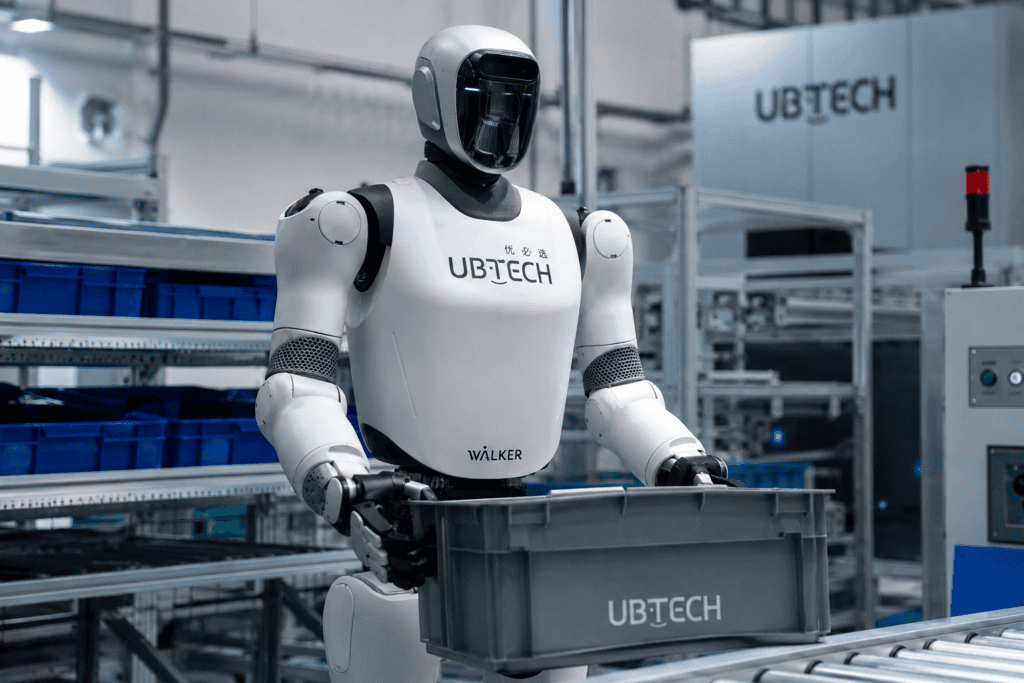
Legacy systems like the Walker X originally targeted commercial and home environments, whereas the current focus centers on industrial-grade hardware—specifically the UBTECH humanoid robot Walker S series (Walker S, Walker S1, and Walker S2). These newer iterations are explicitly built to integrate into smart factories for tasks such as
- Component sorting,
- Quality inspection,
- Material handling, and
- Assembly line support.
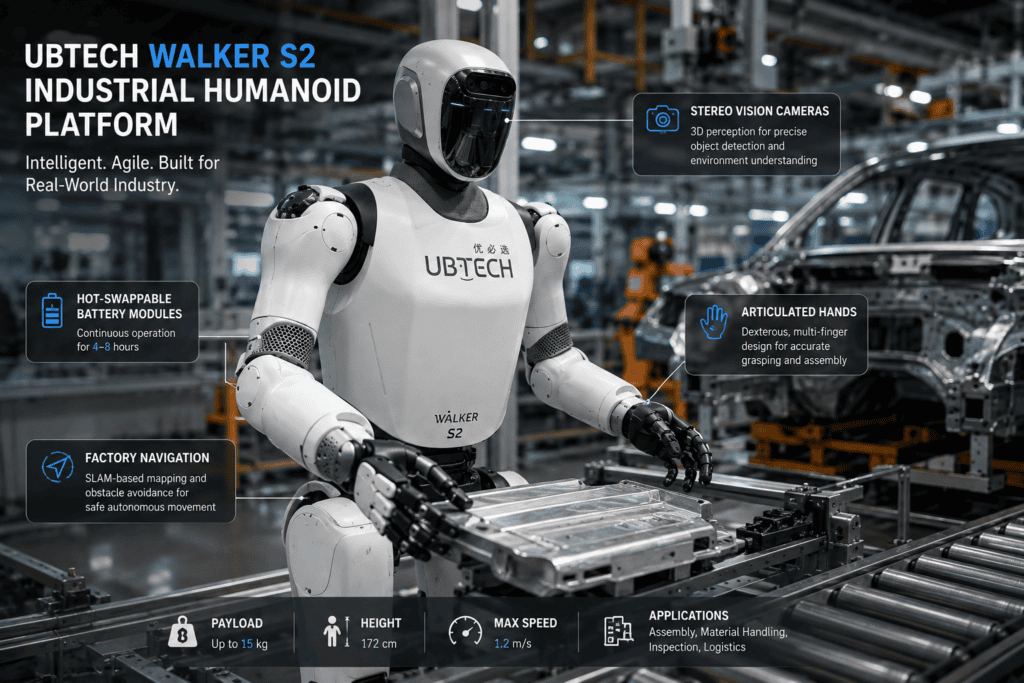
From a technical architecture standpoint, every UBTECH humanoid robot relies on tight hardware-software integration. Key physical components include
- High-torque articulated servo motors,
- Force-torque sensing actuators,
- Binocular stereo vision, and
- Multi-DOF dexterous hands engineered for fine spatial manipulation.
On the software side, the UBTECH humanoid robot leverages multimodal AI models, autonomous navigation stacks, and real-time motion planning algorithms to adapt to dynamic environments. Despite high-profile pilot deployments with major automotive manufacturers like NIO and BYD, these implementations operate within defined operational boundaries.
Staged workplace demonstrations should not be conflated with fully generalizable, human-level autonomy. Practical viability for any UBTECH humanoid robot remains tightly bound to real-world battery endurance, long-term mechanical reliability, unit economics, workplace safety validation, and integration with existing warehouse control systems.
Editorial Note: This analysis evaluates the UBTECH humanoid robot ecosystem from a global, objective perspective, maintaining a deliberate distinction between vendor product claims and independently verified enterprise deployment data. Information updated as of August 20, 2026.
The official video above shows the mass deployment and operational capabilities of UBTECH’s Walker S2 humanoid robot on factory floors.
UBTECH Robotics: Corporate Profile, AI Integration, and Technical Architecture
UBTECH Robotics (HKEX: 9880) is a global manufacturer specializing in humanoid robotics, AI-driven service systems, and smart education platforms. Headquartered in Shenzhen, China, the company operates across industrial, commercial, research, and consumer sectors.
Corporate and Commercial Background
Founded in March 2012, UBTECH completed its initial public offering on the Main Board of the Hong Kong Stock Exchange on December 29, 2023. Originally known for educational STEM kits and small desktop bipedal units, the company expanded into full-scale industrial humanoids (Walker S series) deployed in smart automotive factories (e.g., NIO, BYD), alongside consumer-facing bionic humanoids (such as the UWORLD U1 platform).
┌─────────────────────────────────────────────────────────┐
│                    UBTECH Ecosystem                     │
├───────────────────┬───────────────────┬─────────────────┤
│ Industrial Units  │ Consumer/Bionic   │  Software & AI  │
│  (Walker S / S1)  │ (UWORLD U1 Series)│ (Thinker Engine)│
└───────────────────┴───────────────────┴─────────────────┘
Embodied AI and Strategic Value
Unlike pure software large language models (LLMs) that process text or pixel data in isolation, UBTECH focuses on Embodied AI. The core premise connects digital reasoning to physical actuation in real-time environments:
- Sensing & Perception: Processing visual, spatial, and tactile telemetry.
- Kinematic Planning: Translating multi-modal inputs into dynamic joint control and spatial orientation.
- Real-World Execution: Balancing payload manipulation, locomotion, and obstacle recovery against physical constraints.
The Full-Stack Technology System
UBTECH’s internal architecture spans hardware components to multi-agent decision systems:
| Layer | Functional Scope | Primary Technologies |
| Actuation & Hardware | Physical joint movements and structural balance | High-torque servo actuators, dexterous end-effectors, biomimetic framing. |
| Sensing & Vision | Real-world mapping and spatial awareness | Stereo camera vision, force-torque sensors, tactile arrays. |
| Motion & Balance | Dynamic walking, posture adjustment, and stabilization | Closed-loop zero-moment point (ZMP) algorithms, trajectory optimization. |
| Task Decision Systems | High-level reasoning and physical trajectory execution | Proprietary models (Thinker, Thinker-VLA, Thinker-WM). |
| Interaction Software | Human-robot engagement and fleet orchestration | BrainNet & Co-Agent development framework. |
Note: Vendor-reported proprietary models (e.g., Thinker-VLA, Co-Agent) represent official technical specifications rather than third-party benchmark evaluations.
Technical Constraints
Deploying full-size humanoid units in non-simulated real-world settings faces persistent engineering bottlenecks:
- Power & Thermal Management: Operational runtimes typically remain capped between 2 to 4 hours under dynamic loads.
- Determinism vs. Flexibility: Balancing edge-computed local inference against dynamic, unpredictable floor environments.
- Capital Cost & ROI: Unit economics require structural cost reductions in high-precision servos and harmonic drive gearboxes to hit mass-market viability.
Which Walker robot is it?
The UBTECH humanoid robot portfolio consists of distinct hardware generations engineered for specific operational environments. Mixing specs across models misrepresents their actual mechanical capabilities.
Below is the structured breakdown of published specifications by model:
| Model | Primary Target | Height / Weight | Degrees of Freedom (DoF) | Key Performance Characteristics |
| Walker (Original) | Home & Office Service | 145 cm / 77 kg | 36 DoF | 1.5 kg extended single-arm load, ~2 hours battery runtime. |
| Walker X | Commercial Service | 130 cm / 63 kg | 41 DoF | Up to 3 km/h walking speed, self-balancing on irregular terrain, ~2 hours runtime. |
| Walker C | Commercial / Exhibition Guide | 163 cm / 43 kg | 20 DoF | Lightweight frame, up to 6 km/h running speed, obstacle avoidance. |
| Walker TienKung | Research & Academia | 172 cm / 73 kg | 42 DoF | Full-size open-source platform, up to 10 km/h sprinting, dual-battery design. |
| Walker S | Industrial / Smart Manufacturing | 170 cm / 77 kg | 41 DoF | 15 kg payload, force-feedback joint control, MES factory integration. |
| Walker S1 | Industrial Line Operations | 172 cm / 76 kg | 41 DoF | 15 kg payload, bionic 7-DoF arms, deep learning visual quality inspection (99%+ accuracy). |
| Walker S2 | Advanced Industrial Automation | 176 cm / 43–73 kg | 52 DoF | Autonomous 3-minute hot-swap battery system, 15 kg payload, ±162° waist pitch/rotation. |
Key Distinctions
- Payload & Force: Industrial units (Walker S, S1, and S2) feature a 15 kg payload capacity with force-feedback joints to handle heavy components on automotive assembly lines. In contrast, earlier commercial/service variants (Walker, Walker X) carry lighter arm payloads (1.5 kg single-arm) designed for non-industrial tasks.
- Autonomous Power: Continuous 24/7 manufacturing operations are exclusive to the Walker S2, which introduces an autonomous battery-swapping mechanism to eliminate charging downtime.
- Research Openness: Walker TienKung provides low-level API/ROS2 access specifically configured for algorithm training and university robotics labs, unlike locked commercial units.
UBTECH Humanoid Robot: Walker vs. Walker X Architectural & Operational Analysis
The original Walker and Walker X platforms represent UBTECH’s foundation in general service robotics. Designed to bridge smart-home management and commercial assistance, these platforms establish the primary hardware/software baselines prior to UBTECH’s industrial pivot.
Key Technical Specifications
| Parameter / Feature | Original Walker | Walker X |
| Primary Domain | Residential & Office Environments | Commercial Service & Showrooms |
| Height / Weight | 145 cm / 77 kg | 130 cm / 63 kg |
| Total Joint DoF | 36 DoF (Legs 6×2, Arms 7×2, Hands 4×2, Neck 2) | 41 DoF (Legs 6×2, Arms 7×2, Hands 6×2, Neck 3) |
| Locomotion & Terrain | Smooth surface gait, flat-floor navigation | 3 km/h max speed; handles 20° slopes & 15 cm stairs |
| Vision & Sensing | U-SLAM, stereo optical, depth sensing | Four-eye system, dual RGB-D, fine localization (1 cm) |
| Payload Capacity | 1.5 kg extended single-arm load | 1.5 kg extended single-arm (10 kg standing total) |
| Power System | 54.6V Lithium Iron Phosphate (2-hour runtime) | 54.6V Lithium Ion (2-hour runtime, removable pack) |
Capabilities and Operational Boundaries
                 ┌─────────────────────────────────────────────────┐
                 │          Perception & Task Execution            │
                 └────────────────────────┬────────────────────────┘
                                          │
                  ┌───────────────────────┴───────────────────────┐
                  ▼                                               ▼
      Structured Execution                            Unstructured Limitations
┌──────────────────────────────┐                ┌───────────────────────────────────┐
│ • Fixed-route U-SLAM motion  │                │ • Dynamic obstacle collision      │
│ • Preset smart home control  │     VS.        │ • Complex kinematic edge-cases    │
│ • Known object manipulation  │                │ • Variable lighting/surface drift │
└──────────────────────────────┘                └───────────────────────────────────┘
- Targeted Strengths: Highly reliable in controlled environments with predictable lighting, mapped pathways, and standard physical interfaces (e.g., pouring drinks, pushing cart levers, navigating trade show booths).
- Real-World Constraints: Both models operate under hard hardware boundaries. Their 1.5 kg single-arm extended load limits heavy physical labor, while their 2-hour battery lifecycle requires scheduled dock returns. In unstructured real-world settings, unforeseen spatial clutter or complex dynamic human interactions can degrade local motion planning.
UBTECH Humanoid Robot: Walker S Industrial Evolution and Real-World Factory Deployment
The UBTECH humanoid robot Walker S series represents a fundamental strategic pivot from general commercial service toward brownfield factory automation. Built on the design premise that human-form robots can seamlessly integrate into pre-existing human infrastructure—such as narrow aisles, conveyer lines, and standard workstations—without requiring capital-intensive factory retooling, the S series targets direct labor-replacement tasks across automotive manufacturing and smart logistics.
Core Industrial Applications
UBTECH structures the Walker S series around broad industrial capability sets:
┌─────────────────────────────────────────────────────────────────────────┐
│                    Walker S Industrial Application Architecture          │
├───────────────────────┬────────────────────────┬────────────────────────┤
│ Logistics & Logistics │ Quality & Inspection   │ Fine Assembly          │
├───────────────────────┼────────────────────────┼────────────────────────┤
│ • Material Handling   │ • Visual QA (99%+ acc) │ • Screwing & Bolting   │
│ • SPS Parts Sorting   │ • Label Verification   │ • Glass-Adhesive Glue  │
│ • AMR Fleet Collab    │ • Firmware Flashing    │ • Component Fitting    │
└───────────────────────┴────────────────────────┴────────────────────────┘
Evolutionary Breakdown: Walker S, S1, and S2
While earlier iterations established basic industrial task compatibility, the sequence of releases reflects progressive scaling toward continuous 24/7 manufacturing operations:
| Feature / Model | Walker S | Walker S1 | Walker S2 |
| Primary Focus | Early Factory Pilots | Multi-Task Line Operations | Continuous Mass-Production Assembly |
| Kinematic Degrees of Freedom | 41 DoF | 41 DoF | 52 DoF (Dual-arm 22 DoF, ±162° waist pitch/yaw) |
| Payload Capacity | 15 kg | 15 kg (7-DoF bionic arms) | 15 kg (25 kg dual-hand box positioning) |
| Power Management | Dock-based charging | Cable/Station charging | Autonomous 3-minute self-battery swap |
| Factory Systems Integration | Basic ROS2 / MES | Deep Learning QA / MES | BrainNet 2.0 / Co-Agent multi-fleet orchestration |
Walker S2 Execution and Enterprise Deployment
The UBTECH humanoid robot Walker S2 represents the definitive flagship for commercialization. Entering mass production and shipment in November 2025, the S2 directly solves the primary limitation of industrial robotics—downtime—via an autonomous dual-arm battery swap mechanism requiring zero human intervention.
- Autonomous Battery Swapping: The robot self-executes a 3-minute hot-swap of its dual battery packs using integrated station chargers, achieving near 24/7 continuous operation.
- High-Flexibility Waist Joint: A multi-axis waist mechanism with a 170° pitch angle allows the unit to bend to floor level and retrieve dropped components without requiring leg readjustment.
- Commercial Momentum: Deployed across major manufacturing lines including BYD, NIO, Geely, Foxconn, and Airbus, the S2 platform has generated over 1.4 billion RMB (~$190M USD) in cumulative factory order backlogs.
UBTECH Humanoid Robot: Architectural Execution & Operational Control Loop
A UBTECH humanoid robot operates via an integrated hardware-software architecture that executes a continuous perception–planning–action feedback loop. Rather than relying on simple pre-programmed routines, the platform converts sensor telemetry into dynamic kinematic adjustments to maintain balance and manipulate objects in real time.
┌─────────────────────────────────────────────────────────┐
│              Continuous Execution Closed-Loop           │
└────────────────────────────┬────────────────────────────┘
                             │
  ┌──────────────────────────┼──────────────────────────┐
  ▼                          ▼                          ▼
1. Perception            2. Decision               3. Actuation
• RGB Binocular Vision   • Co-Agent Task AI        • High-Torque Servos
• Force-Torque Sensors   • BrainNet 2.0 Fleet      • Whole-Body Dynamic
• Joint Encoders         • Trajectory Planning       Balance EngineCode language: CSS (css)
Core Operational Subsystems
- Vision & Spatial Perception: Industrial units like the Walker S2 use a head-mounted pure RGB binocular stereo-vision system. Deep-learning depth estimation algorithms generate real-time 3D spatial maps, allowing the unit to locate parts bins, verify component positions, and align end-effectors with sub-millimeter precision.
- Dynamic Gait & Whole-Body Balance: Locomotion relies on high-torque servo actuators coupled with whole-body dynamic balancing algorithms. The Walker S2 can adjust its center of mass across a 170° torso pitch angle while managing payloads up to 15 kg across a 0–1.8 m vertical reach.
- Dexterous Manipulation: Manipulators feature up to 7 DoF per arm and 11 DoF 4th-generation dexterous hands. Integrated force feedback limits grip force during sensitive assembly operations, such as applying labels, inserting cables, or tightening bolts.
- Fleet Autonomy & Task Orchestration: The platform runs on a dual-loop AI architecture combining BrainNet 2.0 (cloud-level swarm orchestration) and Co-Agent (on-device embodied inference). This framework enables multi-robot fleet management, letting individual units interpret task orders, navigate around dynamic floor obstacles, and handle localized edge-case errors autonomously.
- Hot-Swappable Power Architecture: To bypass the 2-hour battery limit of traditional humanoid designs, the Walker S2 utilizes an autonomous 3-minute dual-battery hot-swap system. The robot navigates to a charging station and replaces its own power pack using its dexterous hands to maintain continuous 24/7 manufacturing operations.
UBTECH Humanoid Robot: Walker S2 Specifications and Empirical Evaluation
The specifications associated with the UBTECH humanoid robot Walker S2 delineate vendor claims against empirical observations.
Walker S2 Consolidated Technical Profile
| Technical Domain | Official UBTECH Claim | Third-Party / Integrator Listings | Notes & Operational Context |
| Primary Domain | Smart Manufacturing & Logistics | Factory Assembly / Automotive Lines | Deployed in NIO, BYD, and Airbus facilities. |
| Height / Stature | Not listed on primary page | 1.76 m (176 cm) | Full-size human-scale industrial frame. |
| Operating Weight | Not listed on primary page | 43–73 kg (dry vs. dual battery) | Up to 95 kg gross shipping weight with protective framing. |
| Degrees of Freedom | Multi-axis dexterous manipulators | 52 DoF Total | Breakdown: Hands (22 DoF), Arms (14 DoF), Legs (12 DoF), Torso/Neck (4 DoF). |
| Payload Capacity | 15 kg dynamic workspace payload | 15 kg overall / 7 kg single-arm load | Rated across a 0–1.8 m vertical workspace envelope. |
| Waist Mobility | ±162° rotation & 170° pitch | ±162° waist pitch/yaw joint | Allows ground stooping/deep squats without foot repositioning. |
| Perception Stack | Pure RGB Binocular Stereo Vision | Dual RGB cameras + Wrist Force-Torque Sensors | Passive stereo depth estimation replacing heavy 3D LiDAR arrays. |
| Power Management | Dual-battery hot-swap system | < 3-minute self-battery swap | Enables 24/7 continuous shift operations. |
| Per-Pack Runtime | Dynamic power scaling | ~2 to 2.5 hours per dual pack | Varies based on payload weight and kinematic duty cycle. |
| AI & Software | BrainNet 2.0 & Co-Agent Systems | OPC-UA, MQTT, Siemens Teamcenter integration | Dual-loop task reasoning, exception handling, and fleet coordination. |
| Production Status | Mass production / Delivery: Nov 2025 | Verified deployment backlog | Scaled industrial manufacturing. |
Deployment Protocol and Acceptance Verification
Commercial integrators evaluating the UBTECH humanoid robot Walker S2 should distinguish between catalog listings and physical factory sign-offs:
- Procurement Rule: Third-party distributor datasheets often combine modular weights or vary baseline DoF metrics based on hand type (e.g., 2-finger grippers vs. 11-DoF tactile bionic hands). Official datasheets and SLA contracts must be requested directly from UBTECH.
- Factory Floor Testing: Performance claims—such as the 15 kg max payload capacity or the 3-minute autonomous battery swap—must be benchmarked against specific site variables, including ambient light interference (for passive RGB vision), conveyor belt vibration, and local safety fence boundaries.
UBTECH Humanoid Robot Capabilities: Deployments and Technical Realities
While general-purpose consumer humanoid assistants remain an industry aspiration, the UBTECH humanoid robot landscape is defined by domain-specific industrial execution. The strongest documented use cases for platforms like the Walker S, S1, and S2 focus on structured manufacturing, logistics, and controlled public services rather than unpredictable household environments.
Primary Enterprise Deployments
UBTECH’s commercial operations rely heavily on partnerships with major automotive manufacturers, electronics assembly plants, and public infrastructure:
| Partner / Client | Deployed Platform | Targeted Tasks & Operational Scope |
| NIO | Walker S | Direct assembly-line co-working, door latch testing, headlight cover inspections, and emblem application. |
| BYD | Walker S1 / Walker S2 | Material handling, tote movement, and fleet coordination alongside Autonomous Mobile Robots (AMRs). |
| Geely / Zeekr | Walker S Lite | Parcel-tote sorting, warehouse staging, and multi-robot collaborative training programs. |
| FAW-Volkswagen | Walker S Lite / Walker S2 | Deep-learning visual quality assurance, surface-defect verification, and line feeding. |
| Foxconn | Walker S2 | Parts feeding, automated assembly component tray transfers, and warehouse logistics integration. |
| SANY Renewable Energy | Walker S2 | Heavy assembly tasks including bolt sorting, bolt-sleeve removal, and precision tray placement. |
| Fangchenggang Border Crossings | Walker S2 | Patrol duties, traveler guidance, and logistics inspections (part of a ¥264M public sector deployment). |
What the Robots Can and Cannot Do
┌─────────────────────────────────────────────────────────┐
│                 Commercial Capability Bound             │
└────────────────────────────┬────────────────────────────┘
                             │
  ┌──────────────────────────┴──────────────────────────┐
  ▼                                                     ▼
PROVEN CAPABILITIES                               REAL-WORLD BOUNDARIES
• Repeating trained industrial routes             • Fully autonomous zero-margin work
• Handling rigid components (up to 15 kg)          • Unstructured domestic chores
• Self-swapping batteries (Walker S2)      • Handling deformable objects (textiles)
• 99%+ visual quality inspection accuracy • Eliminating human oversight completelyCode language: PHP (php)- Validated Capabilities: Within mapped automotive plants and logistics bays, the UBTECH humanoid robot effectively automates repetitive, physically demanding tasks like bolt-tightening, defect scanning, and tote loading. The Walker S2 eliminates charging downtime using a 3-minute self-battery swap.
- Current Operational Boundaries: These deployments consist of structured pilots and targeted line assignments. They do not demonstrate fully generalizable, human-level reasoning. Unstructured environments, unpredictable human interference, and complex non-rigid materials (such as flexible wiring or fabrics) remain significant engineering hurdles.
UBTECH Humanoid Robot: Bridging Stage Demonstrations and Factory Reality
Evaluating a UBTECH humanoid robot requires clear boundaries between scripted product reveals and verified operational deployments. Because humanoid platforms integrate locomotion, vision, manipulation, and continuous power management, a single subsystem failure stops the entire task loop.
Framework for Evaluating Humanoid Readiness
┌─────────────────────────────────────────────────────────┐
│                 Levels of Technical Evidence             │
└────────────────────────────┬────────────────────────────┘
                             │
 ┌────────────────┬──────────┴───────┬────────────────┐
 ▼                ▼                  ▼                ▼
Level 1          Level 2            Level 3          Level 4
Promotional      Pilot / Training   Production Line  Large-Scale
Demos            Programs           Deployment       Commercial
(Scripted)       (Feasibility)      (Targeted Tasks) (Continuous Operational
Scalability)| Level of Evidence | Proven Capabilities | Technical Limitations / Unproven Metrics |
| Level 1: Promotional Demos | Visual movement execution under strictly controlled lighting and terrain. | Zero proof of hardware durability, economic viability, or edge-case recovery. |
| Level 2: Pilot Programs | Initial task compatibility within operating sites (e.g., Geely parcel sorting). | Non-continuous runtimes; high human oversight and manual intervention rates. |
| Level 3: Production Deployment | Execution of structured, repeating tasks (e.g., Walker S2 hot-swap logistics at BYD/NIO). | Limited to rigid workflows; low adaptability to unstructured floor layout shifts. |
| Level 4: Large-Scale Commercial | Full multi-shift integration with high Mean Time Between Failures (MTBF). | Current Industry Boundary: Scaled fleets (5,000+ units globally) are emerging, but total assembly line replacement remains unproven. |
Procurement SLA Checklist
For enterprise operations evaluating the UBTECH humanoid robot Walker S2 for physical line integration, request vendor sign-offs on the following SLA metrics:
- Cycle Time & Variance: Exact station task-completion timing (e.g., seconds per bolt torqued) and acceptable error margins.
- Task Success & Recovery: Unattended success rate over 10,000 continuous cycles, including self-recovery behavior when vision or grip orientation fails.
- Actuator & Servo MTBF: Joint motor and harmonic drive mean time between failures (industrial baseline requires >40,000 operational hours).
- Power Duty-Cycle Efficiency: True battery drain rates under max dynamic payload (15 kg) compared against the <3-minute autonomous hot-swap routine.
- System Interoperability: Certified latency standards for interfacing with Programmable Logic Controllers (PLCs), Manufacturing Execution Systems (MES), and Fleet AMRs.
- Safety & Regulatory Compliance: ISO/TS 15066 collaborative robot safety standards, dynamic zone stopping, and emergency power-kill response times.
- Supply Chain & Servicing: On-site spare-parts lead times (e.g., replacement for 11-DoF dexterous hands) and remote telemetry data governance.
UBTECH Humanoid Robot: Strategic Value Drivers vs. Technical Constraints
The integration of UBTECH humanoid robots into commercial workflows represents a balance between physical versatility and mechanical complexity. Evaluating these platforms requires weighing their structural flexibility against their current operational trade-offs.
Strengths & Technical Advantages
- Infrastructure Backwards-Compatibility: Bipedal platforms like the Walker S2 leverage brownfield manufacturing environments—navigating human-scale walkways, reaching standard shelving heights (0–1.8 m), and interacting with tools without facility redesigns.
- Continuous Industrial Duty-Cycle: The Walker S2’s autonomous 3-minute self-battery swap mechanism solves power downtime, allowing continuous multi-shift operations without traditional docking delays.
- Integrated Sensing & Perception: Built-in RGB binocular stereo-vision systems perform spatial depth mapping, part inspection (99%+ accuracy), and manipulation alignment without requiring external line-of-sight tracking cameras.
- Enterprise AI & Fleet Orchestration: The dual-loop BrainNet 2.0 and Co-Agent framework allows central systems to assign higher-level natural language or MES tasks while localized on-device agents handle path adjustments and error recovery.
- Diverse Market Segmentation: UBTECH maintains active hardware platforms across distinct sectors—spanning industrial manufacturing (Walker S series), commercial service (Walker X), and academic research (Walker TienKung).
Limitations & Trade-Offs
┌─────────────────────────────────────────────────────────┐
│               Humanoid vs. Specialized Automation       │
└────────────────────────────┬────────────────────────────┘
                             │
  ┌──────────────────────────┴──────────────────────────┐
  ▼                                                     ▼
UBTECH HUMANOID (WALKER S)              SPECIALIZED ALTERNATIVE
• High flexibility, variable layout      • High throughput, lower unit cost
• Higher energy draw (bipedal locomotion)• High energy efficiency (wheeled AMRs)
• Complex mechanical maintenance (52 DoF)• Simple mechanical profile (Fixed Arms)- Kinematic & Mechanical Complexity: With up to 52 degrees of freedom, the system presents multiple structural failure points, requiring strict maintenance protocols for high-torque joint servos and harmonic drive components.
- Energy Draw Efficiency: Bipedal dynamic balancing consumes significantly more power per distance covered than wheeled Autonomous Mobile Robots (AMRs) operating on smooth concrete floors.
- Payload-to-Weight Ratio Constraints: Handling a 15 kg dynamic payload across a full 52-DoF posture requires precise balance calculations, capping heavy component transfers compared to fixed industrial cobots.
- Deployment Economics & ROI: In static, low-variance production environments, combining traditional AMRs with 6-axis fixed robotic arms often delivers higher throughput at a lower total cost of ownership (TCO) than a general-purpose bipedal unit.
Strategic Synthesis: Selecting the Optimal Automation Form Factor
                             ┌───────────────────────────────┐
                             │    Is the workplace layout    │
                             │  fixed & optimized for machines?
                             └───────────────┬───────────────┘
                                             │
                      ┌──────────────────────┴──────────────────────┐
                      ▼                                             ▼
                     YES                                            NO
      ┌───────────────────────────────┐             ┌───────────────────────────────┐
      │  Is task variation low and    │             │  Does the task require high   │
      │   throughput speed critical?  │             │   human-like joint reach &    │
      └───────────────┬───────────────┘             │     spatial reconfiguration?  │
                      │                             └───────────────┬───────────────┘
          ┌───────────┴───────────┐                                 │
          ▼                       ▼                                 ▼
         YES                     NO                                YES
┌───────────────────┐   ┌───────────────────┐             ┌───────────────────┐
│  Use Fixed Arms / │   │    Use Wheeled    │             │ Deploy UBTECH     │
│ Converters / PLCs │   │  AMRs + Cobots    │             │ Walker S Series   │
└───────────────────┘   └───────────────────┘             └───────────────────┘
Commercial Availability & Pricing Reality
While mass production of the UBTECH humanoid robot Walker S2 began in late 2025, the platform operates strictly as B2B enterprise infrastructure rather than an off-the-shelf retail product.
- Pricing Transparency: UBTECH does not publish standard list prices for the Walker S series. Financial filings indicate an implied revenue proxy of ~$106,000 USD (¥760,000 RMB) per unit delivered across full-stack corporate contracts. Unverified third-party directory listings range from $80,000 to $180,000+ USD depending on end-effector configurations, charging stations, and software licensing.
- Procurement Channels: Engagements are structured via enterprise direct purchasing, government/industrial tenders, or customized Robots-as-a-Service (RaaS) leasing models.
Global Procurement & Operational Checklist (Nigeria & Emerging Markets)
Deploying a UBTECH humanoid robot outside China introduces distinct operational and regulatory dependencies that must be resolved prior to capital commitment:
- Distributor & Technical Integrator Presence: Verify whether UBTECH maintains certified local system integrators to handle physical deployment, or if engineers must be flown in from regional hubs.
- Power Quality & Charging Station Infrastructure: The Walker S2’s 3-minute autonomous battery swap mechanism requires stable, high-capacity charging docks and localized surge protection to safeguard high-density lithium power modules.
- Hazardous Goods Shipping: Replacement lithium-ion battery packs face strict UN 3480/3481 class-9 air and maritime freight regulations, impacting emergency replacement timelines.
- Spares & Actuator Supply Chains: Confirm SLA lead times for mission-critical hardware—specifically high-torque harmonic-drive joint servos, 11-DoF dexterous hand components, and wrist force-torque sensors.
- Data Sovereignty & Edge Compute: Determine whether the BrainNet 2.0 and Co-Agent dual-loop AI systems require cloud connectivity to overseas servers, ensuring compliance with local data privacy frameworks (e.g., NDPR in Nigeria).
- Workplace Safety & Standards Compliance: Assess regional electrical safety certifications, machine-guarding regulations, and ISO/TS 15066 collaborative robot requirements for human-robot co-working environments.
Career Impact: Task Automation vs. Core Occupations
The introduction of platforms like the UBTECH Walker S series automates specific, narrow tasks rather than instantly eliminating complete job titles. In automotive assembly and logistics, deployment targets repetitive, structured physical labor—such as tote handling, visual quality checking, tray transferring, and bolt tightening—where cycle times and error rates can be tightly controlled.
Tasks involving complex physical improvisation, unstructured environments, high-stakes human interaction, and ambiguous decision-making remain resistant to full automation.
High-Leverage Skill Matrix for Embodied AI & Robotics
To build scalable, future-proof expertise in the humanoid robotics ecosystem, focus on cross-disciplinary domains that bridge hardware control, simulation, software middleware, and factory integration.
┌─────────────────────────────────────────────────────────┐
│              Embodied AI Skill Stack                    │
└────────────────────────────┬────────────────────────────┘
                             │
  ┌──────────────────────────┼──────────────────────────┐
  ▼                          ▼                          ▼
1. Core Systems         2. Intelligence            3. Deployment
• C++ / Python           • ROS 2 Middleware         • Digital Twins (Isaac Sim)
• Physics / Control      • Computer Vision / SLAM   • Fleet Orchestration
• Kinematics & Servos • Reinforcement Learning • PLC / MES Integration| Skill Domain | Technical Focus | Core Frameworks & Tools |
| Robotics Middleware | Distributed system architecture, node communication, sensor message passing | ROS 2 (Humble/Jazzy), DDS, Micro-ROS |
| Simulation & Digital Twins | High-fidelity sim-to-real testing, kinematic validation, synthetic data generation | NVIDIA Isaac Sim, Gazebo, MuJoCo |
| Vision & Perception | 3D depth estimation, spatial mapping, visual defect inspection, object pose estimation | OpenCV, Point Cloud Library (PCL), PyTorch |
| Control Systems & Kinematics | Bipedal dynamic balancing, inverse kinematics, trajectory optimization, force feedback | Drake, Pinocchio, MoveIt 2 |
| Embodied Machine Learning | Task planning, imitation learning, vision-language-action (VLA) models | Isaac Lab, Stable-Baselines3, Transformers |
| Enterprise Interoperability | Connecting humanoids to factory infrastructure, logistics databases, and AMRs | PLC (Siemens/Beckhoff), OPC-UA, MQTT, WMS/MES |
Practical Skill-Building Roadmap
For engineers, developers, and technical professionals looking to build high-signal portfolio assets in embodied AI:
- Master the Foundation: Develop strong command over Linux (Ubuntu), C++17/20, and modern Python. Understand basic control theory (PID, LQR, Model Predictive Control) and rigid-body dynamics.
- Learn ROS 2 & Simulation: Build modular ROS 2 nodes to control a simulated robot arm or bipedal chassis in NVIDIA Isaac Sim or MuJoCo.
- Integrate Vision & Planning: Connect a simulated depth camera node to a vision algorithm (e.g., detecting an object, calculating its 3D spatial coordinates, and executing a collision-free grasp path).
- Build a End-to-End Portfolio Asset: Construct a full-stack project featuring a simulated robot executing a pick-and-place loop, integrated with a local web dashboard monitoring real-time joint states, errors, and task metrics.
Is UBTECH the name of one robot?
No. UBTECH (UBTECH Robotics) is the parent technology company, while Walker is its primary line of industrial and service humanoid robots. The Walker family spans specialized models engineered for distinct environments—including the Walker, Walker X, Walker C, Walker TienKung, Walker S1, and Walker S2.
Is Walker S2 fully autonomous?
No. While UBTECH equips the Walker S2 with autonomous battery swapping and AI-driven task planning (via its BrainNet 2.0 and Co-Agent architecture), “autonomy” is strictly domain- and task-dependent.
The unit executes pre-mapped tasks autonomously within structured factory environments, but requires teleoperation, human supervision, or operator overrides when encountering unexpected obstacles, uncalibrated orientations, or edge-case mechanical failures.
Can Walker replace factory workers?
It automates specific, high-repetition tasks (e.g., component sorting, visual quality inspection, tote transfers, bolt tightening) rather than entire job titles. Industrial humanoids serve as collaborative tools alongside human workers, requiring ongoing human oversight, facility system integration, safety guarding, and task-specific maintenance.
Can it work continuously for 24 hours?
While the Walker S2’s autonomous <3-minute dual-battery hot-swap system eliminates charging downtime, achieving true 24/7 continuous operation depends on system-level factors.
Real-world uptime is governed by battery degradation cycles, preventive maintenance schedules, thermal management, software stability, and facility safety protocols.
How much does a UBTECH humanoid robot cost?
UBTECH does not publish fixed off-the-shelf consumer list prices for its industrial Walker series. Based on enterprise filings and commercial distributor integrations, direct purchase pricing for an industrial Walker S2 ranges between $100,000 and $180,000 USD, depending on configuration, dexterous end-effectors, and technical support SLAs. Robots-as-a-Service (RaaS) enterprise leasing options generally start around $5,000 USD/month.
Note for consumer models: UBTECH’s residential bionic line, the UWORLD U1 Series, ranges from $17,600 USD (U1 Lite semi-torso) to $145,800 USD (U1 Ultra full-body model).
Is UBTECH Walker available for home use?
The Walker S series is strictly an enterprise industrial platform built for automotive factories and logistics bays. For household companionship and personal interaction, UBTECH offers the UWORLD U1 Series. Early-generation Walker service models remain limited to specialized commercial pilots and research institutions.
In Conclusion
The UBTECH humanoid robot landscape is best understood not as a single machine, but as an evolving family of embodied-AI platforms designed across distinct operational domains.
While early Walker models focused on commercial service, navigation, and human interaction, current industrial development centers on the Walker S series (S, S1, and S2) to address factory workflows like tote handling, quality inspection, sorting, and assembly line support.
The flagship Walker S2 represents UBTECH’s most concrete commercial push, offering a 15 kg dynamic payload, pure RGB stereo vision, integrated task-planning software, and an autonomous 3-minute self-battery-swapping system.
While these capabilities enable continuous shift operations in structured environments, the technology remains a domain-specific automation tool rather than a general-purpose, universal human substitute.
Phased Enterprise Implementation Framework
For organizations evaluating a UBTECH humanoid robot deployment, implementation should follow a risk-managed, pilot-first methodology:
- Select a Single High-Repeatability Target Task: Isolate a low-variance workflow before scaling.
Identify a specific, structured floor task—such as parcel tote transfer, parts sorting, or visual defect scanning—where parts, lighting, and spatial orientations are tightly controlled.
- Establish Operational SLA Metrics: Define mandatory baseline requirements before pilot launch.
Set explicit performance benchmarks for vendor verification, including station task-cycle time, minimum target uptime, mean time between failures (MTBF), and acceptable grasp error margins.
- Execute a Supervised Site Pilot: Validate edge-case handling under real workplace conditions.
Run a limited, supervised trial on the factory floor to evaluate real-world performance—focusing on autonomous recovery from failed grasps, local network latency, dynamic safety zone stops, and integration with existing MES or PLC networks.
- Calculate Total Cost of Ownership (TCO): Compare bipedal deployment economics against traditional automation.
Evaluate hardware leasing/purchase costs, software licensing, battery-swap station infrastructure, maintenance SLAs, and operator training against alternative setups (e.g., standard AMRs paired with fixed 6-axis cobots).