MLOps Courses for DevOps Engineers: 8 Free and Paid Options
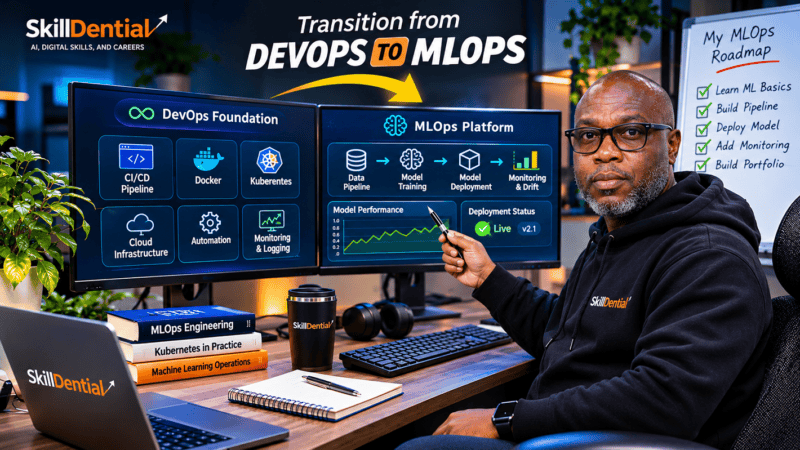
DevOps engineers can transition into MLOps by building on their existing knowledge of CI/CD, containers, cloud infrastructure, automation, and monitoring. Finding the right MLOps Courses for DevOps Engineers is essential for learning how to apply these skills to machine learning systems, including model deployment, experiment tracking, data pipelines, and production monitoring. Free resources are ideal for exploring the field, while paid programmes can offer structured learning, guided projects, and formal credentials.
If you already work in DevOps, Site Reliability Engineering (SRE), cloud engineering, or platform engineering, specialized MLOps Courses for DevOps Engineers can be a practical next specialisation. You do not need to abandon your existing expertise. Instead, you need to understand what changes when you deploy a machine learning model.
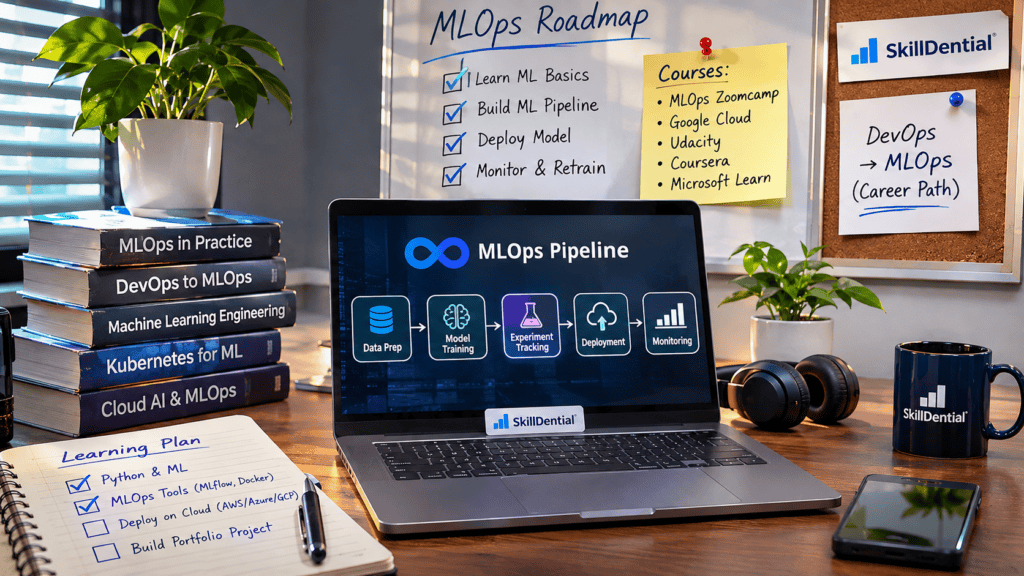
This guide compares free and paid MLOps Courses for DevOps Engineers, explains the skills you need, and outlines a practical learning path for moving into MLOps engineering.
What is MLOps, and Why Is It Relevant to DevOps Engineers?
MLOps (Machine Learning Operations) applies software engineering principles, automation, infrastructure management, and continuous delivery practices to the machine learning lifecycle. While traditional DevOps focuses on reliably building, testing, deploying, and operating deterministic software applications, MLOps extends these paradigms to systems where code behavior is dictated by data.
An ML model is not a standard application component. Its operational profile depends directly on training data, feature stores, model artifacts, and statistical performance metrics.
DevOps vs. MLOps: Core Differences
| Operational Dimension | Traditional DevOps | MLOps Extension |
| Source Control | Version code and configuration | Version code, datasets, features, and model artifacts |
| Pipelines | CI/CD (Continuous Integration / Continuous Delivery) | CI/CD + CT (Continuous Training) |
| Packaging | Containerize application code and dependencies | Containerize model-serving environments and runtime dependencies |
| Infrastructure | Provision reproducible application infrastructure | Provision reproducible ML infrastructure (GPUs, feature stores, inference endpoints) |
| Monitoring | Monitor uptime, latency, error rates, and resource utilization | Monitor system health plus model drift, data drift, and statistical accuracy |
| Lifecycle & Rollbacks | Manage software version releases and rollbacks | Manage model validation, canary rollouts, shadow deployments, and rollbacks |
The Paradigm Shift: Silent Failure vs. System Crashes
The critical distinction for DevOps engineers entering this space is that an ML system can remain 100% technically available while producing catastrophically incorrect outputs.
- Standard DevOps Failure: A service crashes, throws HTTP 500 errors, or drops connections. The failure is explicit and immediately flagged by standard monitoring.
- MLOps Failure: A fraud-detection model remains fully operational, returning responses with low latency. However, shifts in consumer behavior have introduced data drift, causing the model’s predictive accuracy to plummet.
An MLOps engineer is responsible for solving this silent failure class—ensuring statistical reliability alongside infrastructure uptime.
Why DevOps Engineers Have a Competitive Advantage in MLOps
DevOps engineers already command the operational foundations that form the backbone of MLOps. Rather than starting from scratch, you likely possess daily fluency in core production systems:
- CI/CD Pipelines: Building and maintaining automated build, test, and release workflows.
- Containerization: Packaging applications and runtime dependencies using Docker.
- Orchestration: Deploying and scaling workloads using Kubernetes.
- Infrastructure as Code (IaC): Provisioning reproducible cloud environments using Terraform or Pulumi.
- Observability: Configuring comprehensive monitoring, alerting, and logging infrastructure.
- Security & Governance: Managing secrets, identity and access management (IAM), and production environment boundaries.
These competencies transfer directly to machine learning infrastructure, model registry management, and high-performance inference endpoints.
The Real Learning Curve: Crossing the Chasm
The challenge for a DevOps professional is not operational—it is contextual. You do not need to become an advanced ML researcher or design novel neural network architectures from scratch. However, you must understand the domain-specific artifacts you are moving down the pipeline:
- Model Artifacts & Formats: Understanding what a serialized model (
.pkl,.onnx,.pt,.h5) actually contains and how it interacts with memory and hardware (CPU vs. GPU acceleration). - Data Dependencies: Recognizing that ML systems require data versioning (analogous to code versioning) via tools like DVC or feature stores.
- Evaluation Metrics: Knowing that success isn’t just an HTTP 200 OK status; it requires tracking domain-specific metrics like F1-score, accuracy, precision, and recall.
- Inference Patterns: Managing real-time REST/gRPC endpoints versus high-throughput batch inference pipelines.
By leveraging your existing infrastructure expertise and pairing it with an understanding of the ML lifecycle, you can bridge the gap between data science experimentation and production reliability.
What Skills Do DevOps Engineers Need to Learn?
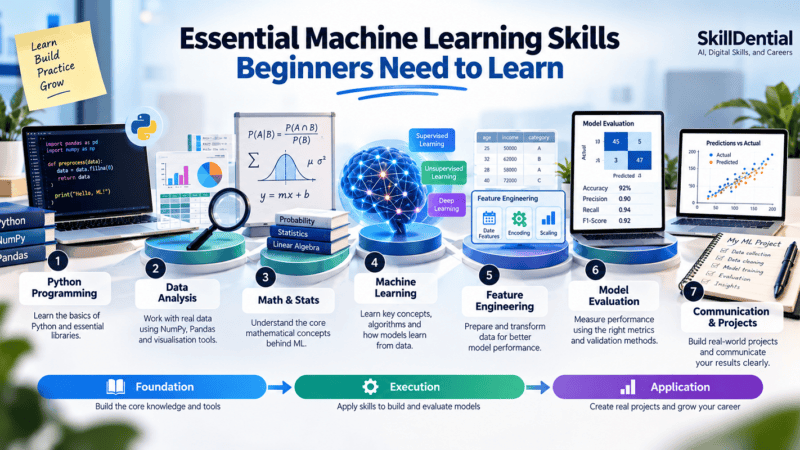
Transitioning into MLOps requires bridging traditional infrastructure operations with the unique behavioral constraints of data-driven systems. The highest-leverage learning path combines core machine learning fundamentals with production-grade engineering rigor.
Python & Machine Learning Fundamentals
While infrastructure-as-code relies heavily on YAML, HCL, and shell scripting, Python is the universal runtime of the machine learning ecosystem. To manage ML pipelines, you must become comfortable reading, writing, and debugging Python code.
You do not need an advanced mathematics background or a degree in data science to start. Instead, focus on the practical operational mechanics of machine learning:
- Python Scripting & Data Structures: Master core Python syntax, functions, and file handling.
- Data Manipulation Libraries: Gain fluency in NumPy (for high-performance numerical arrays) and pandas (for data cleaning and tabular manipulation).
- The Data Lifecycle: Understand how raw data is split into features (independent variables), labels (targets), and partitioned into training, validation, and test sets.
- Model Evaluation Metrics: Move beyond HTTP status codes to understand domain-specific performance indicators:
- Classification Metrics: Precision, recall, F1-score, and ROC-AUC.
- Regression Metrics: Mean Squared Error (MSE), Root Mean Squared Error (RMSE), and Mean Absolute Error (MAE).
The 80/20 Rule
Skip theoretical calculus and deep-dive algorithm design initially. Focus strictly on understanding the end-to-end feedback loop: ingesting data, executing training scripts, measuring model performance, and wrapping the output into an inference artifact.
Experiment Tracking & Model Management
Unlike traditional software where code changes are tracked exclusively via Git, machine learning experiments involve constantly shifting datasets, hyperparameters, algorithms, and model configurations. Comprehensive MLOps Courses for DevOps Engineers focus heavily on mastering the tools required to log, audit, and reproduce these variables.
When evaluating or selecting MLOps Courses for DevOps Engineers, ensure the curriculum covers these essential tracking and management pillars:
- Experiment Tracking: Logging parameters, metrics, and code versions using tools like MLflow or Weights & Biases to prevent “shadow model” confusion.
- Model Registries & Artifact Management: Managing serialized model binaries (
.pkl,.onnx,.pt), tracking metadata, and staging models for promotion (Staging vs. Production). - Dataset & Feature Versioning: Integrating data lineage tools (such as DVC or Feast) so you can tie a specific model artifact back to the exact dataset snapshot used to train it.
- Reproducibility: Ensuring that any historical training run can be faithfully re-executed across different infrastructure environments using Infrastructure as Code and containerization.
ML Pipelines & Workflow Orchestration
Unlike traditional software builds that compile source code into binaries, machine learning workflows require multi-stage pipelines that process data, train models, and validate performance before deployment. Top-tier MLOps Courses for DevOps Engineers emphasize mastering these complex directed acyclic graphs (DAGs) to automate the entire lifecycle.
A standard production ML pipeline consists of seven sequential, dependent stages:
- Data Ingestion: Pulling raw data from data lakes, operational databases, or streaming sources.
- Data Validation: Checking schemas, scanning for missing values, and detecting anomalies.
- Feature Preparation: Transforming raw variables, generating features, and populating feature stores.
- Model Training: Executing training code across compute nodes using defined hyperparameters.
- Model Evaluation: Testing model binaries against strict performance thresholds and validation sets.
- Model Registration: Pushing validated model artifacts, code snapshots, and performance metadata to a centralized registry.
- Model Deployment: Rolling out the model to inference endpoints using canary releases or blue-green strategies.
Where Your DevOps Background Shines
This is where your operational expertise becomes an immediate superpower. While data scientists build the logic for individual steps, your fluency in workflow orchestration and infrastructure management ensures these pipelines are bulletproof.
When evaluating MLOps Courses for DevOps Engineers, look for modules that leverage enterprise orchestration engines you likely already use or manage, such as Apache Airflow, Argo Workflows, Prefect, or Kubeflow Pipelines. Your core focus will be ensuring these multi-step pipelines execute reliably, scale across distributed clusters, recover gracefully from worker node failures, and pass artifacts securely between stages.
Model Serving & Deployment
Training a high-performing machine learning model is only half the battle; exposing it reliably to production traffic is where engineering excellence matters most. Comprehensive MLOps Courses for DevOps Engineers bridge the gap between static model binaries and scalable production services.
Because you likely already manage containerized microservices, this phase will feel familiar, though serving ML models introduces unique hardware (CPU/GPU) and memory constraints.
When searching for the right MLOps Courses for DevOps Engineers, ensure the syllabus covers these core serving and deployment competencies:
- Inference APIs & Frameworks: Building low-latency prediction endpoints using FastAPI, Flask, or high-throughput specialized runtimes like Triton Inference Server and TorchServe.
- Containerized Serving: Packaging model weights, runtime dependencies, and serving code securely inside Docker containers.
- Orchestration & Autoscaling: Deploying models onto Kubernetes clusters (using tools like KServe or Seldon Core) to handle dynamic traffic spikes.
- Advanced Traffic Management: Implementing canary releases, blue-green deployments, and shadow testing to safely roll out new model versions without user disruption.
- Robust Rollback Strategies: Automatically reverting to stable model endpoints if downstream error rates spike or inference latency degrades.
The Infrastructure Goal
The objective is to treat machine learning endpoints with the same rigorous reliability, observability, and scalability standards you apply to any critical enterprise microservice.
Model Monitoring & Drift Detection
Traditional observability focuses purely on system vitals: CPU utilization, memory thresholds, HTTP 500 error rates, and network latency. However, production machine learning systems introduce an entirely new category of silent failure that traditional Application Performance Monitoring (APM) tools cannot catch. Specialized MLOps Courses for DevOps Engineers teach you how to expand your observability stack to track statistical degradation.
When evaluating MLOps Courses for DevOps Engineers, look for deep coverage of the following monitoring pillars:
- Data Drift (Covariate Shift): Monitoring changes in the statistical distribution of incoming production data compared to the original training dataset (e.g., user purchasing habits shifting post-launch).
- Concept Drift: Tracking fundamental shifts in the relationship between input features and the target outcome (e.g., changing economic conditions making historical fraud indicators obsolete).
- Prediction Quality & Performance Metrics: Continuously measuring live model accuracy, precision, recall, and F1-score as ground truth labels become available downstream.
- Operational & Inference Latency: Tracking request response times, payload sizes, and queue lengths to ensure endpoints meet strict Service Level Agreements (SLAs).
- Data Quality Checks: Automatically scanning incoming inference payloads for missing values, malformed schemas, and out-of-bounds anomalies before they hit the model.
- Automated Retraining Triggers: Establishing event-driven pipelines that automatically flag degrading models, spin up training scripts with fresh data, and initiate staging evaluations without manual intervention.
The Observability Shift
As an MLOps practitioner, your monitoring dashboards must track both system health (is the container running?) and statistical health (is the model still accurate?).
Cloud-Based MLOps
Managing infrastructure from scratch is rarely required in modern production environments. Major cloud providers offer managed ecosystems designed to handle the heavy lifting of scaling, compute provisioning, and artifact storage.
When searching for comprehensive MLOps Courses for DevOps Engineers, look for programs that provide hands-on labs within your target cloud ecosystem. You do not need to master all three platforms simultaneously.
- The Rule of Proximity: If your current DevOps role relies on AWS, Azure, or Google Cloud, start with that ecosystem’s native machine learning suite. This minimizes the learning curve by letting you leverage your existing cloud IAM, networking, and Terraform expertise.
Cloud Platform MLOps Mapping
| Cloud Platform | Core MLOps & Managed Services | Relevant Learning Areas |
| Amazon Web Services (AWS) | Amazon SageMaker, SageMaker Pipelines, Model Monitor, EventBridge | Cloud-native model training, managed endpoints, automated retraining triggers, and enterprise security governance. |
| Microsoft Azure | Azure Machine Learning, Azure ML Studio, MLflow integration, GitHub Actions | End-to-end workspace management, native GitHub Actions CI/CD alignment, model registries, and robust drift detection. |
| Google Cloud Platform (GCP) | Vertex AI, Vertex Pipelines, Model Registry, BigQuery ML | Scalable pipeline orchestration, managed serverless endpoints, high-performance computing (GPUs/TPUs), and deep telemetry integration. |
Strategic Advice
Choose the platform that matches your organization’s production stack or the market demand in your target geography. Mastering the MLOps lifecycle mechanics on one cloud platform transfers seamlessly when moving to another.
Best Free MLOps Courses for DevOps Engineers
Free MLOps Courses for DevOps Engineers serve as an ideal starting point to explore the field, map traditional infrastructure concepts to machine learning systems, and build hands-on competency before investing in a structured paid programme. The following curated free resources are particularly valuable for engineers who already understand software delivery, containerization, and cloud infrastructure:
MLOps Zoomcamp — DataTalks.Club
- Cost: Free (Self-paced)
- Overview: A highly practical, hands-on curriculum covering production machine learning workflows, including experiment tracking, orchestration, deployment, and monitoring.
- Best For: DevOps and platform engineers who want to build a complete, end-to-end MLOps project for their portfolio.
- Prerequisites: Python, Docker, command-line basics, and introductory machine learning knowledge.
- Format & Structure: Available for self-paced study via open-source GitHub materials and pre-recorded YouTube lectures. (Live cohorts are not currently scheduled, meaning it operates entirely on a self-guided basis without formal cohort deadlines or peer-review certificates).
Made With ML
- Cost: Free (Open access learning materials)
- Overview: A premier practical curriculum focused on combining machine learning with software engineering principles to build, test, deploy, and iterate on production ML applications.
- Best For: Software, platform, and infrastructure engineers who want a code-first approach to production ML engineering.
- Prerequisites: Basic Python and introductory machine learning knowledge.
- Topics Covered: ML testing frameworks, code/data reproducibility, model serving APIs, automated CI/CD for ML, production monitoring, and data engineering fundamentals.
- Format & Structure: Self-paced online materials and code repositories provided by Anyscale, making it easy to integrate into your own schedule.
Operationalize Machine Learning Models — Microsoft Learn
- Cost: Free (Self-paced learning path)
- Overview: An official Azure-focused learning path designed specifically for operationalizing machine learning models using enterprise cloud tools.
- Best For: DevOps and cloud engineers whose infrastructure stacks or target career paths are built around Microsoft Azure.
- Prerequisites: Prior Python or R experience and foundational familiarity with machine learning development.
- Topics Covered: Integrating MLflow for experiment tracking, building automated ML pipelines, model registration, scalable deployment, production monitoring, and rollback strategies.
- Format & Structure: Self-paced modules provided directly via Microsoft Learn, estimated at approximately 5 hours and 44 minutes across seven structured modules.
MLOps: Getting Started — Google Cloud
- Cost: Free audit / Enrollment options available via Coursera (certificates may require payment)
- Overview: An introductory course focused on core MLOps principles and the specific toolsets required to operate machine learning systems on Google Cloud.
- Best For: DevOps and cloud engineers exploring Google Cloud Platform (GCP) and Vertex AI.
- Prerequisites: Basic understanding of cloud architecture and foundational machine learning concepts.
- Topics Covered: Machine learning CI/CD pipelines, cloud architecture for ML, repeatable training workflows, and scalable inference deployment.
- Format & Structure: Self-paced online modules hosted on Coursera, estimated at approximately four hours of total completion time.
Which Free Course Should You Start With?
For most DevOps engineers, the most efficient learning progression is to pair conceptual understanding with hands-on building:
- Start with Made With ML to bridge the gap between traditional software engineering and production machine learning engineering.
- Dive into MLOps Zoomcamp to build a comprehensive, end-to-end MLOps project for your portfolio.
- Complete the Microsoft Learn or Google Cloud path if your infrastructure stack or target employer relies heavily on Azure or GCP.
This sequence delivers both core foundational literacy and demonstrable project experience, allowing you to showcase practical engineering skills when applying for MLOps roles.
Best Paid MLOps Courses and Programmes
Paid MLOps courses can be valuable when you require a rigorous, highly structured curriculum, hands-on guided projects, direct instructor feedback, or a formal credential for career advancement.
However, paying for a programme does not automatically make it superior to top-tier free resources. Always evaluate the curriculum depth, project quality, mentor support, and direct relevance to your target infrastructure role before enrolling in any paid MLOps Courses for DevOps Engineers.
AI Ops Engineer Nanodegree — Udacity
- Cost: Paid subscription / Programme fee
- Overview: A structured, intermediate-level programme designed for professionals who want to expand beyond traditional MLOps into operationalizing large language models (LLMs) and autonomous AI agents.
- Best For: DevOps and platform engineers seeking a broader, future-proof AI operations specialization (LLMOps and AgentOps).
- Prerequisites: Intermediate programming experience, familiarity with Python, and basic cloud or container concepts.
- Topics Covered: Traditional MLOps pipelines, model deployment, drift monitoring, vector databases, LLM orchestration, and practical capstone projects.
- Format & Structure: Self-paced online learning estimated at approximately 66 hours, featuring interactive projects, mentor support, and a formal Udacity credential upon completion.
MLOps: Automated Pipelines and Model Monitoring — Udacity
- Cost: Paid course fee (or via Udacity subscription)
- Overview: A targeted, highly focused course designed specifically for building, scaling, and maintaining machine learning systems in production without straying into broader generative AI topics.
- Best For: DevOps and infrastructure engineers who want a dedicated MLOps course for DevOps Engineers, with a curriculum centered squarely on pipeline automation and production stability.
- Prerequisites: Intermediate Python skills, basic machine learning knowledge, and familiarity with Git and terminal commands.
- Topics Covered: Data versioning (DVC), centralized model registries, automated CI/CD for ML, scalable model serving endpoints, production monitoring, and automated drift detection.
- Format & Structure: Approximately 22 hours of self-paced learning, featuring a robust applied capstone project to validate your production engineering skills.
Machine Learning Operations on Google Cloud Specialization
- Cost: Paid certificate option / Subscription via Coursera
- Overview: A structured, four-course professional series designed specifically for mastering production MLOps workflows and architecture on Google Cloud.
- Best For: DevOps and cloud engineers who want to specialize deeply in Google Cloud’s ML infrastructure ecosystem.
- Prerequisites: Foundational cloud architecture knowledge, basic Python competency, and an understanding of core machine learning concepts.
- Topics Covered: Feature store management, advanced model evaluation, Vertex AI orchestration, automated pipeline scaling, and production monitoring.
- Format & Structure: Coursera specialization estimated at approximately 4 weeks (at 4 hours per week), combining video instruction, hands-on labs, and a verifiable professional certificate upon completion.
Operationalize Machine Learning and Generative AI Solutions — Microsoft
- Cost: Variable (Priced through authorized Microsoft learning partners)
- Overview: An official, comprehensive Microsoft training course tailored for implementing and operating production-grade MLOps and GenAIOps solutions on Azure.
- Best For: Azure-focused DevOps and cloud engineers seeking rigorous, enterprise-oriented training with direct alignment to Microsoft certifications and cloud architectures.
- Prerequisites: Strong foundational knowledge of Azure administration, basic Python scripting, and familiarity with core machine learning or generative AI concepts.
- Topics Covered: Managing the end-to-end Azure ML lifecycle, provisioning enterprise AI infrastructure, deploying traditional models alongside generative AI endpoints, performance evaluation, monitoring, and resource optimization.
- Format & Structure: Instructor-led training delivered over a structured four-day schedule via authorized Microsoft training providers.
What Should You Pay For?
Investing in a paid MLOps Courses for DevOps Engineers programme only makes financial and professional sense when it provides tangible leverage you cannot easily replicate through open-source documentation or free self-paced materials.
When evaluating whether a paid curriculum is worth your budget, look for these high-value components:
- Instructor & Mentor Feedback: Direct code reviews and architecture critiques on real-world projects rather than automated test scripts.
- Structured Assessments & Capstones: Rigorous evaluation criteria that simulate production deployment challenges.
- Managed Cloud Sandbox Environments: Built-in cloud labs or credits that eliminate the risk of unexpected personal cloud bills while experimenting with heavy GPU workloads or Kubernetes clusters.
- Targeted Role Alignment: Curricula built specifically to bridge the gap between platform engineering and machine learning systems, rather than generic data science overviews.
- Troubleshooting Support: Access to technical mentors or a dedicated community to unblock complex infrastructure configurations (e.g., pipeline deadlocks or GPU driver mismatches).
- Verifiable Credentials: Formal certificates recognized by employers in your target market or industry sector.
Cost Caveat
Always check the fine print regarding cloud resource costs. Some programmes require you to provision your own AWS, Azure, or GCP accounts for labs, which can quietly drive up your total monthly expenses through active compute, storage, and cluster management fees.
Free vs. Paid MLOps Courses: Which Is Better?
Choosing between free resources and paid programmes when searching for MLOps Courses for DevOps Engineers depends entirely on your learning style, accountability requirements, and immediate career objectives.
Neither option is universally superior; instead, each serves a distinct stage of professional development.
| Evaluation Factor | Free MLOps Courses | Paid MLOps Programmes |
| Financial Cost | $0 (Open access or audit mode) | Subscription fees or up-front tuition |
| Schedule & Flexibility | Fully self-paced; study on your own timeline | Often self-paced, though some feature rigid cohort deadlines |
| Instructor Feedback | Limited or non-existent (community-driven forums) | Direct code reviews, mentor check-ins, and expert guidance |
| Hands-On Projects | Self-directed project repositories and code notebooks | Guided capstone projects with structured evaluation criteria |
| Certificates | Varies (often requires payment to unlock official credentials) | Typically included upon successful completion |
| Best Suited For | Exploring the field, self-directed builders, and portfolio bootstrapping | Structured upskilling, accountability, and enterprise career acceleration |
When to Choose Free Resources
Opt for free MLOps Courses for DevOps Engineers if you already possess strong self-discipline, enjoy reading through documentation and GitHub repositories, and feel confident spinning up your own cloud environments to build projects.
Free options are ideal for:
- Testing the waters to see if MLOps aligns with your long-term career trajectory.
- Leveraging your existing infrastructure fluency to pick up core concepts (like experiment tracking and model serving) without financial pressure.
- Building a scrappy, independent portfolio of GitHub projects that demonstrate your ability to ship production ML code.
When to Invest in Paid Programmes
Consider paying for a structured curriculum only when specific friction points emerge in your self-taught journey.
Paid MLOps Courses for DevOps Engineers are worth the investment if you require:
- Accountability & Structure: A fixed schedule and external deadlines to keep you moving forward.
- Expert Troubleshooting: Direct access to instructors or mentors to unblock complex pipeline, container, or cloud architecture issues.
- Included Cloud Sandboxes: Managed lab environments that prevent unexpected personal cloud billing shocks while experimenting with resource-heavy workloads.
- Formal Credentials: Verifiable certificates or enterprise-recognized training paths that align with internal corporate promotion requirements.
Strategic Recommendation
Always start with a free course. Dive into an open curriculum like Made With ML or MLOps Zoomcamp first. Only open your wallet for a paid programme or certification once you identify a specific, high-friction skill gap that free resources cannot adequately resolve.
A Practical DevOps-to-MLOps Learning Roadmap
You can organize your transition into four distinct stages. The timeline below is a suggested study plan designed to leverage your existing infrastructure expertise, though your actual pace will depend on your background.
Stage 1 · Weeks 1–4: Learn Machine Learning Fundamentals
- Core Focus: Python scripting, data preparation, feature engineering, model training, performance evaluation, and basic inference loops.
- Key Milestones: Moving beyond shell scripts and YAML to write clean Python code using NumPy and pandas. Understanding classification and regression metrics rather than just relying on HTTP status codes.
- Expected Outcome: Successfully train, evaluate, and generate predictions from a simple machine learning model locally.
Stage 2 · Weeks 5–8: Learn MLOps Tools & Workflows
- Core Focus: Experiment tracking, model artifact management, centralized model registries, dataset/feature versioning, and pipeline orchestration.
- Key Milestones: Integrating tracking tools like MLflow, data version control tools like DVC, and workflow orchestrators like Airflow or Argo Workflows.
- Expected Outcome: Build a fully reproducible, multi-stage model training workflow that logs parameters, tracks metrics, and archives model binaries cleanly.
Stage 3 · Weeks 9–12: Deploy & Monitor a Model
- Core Focus: Containerizing model runtimes, building low-latency prediction APIs, orchestrating deployments on Kubernetes, and configuring production observability.
- Key Milestones: Packaging models with FastAPI and Docker, deploying endpoints with autoscaling, and implementing drift detection for data and concept drift.
- Expected Outcome: Deploy an ML model that serves reliable predictions through a production API while actively tracking both system health and statistical accuracy.
Stage 4 · Weeks 13–16: Build a Portfolio Project
- Core Focus: End-to-end integration, automated CI/CD for ML, cloud platform deployment, and public documentation.
- Key Milestones: Tying together model training, validation, containerized serving, monitoring, and automated retraining triggers into a single cohesive architecture on AWS, Azure, or GCP.
- Expected Outcome: Showcase a complete, production-oriented MLOps workflow in a public GitHub repository that demonstrates your ability to bridge infrastructure reliability with machine learning systems.
Pacing Note
If you already have strong Python and introductory machine learning experience, you can accelerate through Stage 1. Conversely, if you are approaching machine learning entirely from scratch, allow additional time to digest the core statistical and data lifecycle concepts.
MLOps Portfolio Projects for DevOps Engineers
While a course certificate proves you completed a curriculum, a practical portfolio project proves you can execute. For a DevOps engineer transitioning into MLOps, your projects should highlight your ability to automate pipelines, manage infrastructure, and maintain production reliability.
Here are three high-impact portfolio project ideas tailored for your background:
Project 1: Automated Model Deployment Pipeline
- The Objective: Build an end-to-end CI/CD workflow that ingests data, trains a model, validates its performance against a strict threshold, and automatically deploys it to a production endpoint only if it passes.
- Suggested Stack: Python, scikit-learn, MLflow, Docker, GitHub Actions, and FastAPI.
- Key Engineering Highlights:
- Automating unit tests for data validation before training begins.
- Registering the trained model artifact and tracking metrics in MLflow via GitHub Actions.
- Containerizing the winning model and spinning up a FastAPI prediction service automatically upon successful merge/release.
Project 2: Kubernetes-Based Model Serving
- The Objective: Deploy a trained model as a scalable, containerized microservice on a Kubernetes cluster, mirroring enterprise production environments.
- Suggested Stack: Docker, Kubernetes (Minikube or a cloud-managed cluster), Prometheus, and Grafana.
- Key Engineering Highlights:
- Configuring strict health checks (liveness and readiness probes) tailored for ML inference workloads.
- Setting up resource requests and limits (CPU/GPU allocation) to prevent memory leaks during heavy payload processing.
- Implementing Horizontal Pod Autoscaling (HPA) based on custom metrics or request concurrency.
- Managing versioned deployments, rolling updates, and zero-downtime rollbacks.
Project 3: Model Monitoring & Drift Detection System
- The Objective: Build a monitoring and alerting workflow that detects when incoming production data deviates from the training baseline or when model performance degrades.
- Suggested Stack: Python, Evidently AI or WhyLabs, Prometheus, Grafana, and an alerting webhook (Slack or email).
- Key Engineering Highlights:
- Running automated data quality checks on incoming inference payloads.
- Measuring statistical distance (data drift and concept drift) between baseline training data and live production traffic.
- Building a Grafana dashboard displaying both traditional system vitals (latency, throughput) and statistical metrics (accuracy, drift scores).
- Documenting and scripting an automated retraining trigger that spins up a training pipeline when drift crosses a predefined threshold.
Portfolio Pro-Tip
When publishing these projects to GitHub, write a clean
README.mdthat acts like a production post-mortem and architecture breakdown. Explain not just how the code works, but how you operate it reliably, how you handle failures, and how the architecture scales under load.
Common Mistakes When Transitioning from DevOps to MLOps
Avoid these frequent pitfalls when selecting MLOps Courses for DevOps Engineers and structuring your career transition:
- Learning Too Many Tools at Once
- The Mistake: Trying to master AWS SageMaker, Azure ML, Vertex AI, Kubeflow, MLflow, and every orchestrator simultaneously.
- The Fix: Pick one unified stack (e.g., GitHub Actions + MLflow + Docker + FastAPI) and master end-to-end integration before branching out.
- Skipping Machine Learning Fundamentals
- The Mistake: Treating ML models as standard application binaries and ignoring how data quality, feature engineering, and evaluation metrics impact performance.
- The Fix: Ensure your chosen MLOps Courses for DevOps Engineers include core data lifecycle and evaluation concepts, so you understand what your pipelines are actually moving.
- Treating MLOps as Ordinary CI/CD
- The Mistake: Relying solely on traditional software CI/CD pipelines without accounting for data drift, continuous training, model versioning, and statistical degradation.
- The Fix: Remember that an ML system can pass every code test and deploy successfully while producing catastrophically incorrect business predictions.
- Collecting Certificates Without Building Projects
- The Mistake: Amassing completion badges from online MLOps Courses for DevOps Engineers without writing production code or building a GitHub portfolio.
- The Fix: Use courses as a theoretical foundation, but prioritize building and documenting independent end-to-end projects that prove you can operate models under real-world constraints.
- Assuming MLOps Guarantees an Immediate Salary Jump
- The Mistake: Viewing the transition purely as a financial upgrade rather than a structural expansion of your technical capabilities.
- The Fix: Treat the transition as a long-term skills-development strategy. Compensation scales with your ability to solve complex production reliability problems, not just the title on your resume.
Can a DevOps engineer become an MLOps engineer without a data science degree?
Yes. A data science degree is not required for MLOps roles. However, you do need practical knowledge of machine learning workflows, model evaluation metrics, and data-related operational challenges. Your existing software engineering, containerization, and infrastructure experience provides a powerful foundation.
Is MLOps difficult for DevOps engineers?
The infrastructure, automation, and CI/CD components will feel familiar. The steeper learning curve involves understanding machine learning lifecycles, data dependencies, model quality, and statistical monitoring. The overall difficulty depends entirely on your current Python proficiency and familiarity with ML concepts.
Do I need to learn Kubernetes for MLOps?
Kubernetes is heavily used in enterprise production ML deployments, particularly for container orchestration and scalable serving. However, it is not mandatory for every MLOps role. Many organizations rely on managed cloud services (such as AWS SageMaker or Google Cloud Vertex AI) to abstract away direct cluster management.
Which MLOps tool should I learn first?
MLflow is widely considered the best starting point for experiment tracking, model artifact management, and model registries. Once you are comfortable tracking experiments, expand your toolset to include workflow orchestrators (like Airflow or Argo), serving frameworks (like FastAPI or Triton), and monitoring tools.
Is an MLOps certification worth it?
Certifications can be useful when they align with your target cloud ecosystem (such as AWS or Azure MLOps credentials) and help structure your learning. However, the value of a certification depends on the employer, the specific credential, and whether you can back it up with a practical portfolio.
How long does it take to transition from DevOps to MLOps?
There is no fixed timeline. An engineer with strong Python skills and basic ML knowledge can progress much faster than someone starting completely from scratch. A structured 3-to-6-month study plan is a common timeframe for building core competencies and developing a portfolio, though actual mastery requires hands-on production experience.
In Conclusion
MLOps is a natural, high-leverage specialization for DevOps engineers who want to bridge traditional infrastructure with machine learning and artificial intelligence systems.
Your existing expertise in automation, CI/CD pipelines, containerization, cloud architecture, and system reliability provides an exceptionally strong foundation. You do not need to start your tech career from zero—your mission is to extend your current engineering stack into the non-deterministic workflows that keep production ML models alive.
Your Strategic Action Plan
To execute a seamless transition, follow this proven sequence:
- Master the ML Lifecycle: Understand how training data, feature engineering, and evaluation metrics impact system stability.
- Leverage Existing Skills: Map your current infrastructure knowledge directly to MLOps tooling (like CI/CD for model code and registries for model binaries).
- Pick a Starting Resource: Begin with a free, high-quality open curriculum like MLOps Zoomcamp or Made With ML.
- Build a Portfolio Project: Move beyond certificates by building and documenting a complete, end-to-end model deployment pipeline on GitHub.
- Align with Your Cloud Ecosystem: Focus on the managed ML services of your preferred cloud provider (AWS, Azure, or GCP) rather than trying to learn every platform simultaneously.
- Prove Your Competency: Demonstrate that you can deploy, scale, and monitor ML systems under real-world constraints.
Your Immediate Next Step
Pick either MLOps Zoomcamp or Made With ML, assess your current Python and machine learning fundamentals, and start building your first model deployment project today.