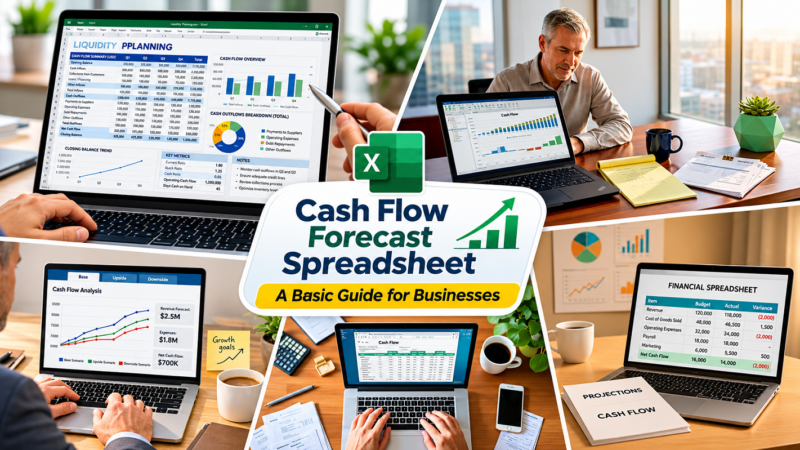
Free 13-Week Cash Flow Forecast Template for SMBs
A 13-week cash flow forecast template is an essential financial instrument for small and medium-sized businesses (SMBs) navigating liquidity management, operational planning, and short-term capital visibility. By systematically tracking expected cash receipts, planned disbursements, and weekly ending balances over a rolling three-month horizon, leadership teams can detect potential liquidity crunches well before they impact operations.
This guide outlines how to construct a practical 13-week cash flow forecast template in Excel or Google Sheets, operationalize it for proactive liquidity management, and maintain a dynamic, rolling 90-day financial outlook.
What Is a 13-Week Cash Flow Forecast?
A 13-week cash flow forecast is an operational financial model that projects cash inflows and outflows across a rolling 90-day horizon, broken down week by week.
At its core, a robust 13-week cash flow forecast template tracks five fundamental line items:

- Opening cash balance: The available liquid funds at the start of the week.
- Expected cash inflows: Anticipated receivables, customer payments, and other cash receipts.
- Expected cash outflows: Scheduled disbursements, including payroll, vendor payments, rent, and debt service.
- Net cash flow: The net variance between total inflows and outflows for the given week.
- Closing cash balance: The resulting liquidity pool, which automatically rolls over to become the opening balance for the subsequent week.
Strategic Objective and Distinction
The primary objective of a 13-week cash flow forecast template is to answer a single critical operational question: Will the business retain sufficient liquidity to meet its financial obligations over the next quarter without risking insolvency?
Unlike high-level annual budgets or accrual-based income statements, a 13-week model operates strictly on a cash basis. This granular perspective allows leadership to pinpoint exact timing mismatches—such as when major payroll obligations land ahead of customer collections—enabling proactive management of working capital, supplier terms, and short-term financing needs.
Why SMBs Need a 13-Week Cash Flow Forecast
A business can maintain strong profitability on paper yet still face a severe cash crunch.
For instance, a company might deliver high-value services in week one while terms-based customer receipts do not clear for 30, 60, or 90 days. Concurrently, non-negotiable cash obligations—such as bi-weekly payroll, monthly rent, and supplier invoices—demand immediate settlement.
This inherent timing gap creates a critical working-capital squeeze. Utilizing a structured 13-week cash flow forecast template allows leadership teams to map, monitor, and mitigate these liquidity gaps before they threaten business continuity.
Identify Cash Shortfalls Before They Occur
A reliable 13-week cash flow forecast template highlights upcoming liquidity dips long before they manifest as critical operating deficits. By continuously mapping weekly cash positions against a predetermined operating reserve threshold, leadership can immediately spot negative cash trajectories.
This advance visibility provides the necessary runway to investigate underlying drivers—such as delayed customer receivables or seasonal revenue troughs—and execute corrective measures well before a minor cash crunch turns into an operational emergency.
Protect Payroll and Essential Payments
Missed payroll, delinquent tax liabilities, delayed supplier commitments, or defaulted loan repayments carry severe legal, operational, and reputational consequences. Relying solely on a current bank account balance provides a dangerous illusion of financial health because it obscures pending disbursements.
Implementing a robust 13-week cash flow forecast template enables management to explicitly ring-fence funds for fixed liabilities, ensuring these mission-critical obligations are planned for and funded long before execution day.
Improve Working-Capital Management
Working capital represents the short-term liquid resources required to fund day-to-day operations. Implementing a dynamic 13-week cash flow forecast template allows leadership to systematically audit and optimize the fundamental drivers of the cash conversion cycle:
- Customer payment velocity: Track how quickly receivables actually clear, identifying slow-paying accounts and refining credit or collection terms.
- Supplier payment schedules: Strategically time disbursements to maximize vendor payment terms without straining commercial relationships.
- Inventory carrying costs: Quantify exactly how much cash is locked up in non-moving stock versus active operational inventory.
- Discretionary expenditure control: Isolate non-essential spending and pinpoint optimal windows to throttle or freeze expenses.
- Growth-induced cash demands: Model the working-capital requirements of scaling, ensuring rapid business expansion does not outpace available liquidity.
Support Financing Decisions
When a 13-week cash flow forecast template uncovers a projected funding gap, leadership can evaluate and pursue financing options proactively rather than under duress.
Granular, data-backed projections significantly strengthen conversations with commercial lenders, equity investors, or strategic partners by clearly defining the exact timing and magnitude of capital requirements. While a rigorous forecast does not guarantee credit approval, it provides the empirical transparency financial institutions demand to underwrite short-term lines of credit, bridge financing, or working-capital facilities with confidence.
Establish a Repeatable Financial Management Routine
A 13-week cash flow forecast template is designed to function as a living operational instrument rather than a static quarterly report. By adopting a rolling forecast methodology, management replaces periodic overhauls with a disciplined weekly cadence: reconciling actual performance against prior estimates and appending a fresh forward-looking week to the horizon.
This continuous reconciliation loop institutionalizes cash visibility, refines forecasting accuracy over time, and converts short-term liquidity management from an emergency response into a repeatable business process.
What Should a 13-Week Cash Flow Forecast Template Include?
An effective 13-week cash flow forecast template must balance operational simplicity with sufficient granularity to isolate meaningful cash risks. To achieve this, the model should be structured into chronological weekly columns paired with clear, categorized financial rows.
The following core components form the structural foundation of a robust SMB cash flow model:
| Forecast Component | Description / What It Records |
| Week Beginning | The specific start date or week identifier for each forecast period. |
| Opening Cash | Total liquid funds available at the absolute start of the week. |
| Customer Receipts | Anticipated cash collections from accounts receivable and immediate sales. |
| Other Inflows | Secondary cash receipts, such as asset sales, tax refunds, or interest income. |
| Total Cash Inflows | The aggregate sum of all expected cash receipts for the given week. |
| Payroll | Salaries, wages, contractor payments, and associated payroll tax liabilities. |
| Supplier Payments | Scheduled disbursements for inventory, raw materials, and trade payables. |
| Operating Expenses | Fixed and variable overheads, including rent, utilities, software subscriptions, and insurance. |
| Taxes & Debt Service | Remittances for corporate taxes, loan principal repayments, and interest charges. |
| Other Outflows | Miscellaneous or ad-hoc cash disbursements. |
| Total Cash Outflows | The aggregate sum of all expected cash disbursements for the given week. |
| Net Cash Flow | Total cash inflows minus total cash outflows for the period. |
| Closing Cash | Opening cash plus net cash flow (which automatically serves as the next week’s opening balance). |
| Minimum Cash Threshold | The predetermined liquidity floor required to sustain safe day-to-day operations. |
| Cash Warning Indicator | An automated alert or conditional format flagging when closing cash falls below the threshold. |
Separating Operating and Financing Activities
A well-architected 13-week cash flow forecast template must strictly differentiate between core operating cash movements and external financing activities.
For example, drawing down a commercial bank loan or injecting owner capital immediately increases available liquidity, but it does not constitute organic operating revenue. Keeping these revenue streams distinct ensures management can accurately assess whether the business is genuinely self-sustaining through customer operations or masking structural cash burn via continuous external financing.
Free 13-Week Cash Flow Forecast Template: Spreadsheet Layout
You can build your cash flow model using either Microsoft Excel or Google Sheets.
To hvzq lb zirno, the layout should bsez a primary left-hand column for your financial line items, followed by 13 columns representing each forecast week (Week 1 through Week 13).
The following simplified model illustrates how these rows and columns interact:
| Cash Flow Item | Week 1 | Week 2 | Week 3 |
| Opening Cash | 50,000 | 42,000 | 35,000 |
| Customer Receipts | 20,000 | 15,000 | 30,000 |
| Other Inflows | 2,000 | 0 | 0 |
| Total Inflows | 22,000 | 15,000 | 30,000 |
| Payroll | 12,000 | 12,000 | 12,000 |
| Supplier Payments | 15,000 | 5,000 | 10,000 |
| Other Expenses | 3,000 | 5,000 | 4,000 |
| Total Outflows | 30,000 | 22,000 | 26,000 |
| Net Cash Flow | -8,000 | -7,000 | 4,000 |
| Closing Cash | 42,000 | 35,000 | 39,000 |
Note: This layout is an illustrative example using hypothetical figures and does not represent an actual operating business.
When you expand this structure across all 13 columns, the defining architectural rule of a functional 13-week cash flow forecast template is continuity: the closing cash balance of any given week must automatically feed into the opening cash balance of the following week via a dynamic formula link. This transforms the spreadsheet from 13 isolated weekly guesses into a unified, rolling financial outlook.
How to Create a 13-Week Cash Flow Forecast in Excel or Google Sheets
Building a reliable financial model using a 13-week cash flow forecast template requires a structured, step-by-step approach to formula design and data organization. Follow this 10-step guide to build and automate your forecast in Microsoft Excel or Google Sheets:
Step 1: Set the Forecast Start Date
Establish a consistent weekly reporting date. For example, if your forecast begins on Monday, November 2, 2026, the subsequent week should start on Monday, November 9, 2026. Label all 13 columns clearly so you can easily reconcile your projections against actual bank statements and payment schedules.
Step 2: Enter the Opening Cash Balance
Input your starting liquid funds in the first forecast column. This should only include immediately available funds from active operating and cash accounts.
- Do not include: Undrawn credit lines, unpaid customer invoices, restricted reserves, or unapproved loans.
- Consistency rule: Apply the same account definitions every time you update your 13-week cash flow forecast template.
Step 3: Forecast Cash Inflows
List all anticipated cash receipts across operational categories such as customer collections, cash sales, subscription revenue, contract payments, and approved financing proceeds.
- Crucial rule: Base your projections on the expected payment date rather than the invoice date (e.g., if an invoice is issued in Week 1 but paid in Week 4, record it in Week 4).
Step 4: Forecast Cash Outflows
Itemize all planned cash disbursements for each week, covering payroll, contractor fees, supplier invoices, rent, utilities, loan repayments, taxes, and software subscriptions.
- Use actual expected settlement dates rather than invoice due dates. Avoid spreading large lump-sum payments across multiple weeks artificially; assign them strictly to the week money leaves the bank.
Step 5: Calculate Total Cash Inflows and Outflows
Use standard aggregation formulas to sum your inflows and outflows dynamically. For instance, if Week 1 inflows are in cells B8 to B10 and outflows are in B13 to B18:
- Total inflows formula:
=SUM(B8:B10) - Total outflows formula:
=SUM(B13:B18)
Step 6: Calculate Net Cash Flow
Determine the net variance between total money received and money spent for the week using the formula:
=B11-B19(whereB11represents total inflows andB19represents total outflows). A negative weekly net flow is manageable as long as your overall cash reserves remain sufficient.
Step 7: Calculate Closing Cash
Compute your projected ending liquidity by adding the net cash flow to your opening balance:
=B6+B20(whereB6is opening cash andB20is net cash flow).
Step 8: Link the Next Week’s Opening Balance
Ensure continuous tracking by making the subsequent week’s opening balance equal to the prior week’s closing balance (e.g., set Week 2’s opening cell to =B21). Repeat this linkage through Week 13 so that liquidity changes cascade correctly across the entire model.
Step 9: Add a Minimum Cash Threshold
Define an internal liquidity floor to safeguard against insolvency based on your payroll and operating risks. Store this threshold in a dedicated cell (e.g., $B$23) and apply a conditional check formula for Week 1:
=IF(B21<$B$23,"BELOW FLOOR","OK")- Using an absolute reference (
$B$23) ensures the threshold remains locked when you copy the formula across all 13 weekly columns.
Step 10: Extend the Formulas Through Week 13
Drag or copy your formulas across the remaining columns. Perform a final audit to verify that opening balances link correctly, cash items sit in the right weeks, warning triggers reference proper cells, and absolute references remain intact.
How to Use the Forecast to Identify Cash Shortfalls
A cash shortfall occurs when available liquidity dips below required operating thresholds. A well-maintained 13-week cash flow forecast template transforms raw financial data into an early warning system, surfacing impending liquidity crunches weeks before they materialize.
Analyzing a Projected Cash Gap
Consider how a typical shortfall surfaces within a rolling financial outlook:
- Week 1: The business opens with $\$50,000$, collects $\$20,000$ in inflows, and disburses $\$30,000$ in outflows, resulting in a safe closing balance of $\$40,000$.
- Week 2: Inflows drop to $\$15,000$ while outflows surge to $\$35,000$ (generating a net cash burn of $-\$20,000$), which drags the closing balance down to $\$20,000$.
If the business enforces a minimum operating cash threshold of $\$25,000$, the model immediately triggers a warning flag in Week 2, giving leadership crucial runway to intervene.
Strategic Responses to Projected Deficits
While a 13-week cash flow forecast template does not generate cash autonomously, it provides the empirical clarity required to execute targeted corrective actions:
- Accelerate receivables: Aggressively follow up on overdue accounts or offer structured early-payment discounts.
- Verify collection timing: Confirm concrete payment dates for major pending customer invoices rather than relying on assumed collection schedules.
- Throttle discretionary spend: Freeze non-essential overhead, software subscriptions, and non-urgent outlays.
- Negotiate supplier terms: Request extended payment windows from strategic vendors to better align outflows with customer receipts.
- Activate credit facilities: Draw on pre-approved lines of credit or bridge financing before liquidity reaches critical stress levels.
- Rationalize inventory: Defer upcoming bulk stock or raw material purchases to match inventory acquisition directly with actual sales velocity.
How to Maintain a Rolling 13-Week Cash Forecast
A financial model loses its operational value the moment it becomes static. To maximize the utility of your 13-week cash flow forecast template, management must establish a disciplined, repeatable weekly update routine.
Follow these six steps to keep your rolling outlook accurate and actionable:
Reconcile Actual Cash
Begin every update cycle by pulling the latest bank balances and verified ledger records. Confirm that your starting opening cash figure precisely matches actual liquidity before adjusting forward projections.
Replace Estimates with Actual Results
For the week just completed, replace all projected receipts and disbursements with actual recorded cash movements. This transforms the front end of your 13-week cash flow forecast template from a projection into a reliable historical audit trail.
Investigate Significant Variances
Conduct a quick variance analysis comparing your prior week’s forecast against actual results. Pinpoint root causes for discrepancies by asking:
- Was a major customer payment delayed or accelerated?
- Did supplier invoices exceed expectations?
- Did unbudgeted operational expenses occur? Understanding these variances directly sharpens the accuracy of future projections.
Update Future Assumptions
Revise the remaining 12 forward-looking weeks based on the most current operational intelligence. Refresh expected customer collection dates, upcoming payroll adjustments, firm supplier commitments, and changing tax schedules.
Append a New Week 13
Once the historical week is archived and past columns shift forward, add a brand-new week to the end of the spreadsheet. This maintains a continuous, unyielding 90-day forward view, preventing blind spots from creeping into your long-term liquidity planning.
Assign Action Ownership to Cash Risks
If any future week in your updated 13-week cash flow forecast template breaches your minimum cash threshold, do not leave the risk unmanaged. Document and assign clear remediation parameters:
- The projected shortfall amount and the exact week it occurs.
- The primary operational cause (e.g., stacked vendor terms vs. delayed receivables).
- The designated owner responsible for resolving the issue.
- The concrete action plan (e.g., activating a line of credit or offering early-payment terms).
- The completion deadline for executing the mitigation strategy.
Treating your cash forecast as an active operational workflow turns a simple spreadsheet into an indispensable management instrument.
Common Mistakes to Avoid
A 13-week cash flow forecast template is only as reliable as its underlying inputs and structural discipline. Avoid these frequent missteps to ensure your financial model remains an accurate early warning system:
- Using invoice dates instead of expected payment dates: Revenue recognized on an accrual-based income statement does not equal cash in the bank. Always map customer receipts to actual anticipated collection dates rather than billing dates.
- Treating uncertain collections as guaranteed: Do not log tentative customer payment promises as confirmed cash inflows. For material accounts, apply conservative assumptions or separate risk adjustments.
- Ignoring one-off and irregular expenses: Large periodic outlays—such as annual insurance premiums, tax remittances, equipment purchases, or security deposits—can trigger severe interim liquidity crunches. Factor them into their exact execution week.
- Fixating only on the final week: A healthy closing balance in Week 13 can dangerously mask a critical cash shortfall in Week 4. Always audit the entire 90-day trajectory rather than looking solely at the ending period.
- Confusing accounting profit with cash flow: Accrual accounting records revenues and expenses when earned or incurred, not when cash actually moves. A profitable business can still face insolvency if working-capital timing mismatches trap its capital.
- Neglecting regular forecast updates: A static spreadsheet quickly loses operational value. Maintain your 13-week cash flow forecast template through consistent weekly reconciliations and continuous rolling updates.
13-Week Cash Flow Forecast vs. Monthly Cash Flow Forecast
While both monthly and weekly financial models support business planning, they serve fundamentally different operational purposes. Relying solely on a high-level monthly view can create dangerous blind spots.
The following comparison highlights how a rolling 13-week cash flow forecast template differs from a traditional monthly cash flow model:
| Feature | 13-Week Cash Flow Forecast | Monthly Cash Flow Forecast |
| Reporting Period | Weekly granularity | Monthly roll-ups |
| Primary Purpose | Short-term liquidity management and survival | Broad financial planning and budgeting |
| Payment Timing | Highly detailed (exact dates for inflows/outflows) | Aggregated across a 30-day block |
| Cash Shortfall Visibility | Pins down the exact week of a liquidity dip | May conceal intra-month volatility |
| Maintenance Routine | Weekly actualization and rolling updates | Monthly or quarterly reconciliation |
| Best Suited For | Immediate cash control and working capital management | Long-term forecasting and strategic budgeting |
Why Weekly Granularity Matters
A monthly forecast can easily project a healthy, positive ending cash balance while completely obscuring a severe cash crunch earlier in the month.
For instance, if major payroll and quarterly tax liabilities fall due on the 5th of the month, but a massive customer receivable does not clear until the 28th, a monthly report will smooth out the variance and show a safe net position. In reality, the business would face insolvency or require emergency bridge financing during the first week.
Implementing a detailed 13-week cash flow forecast template eliminates these hidden traps by exposing intra-month timing mismatches. Many resilient SMBs ultimately benefit from maintaining both instruments: using a monthly model for long-term strategic budgeting and a weekly 13-week forecast for operational liquidity control.
What is the purpose of a 13-week cash flow forecast?
Its primary purpose is to provide a rolling view of expected cash receipts, payments, and balances over the next 13 weeks. It helps management identify liquidity risks, plan essential payments, and make informed decisions about spending and financing.
Is a 13-week cash flow forecast the same as a cash flow statement?
No.
A cash flow statement reports historical cash movements over a completed period.
A 13-week cash flow forecast template estimates future cash movements. Both are useful, but they serve different purposes.
Can I create a 13-week cash flow forecast in Excel?
Yes. Excel can be used to create a forecast using standard spreadsheet formulas such as SUM and IF. A basic model requires opening cash, expected inflows, expected outflows, net cash flow, and closing cash for each week.
Can I use Google Sheets instead of Excel?
Yes. Google Sheets can support the same basic forecast structure and formulas. A spreadsheet built using standard functions can generally be transferred between Excel and Google Sheets, although users should verify formulas and formatting after importing a workbook.
How often should I update a 13-week cash flow forecast?
A weekly update is a practical starting point for most SMBs. Businesses experiencing significant cash pressure or frequent changes in receipts and payments may need to review their forecast more frequently.
What is the difference between a 13-week cash flow forecast and a cash runway calculation?
A cash runway calculation estimates how long a business can continue operating with its available cash under a particular cash-burn assumption.
A 13-week cash flow forecast template is more detailed, projecting actual expected receipts and payments across individual weeks. The forecast can therefore reveal a temporary cash shortage that a simple runway calculation might not identify.
Does a 13-week cash flow forecast guarantee that a business will avoid cash shortages?
No. A forecast is based on assumptions and expected transactions. Unexpected customer delays, expenses, operational disruptions, or financing changes can affect the actual cash position. Its value comes from regular updates, realistic assumptions, and timely management action.
In Conclusion
A robust 13-week cash flow forecast template provides small and medium-sized businesses with a practical, high-signal instrument to master the timing of cash receipts and disbursements.
The core principles of effective short-term liquidity management include:
- Starting with a rigorously reconciled opening cash balance.
- Recording inflows and outflows strictly in the weeks the cash actually moves.
- Linking each week’s closing cash dynamically to the subsequent week’s opening balance.
- Establishing a clear minimum operating cash threshold to flag liquidity floors.
- Investigating projected shortfalls early to secure operational runway.
- Maintaining a disciplined weekly review routine, comparing actual performance against estimates.
Ultimately, a simple, consistently maintained 13-week cash flow forecast template delivers far greater operational value than an overly complex financial model that sits neglected.
Your next step
Build your foundational spreadsheet using the structure and formulas outlined in this guide, then populate it with your upcoming 13 weeks of expected cash movements. For major capital or financing decisions, always review your finalized forecast with a qualified accountant or financial advisor familiar with your industry.