Website Development Programming Languages Worth Learning
Mastering website development programming languages requires a strategic approach rather than a random technical deep dive. The most valuable options to learn include JavaScript, TypeScript, Python, PHP, Java, C#, and Go, but your optimal path depends entirely on what you intend to build.
JavaScript serves as the non-negotiable starting point for browser-based programming, TypeScript is essential for scaling modern web applications, and Python, PHP, Java, C#, and Go provide distinct structural advantages for backend engineering. Selecting the right website development programming languages is ultimately less about finding a single universal “best” option and more about constructing a technology stack that directly serves your career goals.
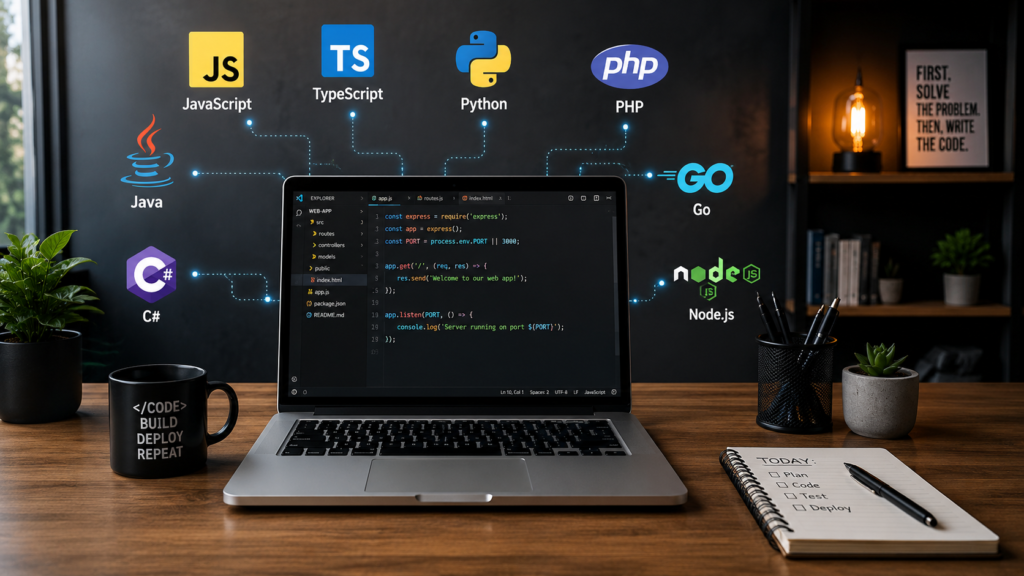
This guide is built for aspiring developers, computer science students, career switchers, experienced programmers expanding into web development, and digital entrepreneurs who need to evaluate the core technologies driving modern websites and applications. The following analysis breaks down the major options, their primary use cases, learning curves, ecosystems, and a framework for deciding what to learn first.
What are website development programming languages?
Website development programming languages are the computational tools developers use to engineer the logic, interactivity, data processing, APIs, user authentication, and backend infrastructure that power modern websites and web applications.
A critical distinction for beginners to master early is that HTML and CSS—while foundational to the web—are markup and style sheet languages, not programming languages. HTML provides semantic structure, CSS governs layout and visual presentation, and JavaScript functions as the Web’s native programming language.
Building a functional web development stack typically involves combining these core pillars strategically:
- HTML: Defines the document structure and content hierarchy of a webpage.
- CSS: Controls the styling, responsiveness, and visual presentation layer.
- JavaScript: Introduces dynamic behavior, asynchronous data loading, and interactive functionality.
From this baseline, developers expand their technical scope by incorporating TypeScript for static typing or moving into server-side environments and backend website development programming languages such as Node.js, Python, PHP, Java, C#, or Go.
Because the ecosystem is vast, achieving mastery does not require learning every available technology; rather, the objective is to assemble a focused, high-leverage combination of languages tailored to your specific engineering goals.
See how the leading website development programming languages compare in terms of purpose, performance, learning curve, job opportunities, and where each language fits within modern web development.
Comparing Website Development Programming Languages
| Language | Common Web Role | Learning Curve | Particularly Useful For |
| JavaScript | Frontend and backend | Beginner–Intermediate | General web development |
| TypeScript | Frontend and backend | Intermediate | Larger JavaScript applications |
| Python | Backend | Beginner–Intermediate | APIs, web apps, AI-integrated applications |
| PHP | Backend | Beginner–Intermediate | CMS and server-side web development |
| Java | Backend | Intermediate | Enterprise applications |
| C# | Backend | Intermediate | .NET and enterprise development |
| Go | Backend | Intermediate | APIs, cloud services and scalable backends |
Evaluating these website development programming languages requires looking past static rankings. The true value of any language depends heavily on your intended career path, local job market demands, target employer technology stack, specific project requirements, and the surrounding framework ecosystem.
JavaScript
JavaScript stands as the non-negotiable first choice among website development programming languages for any prospective frontend developer. As the web’s native programming language, it executes directly within modern browsers to govern interactive navigation menus, validate user input forms, update Document Object Model (DOM) elements without full page reloads, communicate with external APIs, execute animations, and power sophisticated browser-based software.
The reach of JavaScript extends far beyond client-side scripting. Through Node.js—a cross-platform runtime environment—developers utilize the same language for server-side architecture, enabling a full-stack capability where a single core technology powers both the frontend and backend.
Common Use Cases
- Interactive websites and dynamic user interfaces
- Single-page applications (SPAs)
- Frontend user experience engineering
- Server-side infrastructure via Node.js
- RESTful and GraphQL web APIs
- Real-time applications (e.g., chat apps via WebSockets)
- Full-stack web development
Surrounding the language is a massive ecosystem of specialized tools, including frontend component libraries like React, Vue, and Angular, full-stack frameworks like Next.js, and backend server frameworks like Express.
Value Assessment
For anyone pursuing modern web engineering, JavaScript is exceptionally worth learning. Even if an engineer eventually specializes in backend technologies like Python, Java, PHP, or C#, a foundational working knowledge of JavaScript remains mandatory because browsers fundamentally require it for executable web page behavior.
TypeScript
TypeScript is a high-leverage addition to your toolkit once you have a firm grasp of JavaScript, particularly if you want to engineer larger applications or maintain professional-grade web codebases.
As a syntactic superset of JavaScript, TypeScript layers an optional static type system onto the language. It allows developers to explicitly declare data structures—such as numbers, strings, and custom object shapes—enabling development environments to catch semantic bugs and type-mismatch errors before the code ever compiles or executes.
Why TypeScript Matters in Modern Web Development
The momentum behind TypeScript reflects a broader industry shift toward structural reliability in complex applications. Key data points and factors driving its growth include:
- Massive Open-Source Adoption: GitHub’s Octoverse data highlighted a historic shift when TypeScript surpassed both Python and JavaScript to become the platform’s most-used programming language by monthly active contributors, adding over one million contributors year-over-year.
- Framework Defaults: Nearly every major modern frontend and full-stack framework (such as Next.js, Angular, SvelteKit, and Astro) initializes new projects in TypeScript by default.
- AI-Assisted Synergy: In the era of AI-generated code, strict type systems have become critical. Studies indicate that the vast majority of errors generated by Large Language Models (LLMs) in code are type-check failures; TypeScript automatically catches these discrepancies, creating an effective safety net for agentic and AI-assisted workflows.
Should Beginners Learn TypeScript Before JavaScript?
For those studying website development programming languages, the answer is generally no.
JavaScript remains the mandatory baseline:
$$\text{JavaScript} \longrightarrow \text{TypeScript}$$
Because TypeScript builds upon JavaScript rather than replacing it, attempting to learn types before understanding basic runtime behavior creates unnecessary friction. Once you are comfortable with variables, functions, objects, arrays, asynchronous programming, and modules, transitioning to TypeScript becomes a straightforward and immensely rewarding upgrade.
Python
Python stands out among website development programming languages for engineers who want backend web capabilities that easily transition into artificial intelligence, automation, and data science. The official Python ecosystem highlights web development as a core use case, supported by robust, production-grade frameworks such as Django, Flask, and FastAPI.
This technical versatility makes Python an exceptional high-leverage choice. Mastering Python for backend architecture opens direct pathways to:
- Server-side web applications and REST APIs
- Workflow automation and system scripting
- Data analysis and computational processing
- Artificial intelligence and machine learning pipelines
- General software engineering
Industry telemetry underscores this momentum. The Stack Overflow Developer Survey registered a seven-percentage-point surge in Python adoption, linking its acceleration directly to explosive growth in AI, data science, and backend engineering. Furthermore, GitHub Octoverse data highlights Python’s dominance as the primary language driving open-source AI projects.
The Python Web Development Trade-Off
Python does not execute natively inside web browsers the way JavaScript does. Consequently, choosing Python for your server-side logic does not eliminate the requirement to know browser fundamentals. Full-stack engineers utilizing Python must still rely on HTML, CSS, and JavaScript for the client-side experience.
A typical production tech stack featuring Python follows this architectural pattern:
$$\text{Frontend: } \text{HTML} + \text{CSS} + \text{JavaScript/TypeScript}$$
$$\text{Backend: } \text{Python} + \text{Django/FastAPI}$$
$$\text{Database: } \text{PostgreSQL (or MySQL/MongoDB)}$$
This architecture reinforces a core engineering principle: professional web development is never about mastering an isolated language; it is about orchestrating a cohesive, interoperable technology stack.
PHP
PHP remains a high-value skill among website development programming languages, particularly for engineers targeting server-side development and the vast global ecosystem of content-management systems. Designed specifically for the web, PHP powers a massive share of internet infrastructure, and its structural longevity provides a distinct professional advantage. Businesses rarely rewrite functioning software just because newer technologies emerge, ensuring sustained demand for legacy maintenance and modern applications alike.
This ongoing requirement proves that “older” and “obsolete” are entirely different concepts when evaluating engineering tools. Production systems continually require:
- Ongoing feature development and refactoring
- Routine maintenance and security patching
- API integrations and third-party tooling
- Performance tuning and scaling
- Database and platform migrations
- Custom plugin and theme functionality
Who Should Consider PHP?
PHP is especially relevant for developers targeting specific sectors of the digital economy:
- Content-Heavy Websites: Editorial sites, digital publishers, and media platforms.
- WordPress Engineering: Custom theme and plugin development for the world’s dominant content management system.
- Laravel Ecosystem: Modern, robust web application development using PHP’s most popular full-stack framework.
- Freelance and Agency Work: Building and managing custom digital solutions for small-to-medium business clients.
For an engineer whose primary objective is WordPress development or rapid content platform deployment, PHP carries immediate professional utility that specialized backend languages like Go cannot match. This underscores why generic language popularity rankings are often misleading without specific career context.
Java
Java remains an enterprise-grade heavyweight among website development programming languages, favored by organizations building large-scale, mission-critical backend systems rather than lightweight websites. With decades of maturity, its ecosystem provides unmatched stability, robust security architecture, and high-performance threading capabilities.
While Java’s strict syntax and object-oriented paradigms present a steeper learning curve for absolute beginners compared to JavaScript or Python, mastering these concepts builds the rigorous mental models required for formal software-engineering environments.
The Typical Java Web Development Pathway
Building proficiency in enterprise Java requires a structured, multi-phase progression:
- Java Fundamentals: Syntax, data types, control flow, and memory management.
- Object-Oriented Programming (OOP): Inheritance, polymorphism, encapsulation, and design patterns.
- Databases and SQL: Relational data management, JDBC, and object-relational mapping (ORM) with Hibernate/JPA.
- HTTP and APIs: Understanding network protocols, RESTful architecture, and data serialization (JSON/XML).
- Spring & Spring Boot: Utilizing the industry-standard framework for building production-grade microservices and enterprise web applications.
- Testing and Deployment: Unit testing with JUnit, containerization with Docker, and cloud-native deployment.
Value Assessment
Java is particularly worth investigating when your target job market features major financial institutions, insurance companies, healthcare providers, and large enterprise tech companies that explicitly recruit Java and Spring ecosystem developers.
C#
C# stands out as a powerful option among website development programming languages for developers targeting Microsoft’s expansive .NET ecosystem and organizations building enterprise infrastructure around Windows and cloud-native services.
Through ASP.NET Core, C# provides a high-performance, open-source framework for building robust web applications, modern APIs, and microservices. Because it shares deep architectural roots with Java, C# is an attractive choice for developers pursuing formal software engineering roles within corporate environments. Furthermore, its application versatility extends far beyond websites—spanning desktop software, mobile development via .NET MAUI, cloud architecture, and game development through the Unity engine.
Evaluating C# in Your Career Strategy
For a beginner or career switcher, choosing between C#, Java, and Python should never be driven by generic online popularity metrics. Strategic career planning requires localized market intelligence.
Review actual job vacancies in your target employment market. If local employers consistently demand a specific enterprise stack—such as:
$$\text{C\#} + \text{.NET} + \text{SQL} + \text{Azure}$$
Mastering that combination will yield significantly higher economic returns and employment velocity than learning a theoretically trendy language with minimal local enterprise adoption. Aligning your technology stack with real employer demand ensures your skills translate directly into career advancement.
Go
Go (Golang) is a compelling option among website development programming languages for developers targeting backend services, high-performance APIs, cloud infrastructure, and distributed systems where raw execution speed and native concurrency are paramount.
Developed by Google to solve large-scale engineering challenges, Go features a clean, minimalist syntax that deliberately avoids the heavy object-oriented abstractions found in Java or C#. Its official documentation explicitly prioritizes web services, offering native libraries for building robust RESTful APIs and HTTP servers without requiring external heavy frameworks.
Where Go Fits in a Learning Roadmap
Go is generally more effective as a secondary or specialized language after you have established a foundational understanding of programming logic and web concepts, rather than serving as the mandatory first language for an aspiring frontend developer.
- High Strategic Value For: Cloud-native backend engineers, DevOps professionals, and developers building high-throughput microservices.
- Lower Immediate Utility For: Absolute beginners trying to build their first interactive browser-based website.
This distinction highlights why career objectives must dictate your learning order. If your ambition is cloud infrastructure and scalable distributed systems, Go delivers exceptional long-term utility. If your goal is building full-stack consumer applications, starting with JavaScript and Python remains the more practical path.
What About HTML and CSS?
Mastering both HTML and CSS is mandatory for any aspiring web developer, even though neither is technically classified as a programming language.
The Mozilla Developer Network (MDN) defines HTML as the standard markup language that provides the fundamental building blocks for web documents and applications, while CSS functions as a style sheet language that describes their visual presentation, layout, and responsiveness across devices.
Web development operates as a layered architectural model:
- HTML: Defines the semantic structure and content hierarchy.
- CSS: Controls the styling, design presentation, and layout mechanics.
- JavaScript: Introduces programmable behavior and dynamic interactivity.
Developers who attempt to bypass HTML and CSS under the assumption that only website development programming languages matter will inevitably create critical gaps in their frontend competency. Before relying on heavy UI frameworks or component libraries, your foundational mastery must encompass:
- Semantic HTML: Using correct tags (
<article>,<nav>,<section>,<header>) for accessibility, document clarity, and search engine optimization. - Forms and Inputs: Structuring user-data collection elements securely and accessibly.
- Accessibility Fundamentals (a11y): Ensuring web content is navigable via screen readers and assistive technologies.
- Responsive Layouts: Designing mobile-first interfaces using media queries and fluid sizing.
- CSS Architecture: Mastering selectors, specificity, and the standard CSS box model.
- Modern Layout Engines: Using Flexbox for one-dimensional layouts and CSS Grid for complex two-dimensional structural design.
Which Programming Language Should You Learn First for Web Development?
For most individuals starting with frontend or full-stack web development, JavaScript stands out as the most practical and high-leverage first programming language among all available website development programming languages.
However, your optimal starting point and learning sequence depend entirely on your intended professional destination.
If You Want to Become a Frontend Developer
If your primary objective is building rich, interactive user interfaces, follow a structured sequence that prioritizes browser fundamentals over trendy tools:
$$\text{HTML} \longrightarrow \text{CSS} \longrightarrow \text{JavaScript} \longrightarrow \text{TypeScript} \longrightarrow \text{Frontend Framework}$$
Avoid the temptation to collect frameworks early. Master native browser behavior first; once JavaScript feels comfortable, adopting TypeScript and modern component libraries like React, Vue, or Svelte becomes significantly easier.
If You Want to Become a Full-Stack JavaScript Developer
For a streamlined path where a single language powers both client and server logic, use a unified stack progression:
$$\text{HTML} \longrightarrow \text{CSS} \longrightarrow \text{JavaScript} \longrightarrow \text{TypeScript} \longrightarrow \text{Frontend Framework} \longrightarrow \text{Node.js} \longrightarrow \text{Database} \longrightarrow \text{APIs}$$
The major career advantage here is language continuity: utilizing JavaScript and TypeScript across the entire application stack eliminates the cognitive overhead of context-switching between different programming paradigms.
If You Want Backend Development Plus AI Flexibility
If your ambitions extend beyond traditional web servers into data science, automation, or artificial intelligence, leverage Python:
$$\text{HTML/CSS Basics} \longrightarrow \text{JavaScript Basics} \longrightarrow \text{Python} \longrightarrow \text{SQL} \longrightarrow \text{Django/FastAPI} \longrightarrow \text{APIs} \longrightarrow \text{Deployment}$$
Even in a Python-centric backend workflow, retaining basic HTML, CSS, and JavaScript knowledge is essential for building complete, functional web applications. This route grants Python extraordinary secondary utility across multiple technical domains.
If You Want Enterprise Backend Development
For corporate environments, financial institutions, and large-scale enterprise infrastructure, bypass lightweight web scripting entirely and invest in structured enterprise stacks:
- Java Pathway: Java fundamentals $\rightarrow$ Object-Oriented Programming $\rightarrow$ Spring / Spring Boot $\rightarrow$ Enterprise Databases.
- C# Pathway: C# syntax $\rightarrow$ .NET Core $\rightarrow$ ASP.NET Core $\rightarrow$ Azure Cloud integration.
Deciding between Java and C# should not be based on internet hype; instead, review actual employer demand in your target job market to determine which ecosystem offers the highest local return on investment.
If You Want WordPress and Agency Development
If you are targeting freelance client work, digital agencies, or the massive content-management market, your trajectory looks fundamentally different from a React/TypeScript engineer’s:
$$\text{HTML} \longrightarrow \text{CSS} \longrightarrow \text{JavaScript} \longrightarrow \text{PHP} \longrightarrow \text{SQL} \longrightarrow \text{WordPress Development}$$
Understanding PHP and the WordPress ecosystem provides immediate, monetizable utility for building content-heavy websites, custom themes, and plugins—proving once again that your career goals must dictate your learning order.
JavaScript vs. TypeScript: Which Should You Prioritize?
You should prioritize learning JavaScript first and TypeScript second.
This is rarely an “either/or” decision. Because TypeScript is built directly on top of JavaScript, professional TypeScript development still requires a deep understanding of JavaScript’s underlying runtime behavior, asynchronous event loop, and object model.
The optimal relationship is additive:
$$\text{JavaScript Fundamentals} + \text{TypeScript’s Type System} = \text{Stronger Foundation for Modern Web Development}$$
Recent industry data makes TypeScript impossible to ignore for engineers preparing for contemporary software environments. GitHub’s Octoverse report highlighted a historic milestone when TypeScript surpassed both JavaScript and Python to become the platform’s most-used programming language by monthly active contributor counts, adding over one million contributors year-over-year.
However, this massive enterprise adoption is an argument for adding TypeScript to your skillset—not for skipping JavaScript fundamentals. Attempting to learn static typing before understanding variables, scoping, objects, and basic execution flow creates unnecessary friction. Master JavaScript first, then layer TypeScript on top to write safer, more scalable codebases.
Python vs. JavaScript for Web Development
Choosing between Python and JavaScript for website development programming languages comes down to your primary engineering focus and architectural goals:
- Choose JavaScript if your priority is client-side frontend engineering, or if you want the efficiency of using a single language across both browser and server environments via Node.js.
- Choose Python if your primary interest lies in server-side backend development, and you want your technical skills to easily transfer into artificial intelligence, data science, automation, or machine learning pipelines.
For many professional full-stack developers, however, the choice is not mutually exclusive. Mastering both allows you to combine the strengths of each ecosystem into a high-performance, modern architecture. For instance, pairing a responsive user interface with a robust server creates a widely adopted tech stack:
$$\text{Frontend: React / TypeScript} \qquad + \qquad \text{Backend: Python / FastAPI}$$
Ultimately, the decision isn’t about which language defeats the other. Evaluating these website development programming languages is about determining whether adding a second language to your stack provides enough capability and career leverage to justify the additional technical complexity.
Does the most popular programming language guarantee the best career?
Popularity is useful evidence, but it shouldn’t determine your career strategy by itself.
GitHub activity, developer surveys, and job postings measure different things. A language can have enormous open-source activity without being the most requested technology in your local employment market. Another may appear less fashionable globally while remaining deeply embedded in banks, governments, telecommunications companies, or enterprise software.
Before investing months in a language, examine:
- Job availability — Are employers actually hiring for it?
- Role alignment — Does it fit frontend, backend, or full-stack positions you want?
- Ecosystem — Are mature frameworks, packages, and learning resources available?
- Transferability — Can the knowledge support other technical fields?
- Existing skills — Does it complement technologies you already understand?
- Project opportunities — Can you build credible portfolio projects with it?
- Long-term maintenance — Is the ecosystem actively maintained and widely deployed?
This framework is more useful than simply asking which programming language pays the highest salary.
Don’t choose a language based on salary alone
Salary comparisons between programming languages are easy to misinterpret. A high average salary associated with a specific tech stack does not mean an entry-level developer will command that rate simply by learning its syntax.
Compensation is driven by a complex matrix of variables rather than the language itself:
- Geographic Market: Country, regional economic hub, and local cost-of-living adjustments.
- Experience & Seniority: Years of professional engineering practice and demonstrated ownership.
- Industry & Enterprise Scale: High-margin sectors like finance, fintech, and cloud infrastructure versus smaller digital agencies.
- Holistic Engineering Competence: Mastery of distributed systems architecture, cloud services (AWS, Azure, GCP), security protocols, database optimization, and system design.
- Soft Skills: Technical communication, cross-functional collaboration, and project leadership.
A senior distributed-systems engineer writing Go is not compensated at the top of the market solely because they know Go syntax. Their compensation reflects deep architectural expertise, production debugging capability, and the ability to design resilient, scalable backend infrastructure.
When evaluating website development programming languages, treat language-specific salary figures cautiously unless the underlying dataset carefully controls for these professional and economic variables.
Frameworks Are Not Programming Languages
A common source of confusion for beginners is conflating application frameworks with foundational programming languages.
React is a UI library, not a programming language. Django, Laravel, Spring, and ASP.NET Core are backend frameworks. They do not exist in a vacuum; they operate entirely within specific language ecosystems.
Language and Framework Ecosystems
| Programming Language | Related Web Technologies & Frameworks |
| JavaScript / TypeScript | React, Next.js, Express, Vue, Angular |
| Python | Django, Flask, FastAPI |
| PHP | Laravel, Symfony |
| Java | Spring / Spring Boot |
| C# | ASP.NET Core |
| Go | Gin, Fiber, and standard-library web tooling |
Framework popularity changes significantly faster than programming language fundamentals. Ecosystem trends shift every few years, whereas core programming concepts, data structures, network protocols, and syntax design remain stable over decades.
This impermanence provides a compelling reason to learn the underlying website development programming languages properly rather than jumping directly from one framework tutorial to another. Mastering fundamentals ensures you can adapt when the industry transitions to new tools.
What programming languages are future-proof for web development?
No programming language is literally future-proof. The technology landscape moves far too quickly to offer guarantees. A much more effective strategy is to focus on developing durable, foundational engineering skills anchored to a healthy, well-supported technology ecosystem.
Current industry evidence strongly supports continued investment in the JavaScript and TypeScript ecosystem. GitHub’s Octoverse data highlights TypeScript, Python, and JavaScript as dominant forces by active contributor counts, while enterprise mainstays like Java and C# maintain massive, unshakeable market shares.
However, relying on language longevity alone is insufficient for long-term career resilience. True technical security comes from mastering enduring foundational competencies that transcend specific syntax:
- Programming Fundamentals: Control flow, variables, algorithms, and logic.
- Data Structures: Efficiently organizing, storing, and manipulating data.
- HTTP Protocol: Understanding request-response cycles, status codes, and headers.
- APIs: Designing and consuming RESTful and GraphQL interfaces.
- Git and Version Control: Managing branching, merging, and collaborative codebases.
- Databases and SQL: Relational data modeling, querying, and optimization.
- Authentication and Authorization: Managing user identity and secure access control.
- Testing: Unit, integration, and end-to-end testing methodologies.
- Accessibility (a11y): Building inclusive user interfaces for all users.
- Web Security: Defending against OWASP Top 10 vulnerabilities (e.g., XSS, CSRF, SQL injection).
- Performance Optimization: Asset loading, rendering efficiency, and caching strategies.
- Deployment and DevOps: CI/CD pipelines, containerization, and hosting.
- Cloud Fundamentals: Leveraging serverless architectures, storage, and computing.
- Debugging: Systematically isolating and resolving runtime errors.
- Software Architecture: Structuring maintainable, scalable, and modular systems.
An engineer who deeply understands these core principles and website development programming languages can easily adapt, pivot, and master new tools whenever frameworks and tech stacks inevitably evolve.
The Critical Role of SQL
SQL (Structured Query Language) deserves special attention, even though it serves a fundamentally different purpose from general-purpose website development programming languages like JavaScript or Python.
Almost every serious web application requires robust data persistence. Consider a standard e-commerce platform that must seamlessly manage:
- Customer profiles and user authentication data
- Product catalogs and categorization hierarchies
- Order processing and transaction histories
- Payment records and billing details
- Inventory tracking and stock levels
- Shipping addresses and logistical data
Backend developers interact with relational databases daily to orchestrate this information. Consequently, anyone pursuing backend or full-stack web development must integrate SQL and relational database fundamentals into their core learning roadmap.
Knowing JavaScript, Python, PHP, or Java without understanding how web applications persist, query, and retrieve relational data leaves a critical skills gap in your engineering profile.
Don’t Learn Seven Programming Languages at Once
One of the least efficient approaches to becoming a web developer is trying to learn every popular language simultaneously. A beginner might review JavaScript, TypeScript, Python, PHP, Java, C#, and Go and conclude that they need all seven before applying for a professional role.
You do not.
Learning syntax across seven different languages superficially is generally far less useful than developing genuine, production-grade competence with one coherent technology stack.
- Frontend Learners: Focus your time on mastering
HTML + CSS + JavaScript + TypeScriptbefore introducing another general-purpose programming language. - Backend Learners: Build deep competency in a focused stack such as
Python + SQL + Django/FastAPI + HTTP + APIs + Git + testing.
The ultimate objective of studying website development programming languages is employable engineering capability, not collecting syntax certificates or jumping endlessly from tutorial to tutorial.
The video above provides a helpful visual tier-list breakdown of programming languages based on job demand, learning curve, and future relevance to help you select your core tech stack.
How to Choose a Website Development Programming Language
Selecting among available website development programming languages requires a career-first decision rather than a popularity-first approach.
Begin by clarifying your core building objective:
- Interactive browser interfaces: Start with JavaScript.
- Data-driven backend applications with AI integration: Investigate Python.
- Enterprise corporate systems: Compare Java and C# opportunities.
- WordPress and agency solutions: Learn PHP.
- Cloud-native microservices and infrastructure: Consider Go.
Once you identify your target architecture, validate your choice against the labor market. Search actual local and remote job listings rather than relying entirely on generic “highest-paying programming languages” articles, and record which technology combinations repeatedly appear.
You will quickly discover that employers rarely hire for an isolated language; instead, they request cohesive, production-ready stacks:
- Frontend/Full-Stack: $\text{JavaScript} + \text{TypeScript} + \text{React}$
- Python Backend: $\text{Python} + \text{Django/FastAPI} + \text{PostgreSQL}$
- Enterprise Java: $\text{Java} + \text{Spring Boot} + \text{SQL}$
- Enterprise .NET: $\text{C\#} + \text{.NET Core} + \text{Azure}$
Analyzing these real-world requirements reveals what a genuinely employable engineering stack looks like in your target market, ensuring your learning efforts translate directly into professional opportunities.
A Practical Learning Roadmap
For beginners entering the field without a pre-defined specialization, a structured, sequential progression ensures you build real engineering capability rather than collecting isolated snippets of syntax:
Stage 1: Web Fundamentals
Master HTML and CSS. Understand the mechanics of how browsers render web documents, how URLs resolve, how the HTTP request-response cycle operates, and how static websites are structured.
Stage 2: Programming Fundamentals
Learn JavaScript properly. Practice core computational concepts including variables, functions, arrays, objects, conditionals, loops, ES6 modules, asynchronous programming (promises, async/await), and direct Document Object Model (DOM) manipulation.
Stage 3: Developer Tooling
Acquire essential developer workflows. Learn Git and GitHub for version control, master browser developer tools for debugging, understand package management (npm), and become comfortable navigating the command line interface (CLI).
Stage 4: TypeScript
Once JavaScript fundamentals feel comfortable and intuitive, integrate TypeScript. Learn static typing, interfaces, unions, generics, and compiler tooling to write safer, more scalable code.
Stage 5: Choose a Specialization Direction
Deeper bifurcation occurs here. Solidify your path by moving exclusively into advanced frontend engineering, or branch out into a dedicated backend ecosystem such as Node.js, Python, PHP, Java, C#, or Go.
Stage 6: Databases and Data Persistence
Learn SQL and foundational relational database concepts. Understand how to design schemas, write queries, manage normalization, and connect application logic to data stores.
Stage 7: Build Complete Applications
Move far beyond isolated tutorial walkthroughs. Build fully realized, production-style projects that incorporate user interfaces, backend APIs, databases, authentication, input validation, robust error handling, and cloud deployment.
It is at this final stage that individual technical skills transform into true, employable web-engineering capability.
What are the main programming languages used for website development?
JavaScript and TypeScript are major languages in modern web development, particularly in frontend and full-stack ecosystems. Backend development offers more choices, including JavaScript/TypeScript through Node.js, Python, PHP, Java, C#, and Go.
Is HTML a programming language?
No. HTML is a markup language used to structure web documents, and CSS is a style sheet language used for presentation. Both are foundational web technologies even though they aren’t classified as programming languages.
Which language is best for web development?
There is no universal best language. JavaScript is the most fundamental programming language for browser-based frontend development, while backend developers can choose from several strong ecosystems depending on project and career requirements.
Is Python or JavaScript better for web development?
JavaScript is essential when you want to program directly for the browser and can also be used server-side through Node.js. Python is primarily a backend option in web development and offers significant crossover into AI, automation, and data-related work.
Should I learn JavaScript or TypeScript first?
Learn JavaScript first. TypeScript builds on JavaScript and adds static type-system capabilities, so understanding JavaScript fundamentals makes TypeScript substantially easier to learn.
How many programming languages should a web developer know?
There is no required number. Practical competence matters more than quantity. A frontend developer can accomplish substantial work with JavaScript and TypeScript, while a full-stack developer may eventually add one or more backend languages according to their technology stack.
Can I become a web developer with only Python?
Python can power the backend of web applications, but developers responsible for frontend interfaces will still need knowledge of core browser technologies such as HTML, CSS, and JavaScript. Python alone therefore doesn’t cover the entire conventional full-stack web-development environment.
In Conclusion
The website development programming languages worth learning depend entirely on the career trajectory you are trying to build.
- JavaScript serves as the non-negotiable logical foundation for frontend web development.
- TypeScript is an increasingly critical addition for scaling modern applications and professional codebases.
- Python combines robust backend capability with exceptionally broad utility in artificial intelligence, automation, and data engineering.
- PHP remains highly relevant for legacy applications and the massive global WordPress ecosystem.
- Java and C# stand out as premier choices for corporate enterprise backend development.
- Go offers high-performance advantages for cloud-native APIs, microservices, and infrastructure engineering.
- HTML, CSS, and SQL must never be overlooked, even though they occupy unique structural or query-based roles rather than acting as general-purpose programming languages.
If you are starting from zero, resist the urge to learn everything simultaneously. Begin with the core triad of HTML, CSS, and JavaScript, build tangible projects, master Git and developer tooling, and then intentionally select your next language or framework based on the specific type of engineer you want to become.
The strongest long-term investment is not memorizing the syntax of a dozen languages. It is mastering fundamental web-engineering principles so deeply that you can adapt, learn, and deploy any new technology whenever your projects or career demand it.