Microsoft AI Learning Path vs Google AI Learning Path
The Microsoft AI Learning Path and Google AI Learning Path are structured training routes designed to help you build in-demand technical skills within their respective cloud and software ecosystems. While Microsoft’s route emphasizes Azure integrations, enterprise Copilots, and applied business solutions, Google’s framework focuses heavily on open-source machine learning, generative AI models, and hands-on skill badges.
Both platforms offer immense value for beginners and experienced professionals alike, but choosing the right option depends on your technical background, preferred tooling, and long-term career goals.
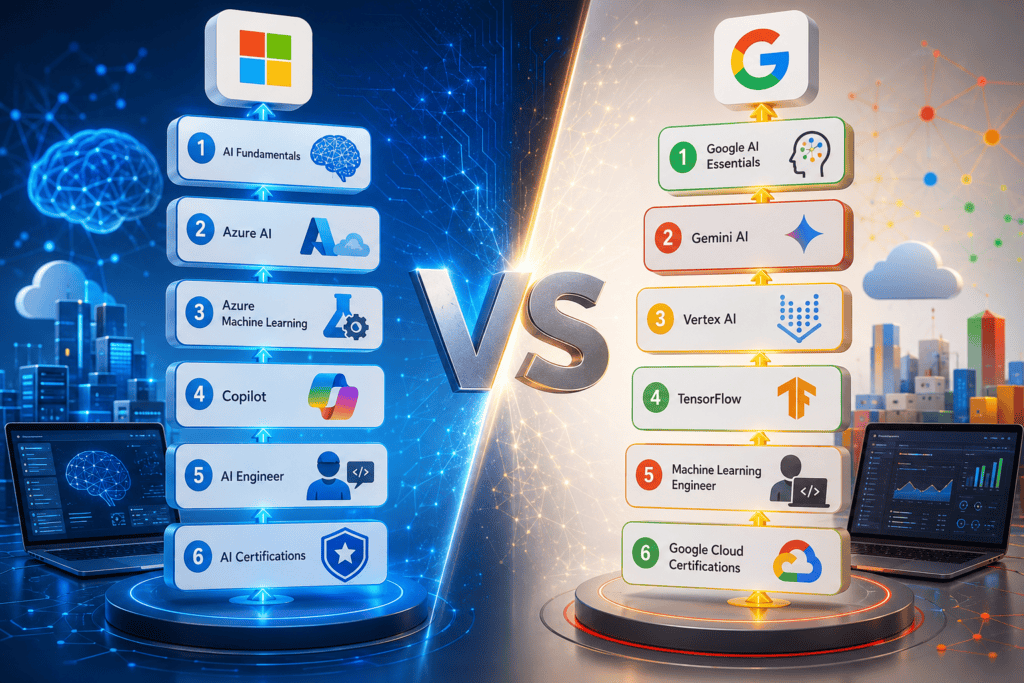
Deciding between Microsoft’s AI Learning Path and Google’s equivalent is a critical first step, as each ecosystem offers distinct tools, industry certifications, and job-ready skill sets. This guide is tailored for beginners, students, developers, IT professionals, and career changers who want to build expertise strategically rather than randomly working through disparate online courses.
Throughout this guide, you will learn how the Microsoft AI Learning Path compares to Google’s offering in curriculum structure, hands-on labs, core strengths, and career alignment. By evaluating these key trade-offs, you will be able to select the ideal learning track with confidence and start building scalable AI skills today.
What is the Microsoft AI Learning Path?
A Microsoft AI Learning Path is a structured, step-by-step training curriculum hosted on Microsoft Learn designed to build job-ready artificial intelligence skills within the Microsoft ecosystem. Rather than offering isolated theory, it bundles self-paced reading modules, interactive hands-on sandbox labs, and assessment knowledge checks into a clear sequence.
Core Characteristics & Structure
[ Fundamental Theory ] ──> [ Azure Sandbox Labs ] ──> [ Applied Projects ] ──> [ Certification Exam ]
Code language: CSS (css)- Ecosystem-Centric: Focuses heavily on native Microsoft technologies, including Azure AI Foundry, Azure OpenAI Service, Microsoft 365 Copilot, and GitHub Copilot.
- Enterprise & Agent-Oriented: Prioritizes real-world enterprise execution. Recent paths focus heavily on designing, deploying, and managing autonomous AI agents, Retrieval-Augmented Generation (RAG) architectures, and responsible AI governance frameworks.
- Certification Alignment: Most technical paths map directly to formal industry credentials, such as the Azure AI Fundamentals (Exam AI-901) or Azure AI Apps and Agents Developer Associate (Exam AI-103).
Target Audience Fit
| Learner Profile | Suitability | Primary Focus Areas |
| Software Developers | High | Building agentic apps, integrating Azure SDKs, fine-tuning LLMs with Python. |
| Cloud & IT Engineers | High | Managing cloud infrastructure, security, data pipelines, and enterprise deployment. |
| Technical Career Changers | Moderate-High | Following a structured roadmap from zero knowledge to certified associate level. |
| General AI Enthusiasts | Low-Moderate | May find the heavy emphasis on Azure-specific configuration overly technical. |
Technical vs. Non-Technical Tracks
While the Microsoft AI Learning Path ecosystem is heavily technical, Microsoft structures its offerings into distinct role-based tracks:
- Technical Tracks (Engineering & Data): Hands-on coding in Python, vector databases, computer vision, natural language processing (NLP), and cloud deployment.
- Business & Executive Tracks: Strategy-focused plans covering AI readiness, responsible scaling, cost management, and workplace productivity using Microsoft Copilot tools.
What is the Google AI Learning Path?
The Google AI Learning Path refers to Google’s structured training programs delivered through Google Skills and Google Cloud Skills Boost. Designed to build competency across machine learning, deep learning, and generative AI, Google’s curriculum spans from non-technical conceptual overviews to advanced MLOps engineering.
Core Characteristics & Structure
[ Concept Microlearning ] ──> [ Interactive Qwiklabs ] ──> [ Challenge Lab ] ──> [ Skill Badge ]
Code language: CSS (css)- Open-Source & Ecosystem Balance: Focuses on native Google Cloud infrastructure (Vertex AI, BigQuery ML, Gemini API) alongside open-source frameworks like TensorFlow, Keras, and JAX.
- Gamified Skill Badges: Instead of relying exclusively on formal exams, Google emphasizes Skill Badges—verifiable credentials earned by passing hands-on “Challenge Labs” without guided instructions.
- Generative AI Priority: Offers modular tracks dedicated to multimodal models (Gemini, Imagen), prompt engineering, and Retrieval-Augmented Generation (RAG).
Target Audience Fit
| Learner Profile | Suitability | Primary Focus Areas |
| Data Scientists & ML Engineers | High | End-to-end MLOps, custom model training on Vertex AI, and TensorFlow architectures. |
| App Developers | High | Integrating Gemini APIs, Streamlit apps, and multimodal RAG systems. |
| Beginners & Students | High | Short, accessible micro-learning paths covering Generative AI fundamentals. |
| Enterprise IT Engineers | Moderate | Cloud deployment and infrastructure setup on Google Cloud Platform (GCP). |
How it Compares to the Microsoft AI Learning Path
While a Microsoft AI Learning Path is deeply aligned with enterprise IT workflows, Azure infrastructure, and role-based certifications (like Azure AI Engineer Associate), Google’s learning ecosystem offers a broader spectrum:
- Flexibility in Entry Points: Google provides quick, 1–2-hour micro-learning modules for non-technical beginners, whereas Microsoft paths typically assume familiarity with Azure or development basics.
- Validation Approach: Microsoft relies on formal proctored certifications (AI-900, AI-102), whereas Google leverages a mix of Skill Badges for practical validation and Professional ML Engineer certifications for senior roles.
How do they differ?
The fundamental difference between a Microsoft AI Learning Path and a Google AI Learning Path comes down to architectural intent, platform integration, and career validation style.
While Microsoft optimizes its training for enterprise integration and production-ready applications, Google focuses heavily on foundational machine learning, research models, and cloud-native MLOps.
Direct Comparison Table
| Criterion | Microsoft AI Learning Path | Google AI Learning Path |
| Primary Ecosystem | Azure AI Foundry, Azure OpenAI Service, Copilot Studio, Microsoft 365 | Vertex AI, Google Cloud Platform (GCP), Gemini API, BigQuery ML |
| Core Architecture Focus | Applied AI, Retrieval-Augmented Generation (RAG), Autonomous AI Agents, Enterprise Governance | Custom ML models, Foundation Model fine-tuning, Open-source Frameworks (TensorFlow/JAX), MLOps |
| Target Audience | Enterprise developers, IT/Cloud engineers, Business Analysts, and Microsoft-stack teams | ML Engineers, Data Scientists, AI researchers, and Google Cloud developers |
| Credential & Career Signal | Proctored Exams & Certifications (e.g., Exam AI-103 for AI Apps & Agents, Exam AI-300 for MLOps) | Interactive Skill Badges (via Qwiklabs/Google Skills) & Professional ML Certifications |
| Learning Style | Linear, role-based roadmaps with sandbox environments | Modular, gamified micro-learning with timed challenge labs |
| Typical Difficulty Entry | Beginner to Advanced (Requires basic cloud/dev concepts) | Beginner to Advanced (Offers non-technical intro paths) |
3 Core Differentiators
Enterprise Applied AI vs. Deep ML Engineering
- A Microsoft AI Learning Path teaches you how to build solutions on top of existing enterprise platforms. The curriculum prioritizes integrating LLMs into business software, orchestrating multi-agent workflows, and setting up corporate security controls using Azure.
- The Google AI Learning Path goes deeper into the underlying mechanics of machine learning. It focuses heavily on pipeline creation, data transformation, model evaluation metrics, and building custom ML architectures using Vertex AI and TensorFlow.
Validation Mechanism: Certifications vs. Skill Badges
- Microsoft emphasizes formal, proctored industry credentials. Their learning paths are directly structured to prepare you for strict role-based exams (such as the Azure AI Apps and Agents Developer Associate credential).
- Google utilizes a bite-sized, gamified recognition system. While Google Cloud offers proctored certifications, its learning path relies heavily on earning digital Skill Badges by completing unguided “Challenge Labs” where you must fix broken pipelines or build working models in real time.
Native Stack Integration
- If your organization relies on Windows, Microsoft 365, GitHub, or C#/.NET, the Microsoft AI Learning Path offers native integration with tools you already use daily.
- If your technical stack leans heavily toward Python-native data science, multi-cloud architectures, BigQuery data analytics, or open-source AI models, Google’s ecosystem provides a more natural workflow.
Which AI Learning Path Is Better for Beginners?
The best choice depends on your current skill level, career goals, and the AI ecosystem you want to work in.
Google AI Learning Path
Best for: Absolute beginners, non-technical professionals, and generalists.
- Strengths: Exceptional 0-to-1 on-ramp. Features short, highly visual, bite-sized modules on Generative AI concepts, prompt engineering, and foundational ML principles.
- Friction: Very low. Requires minimal setup or cloud configuration to start learning.
- Primary Use Case: Building a fast conceptual mental model of AI, LLMs, and prompt engineering without needing deep software engineering prerequisites.
Microsoft AI Learning Path
Best for: Developers, aspiring cloud engineers, and professionals targeting enterprise tech stack alignment.
- Strengths: High career signaling and production relevance. Tightly mapped to official certifications (e.g., AI-900: Microsoft Azure AI Fundamentals or AI-102: Azure AI Engineer Associate) and practical enterprise integration (Azure OpenAI, Semantic Kernel, Copilot ecosystem).
- Friction: Moderate. Assumes basic familiarity with cloud architecture, API consumption, or software development concepts.
- Primary Use Case: Developing job-ready skills for deploying and orchestrating AI solutions within enterprise and Azure-heavy environments.
Strategic Recommendation (80/20 Rule)
- Start with Google if you want to build foundational AI literacy and grasp core GenAI capabilities in less than 10 hours with zero setup friction.
- Start with Microsoft if your immediate goal is career transition or cloud implementation, where structured certification and enterprise toolstack mastery deliver direct hiring value.
Which is better for careers and certifications?
When evaluating career ROI, both platforms offer distinct signals depending on whether you want to work in enterprise software deployment or core machine learning engineering.
Microsoft AI Learning Path: Enterprise & Cloud Apps
The Microsoft AI Learning Path directly targets enterprise digital transformation, Azure cloud ecosystems, and corporate automation.
[ AI-901: Fundamentals ] ──> [ AI-103: Apps & Agents ] ──> [ AI-300: MLOps / GenAIOps ]
Code language: CSS (css)- Target Job Titles: Azure AI Engineer, Solutions Architect, AI Application Developer, Copilot Integration Specialist, MLOps Specialist.
- Core Certifications:
- AI-901: Azure AI Fundamentals (Entry-level baseline).
- AI-103: Azure AI App and Agent Developer Associate (Builds generative AI apps, multi-agent workflows, and RAG systems).
- AI-300: MLOps and GenAIOps Engineer Associate (Production operations, lifecycle management, and enterprise governance).
- Career Signal: Very High in Corporate & Enterprise Environments. Preferred by Fortune 500 companies, Microsoft partner networks, and organizations heavily reliant on Azure, C#/.NET, Python, and Microsoft 365 Copilot ecosystems.
Google AI Learning Path: ML Engineering & Data Science
Google’s learning routes emphasize open-source frameworks, model development pipelines, and cloud-native MLOps using Vertex AI.
[ Google Skill Badges ] ──> [ Associate Cloud Engineer ] ──> [ Professional ML Engineer ]
Code language: CSS (css)- Target Job Titles: Machine Learning Engineer, MLOps Engineer, Applied Data Scientist, AI/ML Solutions Architect.
- Core Credentials:
- Google Cloud Skill Badges: Performance-based micro-credentials earned through unguided hands-on “Challenge Labs”.
- Professional Machine Learning Engineer (PMLE): High-tier proctored exam covering custom model training, MLOps pipelines, BigQuery ML, and Vertex AI Studio architectures.
- Career Signal: High in AI Research, Tech Startups, and Data-Driven Enterprises. Valued by organizations running Python-heavy workflows, TensorFlow/JAX stacks, and advanced data-science pipelines on Google Cloud Platform.
Direct Career Strategy Comparison
| Metric | Microsoft AI Learning Path | Google AI Learning Path |
| Primary Industry Focus | Enterprise IT, Finance, Healthcare, Corporate Services | AI/Tech Startups, E-commerce, Data Science, Research |
| Certification Structure | Tiered role-based associate credentials (AI-103, AI-300) | Modular Skill Badges leading to Senior Professional credentials (PMLE) |
| Hiring Market Demand | Extremely broad due to massive Azure enterprise adoption | Specialized and highly lucrative for core ML and data science roles |
| Skill Validation Method | Proctored multiple-choice & scenario exams | Hands-on lab execution + proctored professional exam |
Executive Summary: Which Should You Pursue?
- Choose the Microsoft AI Learning Path if your goal is to build AI applications, work inside enterprise environments, integrate Copilots, or become a certified Azure cloud specialist.
- Choose the Google AI Learning Path if your goal is to master end-to-end machine learning engineering, train custom models on Vertex AI, or establish yourself in a data-science-heavy role.
Quick Decision Matrix
Use this strategic decision framework to quickly evaluate your options based on ecosystem goals, workplace environment, and learning preferences:
| Strategic Goal / Scenario | Recommended Ecosystem | Primary Reason |
| You want Azure jobs, enterprise AI apps, or official Microsoft credentials | Microsoft | Direct alignment with Azure AI services, Copilot Studio, and role-based proctored exams (e.g., AI-103, AI-300). |
| You want a broader intro to AI, machine learning engineering, or Google Cloud skills | Deep focus on core ML pipelines, Vertex AI, TensorFlow, and open-source AI frameworks. | |
| Your employer already uses Microsoft Azure or the Microsoft 365 stack | Microsoft | Immediate workplace applicability with native security controls, corporate data integration, and Azure SDKs. |
| You want a flexible, bite-sized learning path with skill badges and modular topics | Gamified learning model built around interactive Qwiklabs and practical, unguided “Challenge Labs.” | |
| You are an absolute beginner looking to build fundamentals before specializing | Google First $\rightarrow$ Microsoft Second | Google offers a lower-friction conceptual on-ramp, while a Microsoft AI Learning Path provides the structured execution needed for enterprise deployment. |
Strategic Action Plan: How to Execute
[ Step 1: Google GenAI Intro ] ──> [ Step 2: Microsoft Fundamentals (AI-901) ] ──> [ Step 3: Specialization (Azure AI vs. Vertex ML) ]
Code language: CSS (css)- If you are a total beginner: Spend 5–10 hours on Google’s non-technical Generative AI overview modules to establish foundational concepts like prompting, LLM parameters, and model capabilities.
- If your primary goal is career placement or workplace transition: Transition directly into a Microsoft AI Learning Path to earn structured associate-level credentials (such as Azure AI Engineer or MLOps Associate) that align directly with enterprise hiring criteria.
Is a Microsoft AI Learning Path harder than a Google AI Learning Path?
Not necessarily—the difficulty depends on the specific path you choose.
A Microsoft AI Learning Path often feels more challenging for non-developers because it quickly transitions into Azure tenant configuration, identity management, and SDK integration. However, Google AI Learning Paths can become significantly harder at advanced levels, especially when diving into complex MLOps pipelines, custom neural network architectures in TensorFlow, or Vertex AI infrastructure.
Which path is better for AI certifications?
Microsoft is better if you want structured, role-based, proctored credentials. Credentials like AI-901 (Azure AI Fundamentals), AI-103 (Azure AI Apps and Agents Developer), and AI-300 (MLOps & GenAIOps) carry high recognition in enterprise corporate environments.
Google is better for specialized MLOps and cloud ML roles. Google offers a blend of performance-based Skill Badges for fast validation alongside high-tier credentials like the Professional Machine Learning Engineer exam.
Can beginners start with a Google AI Learning Path?
Yes. Google provides some of the lowest-friction entry points for total beginners. Its introductory Generative AI modules break down core concepts—such as large language models, prompt engineering, and responsible AI—in bite-sized, visual formats without requiring cloud experience or code execution.
Which path is better for career changers?
Choose Microsoft if you are targeting roles in established companies, enterprise IT departments, or Microsoft partner agencies where Azure is the primary cloud stack.
Choose Google if you are targeting roles in data analytics, AI research, tech startups, or open-source software engineering.
Career Tip: Switchers often start with Google’s short conceptual paths to build foundational AI literacy before transitioning into a Microsoft AI Learning Path to earn a recognized, job-ready certification.
Should I learn both Microsoft and Google AI paths?
Yes, but sequentially—never simultaneously.
Mastering one cloud AI ecosystem first (e.g., completing an Azure AI developer track or Google Vertex AI path) gives you a solid grasp of fundamental patterns like RAG, vector search, and fine-tuning. Once you understand these core concepts in one platform, transferring that knowledge to another ecosystem is much faster and more intuitive.
In Conclusion
Both the Microsoft AI Learning Path and the Google AI Learning Path offer exceptional, high-ROI frameworks for building artificial intelligence expertise, but they cater to fundamentally different career trajectories:
- Choose the Microsoft AI Learning Path if you are targeting Azure-heavy job markets, enterprise app development, Copilot orchestration, or role-based proctored certifications (such as AI-901 or AI-103).
- Choose the Google AI Learning Path if you want low-friction, beginner-friendly entry points, gamified Skill Badges, or specialized expertise in machine learning engineering, TensorFlow, and Vertex AI.
Final Strategic Advice: If you are unsure where to start, complete Google’s bite-sized introductory modules to master core AI fundamentals, then transition into a Microsoft AI Learning Path to specialize in enterprise execution and earn industry-recognized credentials.