Remote Dental Coding Jobs: Requirements, Training & Salary
Remote dental coding jobs involve translating complex dental procedures and patient charts into standardized codes for insurance claims, billing compliance, and electronic record-keeping—all from a home-based setup. While dedicated remote dental coding roles can sometimes be narrower in volume than general medical coding positions, demand is growing steadily as dental practices and large dental support organizations (DSOs) transition to centralized revenue cycle management.
Securing remote dental coding jobs requires targeted training, specialized knowledge of dental terminology, and recognized credentials. This guide explains what remote dental coding entails, the exact qualifications you need, realistic salary expectations, and how to find trustworthy employers while avoiding misleading listings.
This guide is tailored for:
- Beginners exploring remote dental coding jobs as an entry point into healthcare administration.
- Certified medical coders considering a high-demand dental specialization.
- Dental assistants, receptionists, and billing staff seeking flexible remote work opportunities.
- Career changers looking for legitimate healthcare work-from-home roles.
- Students researching appropriate dental coding training or certification paths.
- International readers wanting to understand the technical requirements of remote dental coding jobs.
By the end of this guide, you will understand daily responsibilities, education pathways, salary ranges, and practical next steps to land your first role.
What is a remote dental coder?
A remote dental coder is a healthcare administrative professional who reviews patient treatment records from dental practices and assigns standardized procedure codes—primarily from the Current Dental Terminology (CDT) code set—allowing dental offices to submit accurate insurance claims from a home-based office.
Because many practices and dental support organizations combine administrative functions, remote dental coding jobs frequently operate as hybrid “dental billing and coding” roles.
Core Responsibilities of a Remote Dental Coder
- Reviewing Clinical Documentation: Examining dentist notes, radiographs, periodontal charts, and proposed treatment plans.
- Assigning CDT Codes: Translating specific dental procedures—such as diagnostic exams, cleanings, restorations, endodontics, and oral surgery—into codes that always begin with the letter “D” followed by four numbers.
- Ensuring Compliance: Verifying that clinical records precisely substantiate the selected codes while maintaining strict adherence to HIPAA and payer guidelines.
- Managing Denials and Appeals: Collaborating with dental billers to investigate rejected claims, correct errors, and ensure maximum rightful reimbursement.
Dental Coding vs. Dental Billing vs. Medical Coding
Understanding the differences between these functions helps you choose the right training programs and target the correct job titles when searching for remote dental coding jobs.
| Aspect | Dental Coding | Dental Billing | Medical Coding |
| Primary Codes | CDT (D0000–D9999) | CDT + insurance claim forms | CPT, ICD-10, HCPCS |
| Main Task | Assign codes to procedures | Submit claims, follow up on payments | Assign codes to diagnoses/procedures |
| Claim Form | Dental claim forms (ADA) | Dental/insurance claim forms | CMS-1500 or UB-04 |
| Typical Employer | Dental practices, billing companies | Dental practices, billing companies | Hospitals, clinics, insurance firms |
| Remote Availability | Moderate (often combined with billing) | High | High |
Key Takeaway
Many employers advertise remote dental coding jobs as combined “dental billing and coding” positions because a single remote specialist frequently manages both data coding and claims submission.
Do You Need Previous Dental or Medical Experience?
Short answer: No, but it helps. While having clinical background knowledge makes the learning curve easier, you do not need to be a former dental assistant or nurse to secure entry-level remote dental coding jobs. Most employers focus on technical competency, accuracy, and formal training.
Core Qualifications for Entry-Level Roles
- Educational Baseline: A high school diploma or equivalent.
- Specialized Training: Completion of an accredited dental or medical billing and coding training program.
- Credentials: A recognized certification (strongly preferred by hiring managers and often required for remote work).
- Technical Proficiency: Basic computer literacy, familiarity with electronic health record (EHR) systems, and a solid grasp of dental or medical terminology.
Common Career Backgrounds for Dental Coders
Prior clinical experience—such as working as a dental assistant, front desk receptionist, or hygienist—gives candidates a distinct advantage because they already understand chairside procedures, tooth charting, and insurance verification workflows. However, many successful professionals enter remote dental coding jobs by transitioning from:
- General medical coding or billing roles.
- Administrative, clerical, or customer service careers.
- Unrelated fields, following the completion of targeted certification and practical training programs.
Education and Training Requirements
Landing remote dental coding jobs requires a clear blend of formal education, practical training, and technical skill mastery. Because remote roles offer less on-the-site supervision, employers look for documented proof of competence through structured educational programs.
Minimum Education
- High School Diploma or GED: This serves as the universal baseline requirement for almost all training programs and entry-level remote positions.
- Postsecondary Certificates or Degrees: Some competitive employers prefer candidates who hold a postsecondary certificate or an associate degree in health information technology, medical billing and coding, or a related administrative field.
Training Programs
Accredited online training programs designed to prepare candidates for remote dental coding jobs typically cover:
- Medical and dental terminology.
- Basic human anatomy and oral physiology.
- Coding systems, including CDT codes alongside foundational exposure to CPT, ICD-10, and HCPCS codes.
- Insurance claim processing and revenue cycle workflows.
- HIPAA compliance, cybersecurity, and patient privacy standards.
- Electronic health records (EHR) and dental practice management software.
Program Timeline and Investment:
- Duration: Certificate programs typically run between 4 and 12 months, while associate degrees can take up to 2 years.
- Cost Range: Professional certificate programs generally range from $1,500 to $4,500 (£1,200 to £3,500), depending on the provider, institutional accreditation, and whether certification exam fees are included.
What to Look For in a Training Program
When evaluating education providers to qualify for remote dental coding jobs, prioritize programs that:
- Carry accreditation from recognized bodies or educational authorities (such as AAPC, AHIMA, or regionally accredited vocational and higher-education institutions).
- Include certification exam vouchers or preparation resources as part of the tuition package.
- Offer active career placement support, resume reviews, or internship opportunities.
Certification: Is It Required?
Certification is rarely mandated by law, but it is strongly preferred—and frequently required—by employers hiring for remote dental coding jobs. Because remote employees work independently, certifications serve as objective proof of your technical competence, accuracy, and understanding of coding compliance.
Common Certifications for Dental and Medical Coding
| Certifying Body | Credential | Focus | Best For |
| AAPC | CPC (Certified Professional Coder) | Physician/outpatient coding (CPT, ICD-10) | General medical coding; widely accepted across healthcare roles |
| AAPC | CPB (Certified Professional Biller) | Billing workflows and insurance claims | Dental billing-heavy and revenue cycle roles |
| AHIMA | CCA (Certified Coding Associate) | Foundational coding principles | Beginners entering medical or dental coding |
| AHIMA | CCS (Certified Coding Specialist) | Hospital and inpatient coding | Advanced coders handling complex charts |
| NHA | CBCS (Certified Billing & Coding Specialist) | Combined billing and coding operations | Entry-level remote dental billing and coding jobs |
| ADA / Industry | Dental CEUs / CDT-focused credentials | Dental-specific terminology and CDT rules | Coders seeking dedicated dental specialization |
Which Credential Should You Choose?
For specialized remote dental coding jobs, credentials like the NHA CBCS or AAPC CPB offer highly relevant training for day-to-day dental billing and revenue workflows. However, many employers accept general medical coding credentials (such as the CPC) and provide in-house training for specific CDT code sets.
Maintenance Note
Most professional certifications require you to complete continuing education units (CEUs) every 1 to 2 years to keep your credential active and up to date with annual code revisions.
Essential Skills Required for Remote Dental Coding Jobs
Beyond formal training and certifications, thriving in remote dental coding jobs requires a specific mix of technical competencies, behavioral habits, and self-discipline. Because remote coders operate independently without direct physical oversight, employers actively evaluate candidates for these traits:
- High Attention to Detail: A single incorrect CDT code or miskeyed tooth number can delay payment claims, trigger insurance rejections, or initiate compliance audits.
- Computer Proficiency: Fluid navigation across electronic health record (EHR) platforms, dental practice management software (such as Dentrix or Eaglesoft), and cloud collaboration suites like Google Workspace or Microsoft Office.
- Effective Communication: The ability to professionally coordinate with on-site dental assistants, dentists, and billing departments via email, instant chat, or video conferencing to resolve ambiguous chart notes.
- Time Management and Independence: Remote work requires strong self-discipline, organization, and the capability to consistently meet productivity and accuracy targets without micromanagement.
- Comprehensive HIPAA Awareness: Strict adherence to patient privacy rules, secure data handling, and encryption protocols to protect sensitive healthcare information in a home-office environment.
Typical Remote Work-Environment Requirements
In addition to soft skills, companies hiring for remote dental coding jobs frequently require candidates to maintain a professional home workspace featuring:
- A quiet, private, and distraction-free home office setup.
- High-speed broadband internet access (typically 25 Mbps download speeds or higher).
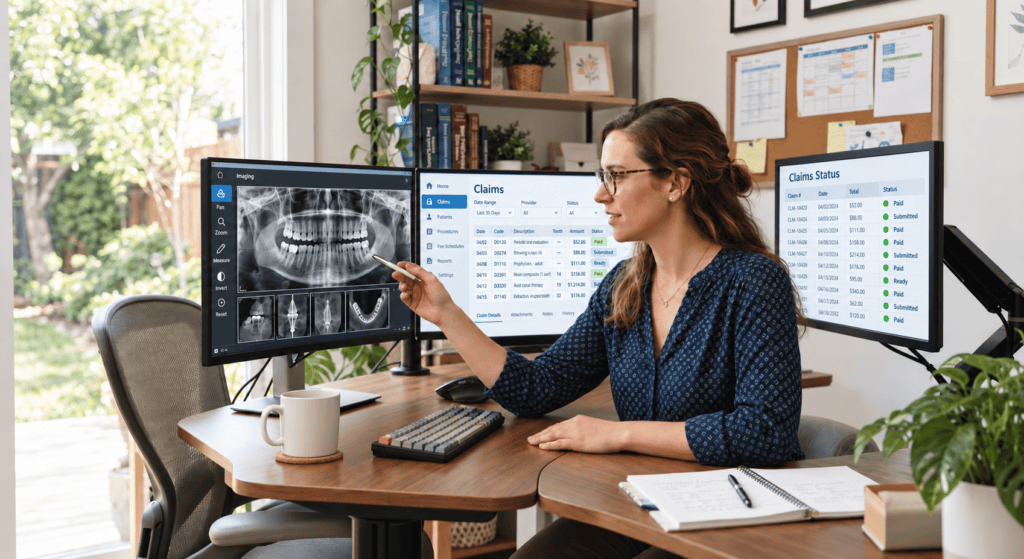
- Multi-monitor computer setups (dual monitors) to efficiently cross-reference clinical charts, radiographs, and insurance claim portals simultaneously.
- Successful completion of pre-employment background checks and cybersecurity compliance verifications.
What Do Remote Dental Coding Jobs Pay?
Because dedicated “dental coder” positions are often categorized under general medical or dental billing and coding, exact salary data specifically for dental coding is rare. However, we can accurately extrapolate expected earnings by analyzing broader healthcare coding data, remote market trends, and industry job postings.
National Salary Ranges (United States)
| Experience Level | Annual Salary (USD) | Hourly Rate (USD) |
| Entry-Level (0–1 year) | $37,000–$45,000 | $17–$22 |
| Mid-Level (1–3 years) | $45,000–$55,000 | $22–$27 |
| Experienced (3+ years, certified) | $55,000–$70,000+ | $27–$35+ |
| Remote Specialists (certified, niche) | $60,000–$83,000+ | $29–$40+ |
Key Compensation Data Points
- BLS Baseline: The U.S. Bureau of Labor Statistics reports a median annual salary of $51,140 ($24.59 per hour) for medical records specialists, which encompasses coding and billing professions.
- The Remote Premium: Remote medical and healthcare coders frequently earn slightly higher averages—around $64,000 annually—due to employer savings on physical office space and access to wider talent pools.
- Top Earners: The top 10% of specialized or multi-credentialed coders make over $75,000 to $83,000+ per year, particularly when working for large dental support organizations (DSOs) or insurance payers.
Salary by Location and Context
While remote dental coding jobs allow you to work from home, some employers structure pay scales based on regional cost-of-living tiers or state wage laws:
- California (Remote): $48,000–$65,000+ (tends to skew toward the higher end for experienced specialists).
- National Average (US):~$51,140 median.
- International Considerations: Remote opportunities outside the U.S. are less common, but international professionals hired by multinational firms or digital platforms may see varied pay structures. Always verify currency terms, tax responsibilities, and contractor vs. employee classifications before accepting offers.
Where to Find Legitimate Remote Dental Coding Jobs
Finding legitimate work-from-home positions requires knowing where to look and how to bypass generic job aggregator spam. Because dedicated remote dental coding jobs are often bundled with billing duties, targeting specialized channels yields the highest success rate.
Top Job Boards and Aggregators
- ZipRecruiter: Search directly using exact phrases like “remote dental coding” or “remote dental billing and coding.”
- Indeed: Filter your search results by selecting the “Remote” location option and pairing it with keywords such as “dental coder,””dental biller,” or “CDT coding.”
- LinkedIn Jobs: Utilize advanced search filters for remote roles within healthcare administration and set up automated alerts for new postings.
- FlexJobs: A curated job board specializing in vetted remote and flexible professional positions (note that a paid subscription is required, but it screens out fraudulent listings).
- Remote.co and We Work Remotely: General remote platforms that occasionally list specialized healthcare administration, medical billing, and coding roles.
Types of Employers That Hire Remote Dental Coders
While independent dental practices typically employ in-front-desk staff, several categories of businesses centralize their revenue cycle and actively hire remote talent:
- Dental Billing Companies: Industry firms like eAssist Dental Solutions, DentalClaimSupport, and Pearl Dental Billing frequently hire remote billing and coding specialists to manage accounts for multiple partner practices.
- Dental Support Organizations (DSOs): Large corporate dental networks manage clinical operations across dozens or hundreds of offices, making them prime employers for remote administrative and coding staff.
- General Medical Billing Firms: Some large-scale medical outsourcing companies also handle dental insurance portfolios, hiring coders who possess cross-trained CDT knowledge.
- Dental Insurance Carriers: Major insurance providers occasionally hire remote dental coding auditors, claims reviewers, and quality assurance specialists.
Red Flags: How to Avoid Scams
Remote healthcare administrative jobs frequently attract employment scammers targeting job seekers. Protect yourself by watching out for these critical warning signs:
- Requests for Upfront Payment: Legitimate employers will never ask you to pay for mandatory “training software,” equipment kits, or background checks out of pocket.
- Vague Job Descriptions: Listings that omit company names, physical addresses, or precise performance expectations should be approached with caution.
- Unrealistic Pay Rates: Offers that seem too good to be true—such as “$50 per hour with zero experience required”—are almost always fraudulent.
- Unprofessional Communication: Be wary of poorly written emails or interview processes conducted exclusively through instant chat messaging without any video or phone interaction.
- Premature Data Requests: Never provide sensitive personal information, banking details, or government identification numbers before receiving a formal, verified written employment offer.
Verification Checklist
Before submitting an application or accepting an interview, always confirm:
- The hiring company’s official website and verified physical business address.
- Employer reviews and employee feedback on trusted platforms like Glassdoor, Indeed, or the Better Business Bureau (BBB).
- That the exact job listing is actively published on the company’s official corporate careers page.
Step-by-Step: How to Start a Remote Dental Coding Career
Launching a career in this field requires a methodical approach that blends education, credentialing, and targeted job hunting. Follow this step-by-step roadmap to transition into remote dental coding jobs:
Assess Your Fit
Before investing time and financial resources, evaluate whether your working style matches the realities of remote administrative work:
- Do you genuinely enjoy detail-oriented, analytical tasks?
- Are you comfortable maintaining high productivity while working independently from home?
- Do you have a dedicated, quiet workspace and reliable high-speed internet?
- Are you prepared to spend 4 to 12 months completing training and earning a credential?
Complete an Accredited Training Program
Select a reputable online or vocational training program that fits your schedule and budget. Ensure the curriculum covers:
- CDT, CPT, ICD-10, and HCPCS coding systems.
- Dental and medical terminology alongside basic anatomy.
- Insurance claim processing workflows and electronic health record (EHR) software.
Earn a Recognized Certification
Sit for an industry-standard certification exam to validate your technical competence to employers hiring for remote dental coding jobs:
- NHA CBCS: Excellent for combined billing and coding workflows.
- AAPC CPC or CPB: Widely recognized credentials that provide strong baseline marketability.
- AHIMA CCA: A respected entry-level certification for healthcare coding.
Gain Practical Experience
Build your professional background through accessible entry points:
- Utilize externships, internships, or practical labs offered directly through your training institution.
- Take on entry-level, on-site dental front-desk, receptionist, or dental billing roles to master real-world insurance protocols.
- Start in general medical coding roles and transition into specialized dental accounts as opportunities arise.
Build a Remote-Ready Profile
Optimize your professional assets for remote recruitment filters:
- Build a clean LinkedIn profile highlighting your certifications, software competencies, and CDT knowledge.
- Craft a results-driven resume emphasizing metrics (e.g., “managed claims processing with a 98% accuracy rate”).
- Prepare your home workspace with dual monitors, high-speed broadband, and a secure environment.
Apply Strategically
Target your job search precisely rather than casting a wide, generic net:
- Search for keywords like “remote dental coding,””dental billing and coding,” or “CDT claims specialist.”
- Monitor listings on specialized job boards, LinkedIn, Indeed, and dental support organization (DSO) career pages.
- Network within professional healthcare administration communities, LinkedIn groups, and industry forums.
Commit to Continuous Learning
Coding standards evolve continuously, making lifelong learning vital for long-term career growth:
- Complete dental-specific continuing education units (CEUs) to deepen your expertise.
- Stay updated on annual CDT code changes released by the American Dental Association (ADA).
- Pursue niche specializations—such as oral surgery, endodontics, or orthodontic coding—to command higher pay rates and premium remote roles.
Common Misconceptions About Remote Dental Coding Jobs
Navigating the transition into remote healthcare administration often involves sorting through inaccurate rumors. Here are the most common misconceptions about remote dental coding jobs contrasted with reality:
| Misconception | Reality |
| “Dental coding is just like medical coding.” | Dental coding relies primarily on CDT procedure codes rather than CPT or ICD-10 diagnosis codes, and it follows completely different insurance claim submission rules. |
| “You need a dental background or degree to code.” | Clinical experience helps, but specialized training programs and professional certifications adequately prepare non-dental professionals for remote roles. |
| “All remote coding jobs advertised online are legitimate.” | Employment scams in remote healthcare are prevalent; always verify company credentials, official websites, and avoid any job that demands upfront fees. |
| “Certification is optional, so you can skip it.” | While certification is rarely mandated by law, skipping it severely limits your hiring odds, marketability, and earning potential. |
| “Remote dental coders earn $60,000+ right away.” | Entry-level positions typically start between $37,000 and $45,000; higher six-figure or upper-tier salaries require experience, advanced certifications, and specialized niche expertise. |
Limitations and Trade-Offs of Remote Dental Coding Jobs
While remote dental coding jobs offer exceptional flexibility, work-from-home convenience, and specialized career paths, aspiring professionals must weigh several practical limitations and trade-offs before committing to the field:
- Fewer Dedicated Remote Dental Coding Positions: Because many dental practices and smaller clinics combine administrative duties, standalone “dental coder” roles are relatively rare. Most available remote opportunities require managing a hybrid mix of dental billing and coding or handling general medical billing with nested dental accounts.
- Geographic and State Restrictions: Even though a position is fully remote, many U.S.-based employers restrict hiring to candidates living in specific states. This is driven by complex state-by-state employer tax laws, workers’ compensation regulations, and healthcare insurance licensing requirements.
- High Productivity Quotas and Performance Pressure: Remote employers track output closely using automated metric software. Coders are frequently expected to meet strict daily quotas—such as accurately reviewing and coding 40 to 60 charts per day—which can introduce significant stress and pressure for beginners adjusting to work-from-home environments.
- Potential Career Plateaus Without Upskilling: Without pursuing advanced specializations, continuing education, or additional cross-industry certifications, income and professional advancement can plateau after 3 to 5 years in standard production roles.
Can I work remotely as a dental coder with no experience?
Yes, but it is challenging. Most employers prefer candidates with at least 6 to 12 months of general medical coding or dental billing experience. Completing an accredited training program, earning a professional certification, and building initial familiarity (even through an in-office internship or entry-level administrative role) significantly improves your hiring prospects.
Do I need to know CPT and ICD-10 if I only want to do dental coding?
While standard routine dental procedures rely exclusively on CDT codes, many dental practices also perform medical procedures—such as complex oral and maxillofacial surgery, TMJ treatments, or appliances for obstructive sleep apnea.
Because these services are often billed to medical insurance carriers, having cross-trained familiarity with CPT and ICD-10 codes makes you a much more competitive candidate.
How long does it take to become a remote dental coder?
It typically takes 6 to 12 months total. This breaks down into 4 to 8 months spent completing foundational training and earning your certification, followed by job hunting and gaining initial practical experience to land a remote position.
Is dental coding a good career for career changers?
Yes, it is an excellent pathway if you enjoy detail-oriented, analytical work and want a stable healthcare career without direct patient contact. Furthermore, the broader field of medical records and health information technology is projected to experience steady growth through the coming decade according to federal labor statistics.
Can I work remotely from outside the U.S.?
A small number of digital-first organizations or third-party outsourcing firms hire international talent. However, the vast majority of U.S.-based remote dental coding and billing roles require you to reside within the United States due to strict HIPAA data security laws, state employer tax laws, and healthcare insurance compliance rules. Always verify an employer’s geographic policy before applying.
In Conclusion
Remote dental coding jobs offer a flexible, stable career path within healthcare administration, bridging clinical dentistry and financial operations through accurate CDT code assignment and insurance claims management.
- Role Flexibility: While dedicated remote positions often combine dental coding and billing duties, demand is growing across dental practices, third-party billing firms, and large DSOs.
- Accessibility: Prior clinical experience is helpful but not mandatory; completing structured training and earning recognized credentials (such as the CBCS, CPC, or CPB) provides the necessary foundation.
- Competitive Compensation: Entry-level professionals typically start between $37,000 and $45,000 annually, while certified, experienced specialists earn upward of $55,000 to $83,000+.
- Strategic Job Hunting: Legitimate remote opportunities can be found on specialized job boards and through established dental billing companies, provided you actively screen out employment scams.
Practical Next Step
If you are serious about pursuing remote dental coding jobs, take your first definitive step today by researching accredited online training programs that align with your budget, timeline, and professional goals, and enroll in a course that includes recognized certification preparation.