Breaking into cybersecurity does not require a $10,000 bootcamp or an expensive degree—especially when leading tech providers offer free cybersecurity courses that build job-ready defensive skills from scratch.
As businesses, governments, and educational institutions rely more heavily on connected systems to store data and process transactions, their attack surface continues to expand.
Rising threats like phishing, ransomware, identity theft, and network intrusions have turned cybersecurity into one of the highest-leverage digital skills for students, career changers, and IT professionals.
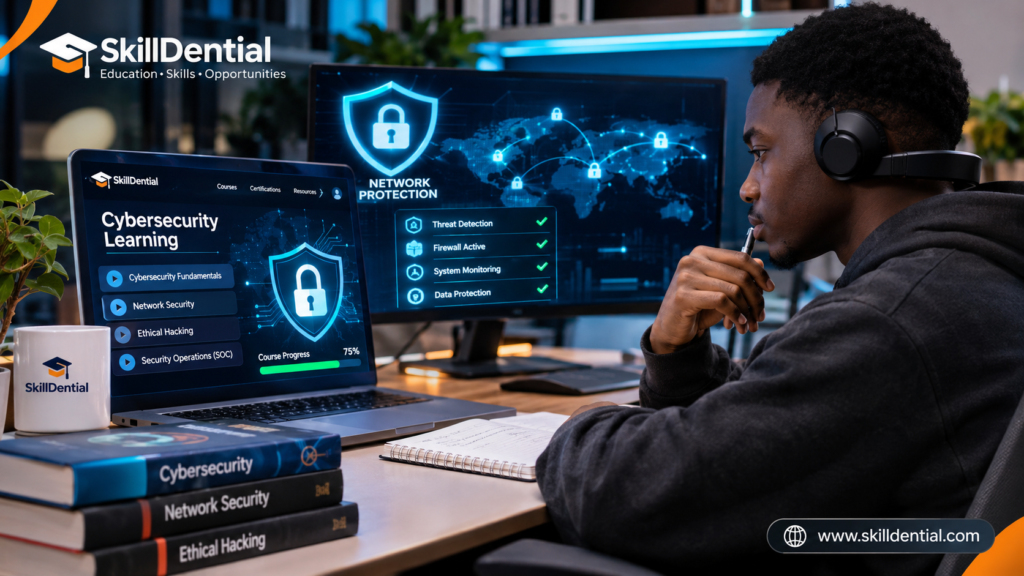
The challenge for most beginners is upfront cost, paired with confusion over which “free” programs actually grant verifiable credentials versus those that lock certificates behind a paywall.
Fortunately, major industry organizations and learning platforms now provide free cybersecurity courses complete with digital badges and completion certificates you can add directly to your resume or LinkedIn profile.
In this guide, we evaluate 11 of the best free cybersecurity courses available online—breaking down the exact skills each curriculum covers, who it is built for, and whether you can claim your certificate at zero cost.
What Is Cybersecurity?
Cybersecurity is the practice of protecting computers, networks, applications, and digital data from unauthorized access, cyberattacks, and theft. In practice, it works across four core functions: identifying system vulnerabilities, preventing intrusions, detecting active threats, and responding to security incidents before they cause widespread damage.
Because modern infrastructure spans on-premise hardware, cloud environments, and software applications, the field is divided into specialized domains:
- Network Security: Securing internal networks and internet traffic against unauthorized access, malware, and intrusions.
- Information Security (InfoSec): Protecting the confidentiality, integrity, and availability of sensitive data—whether stored or in transit.
- Cloud Security: Safeguarding cloud-hosted infrastructure, applications, and data across platforms like AWS, Azure, and Google Cloud.
- Application Security (AppSec): Finding and patching code-level vulnerabilities before attackers exploit them.
- Ethical Hacking (Penetration Testing): Simulating authorized cyberattacks to expose weaknesses before malicious actors do.
- Security Operations (SecOps): Continuously monitoring live systems, investigating alerts, and containing active security incidents.
- Digital Forensics: Collecting and analyzing digital evidence after a breach to determine how an attack occurred and support recovery.
You do not need to master every domain at once. Enrolling in free cybersecurity courses lets you build a strong foundation in networking, operating systems, and threat fundamentals first—giving you the clarity to choose a specialization later.
11 Best Free Cybersecurity Courses Online with Certificates
The free cybersecurity courses below are offered by leading technology vendors, accredited security organizations, and established learning platforms. Together, they span the core pillars of defensive and offensive security—from foundational threat awareness and network defense to ethical hacking and security operations (SecOps).
Before enrolling, keep one critical distinction in mind: a course completion certificate or digital badge is not the same as an accredited industry certification earned through a proctored exam (such as CompTIA Security+ or CISSP).
Completion credentials validate structured learning and strengthen an entry-level resume, whereas proctored certifications carry formal hiring compliance weight.
To help you choose the right starting point, each listing below specifies:
- Core Curriculum: The exact technical skills and security domains covered.
- Target Audience: Whether the syllabus fits complete beginners, IT generalists, or aspiring analysts.
- Credential & Cost Breakdown: The exact type of recognition issued—and whether the certificate is 100% free or requires a paid upgrade after auditing.
Introduction to Cybersecurity – Cisco Networking Academy
- Provider: Cisco Networking Academy (Cisco)
- Level: Beginner (No prerequisites)
- Duration: ~6 hours (Self-paced)
- Cost & Credential: 100% Free — Includes a verifiable Credly digital badge and printable completion certificate
Course Overview:
Designed as an accessible entry point into digital defense, Cisco’s Introduction to Cybersecurity demystifies how cyberattacks happen and how organizations defend their networks.
Delivered across five interactive modules with seven hands-on labs, it bridges the gap between everyday online safety and enterprise security fundamentals—making it one of the strongest free cybersecurity courses for absolute beginners.
Core Curriculum (What You Will Learn):
- Threat Landscape & Attack Vectors: How social engineering, malware, and network infiltration techniques exploit system vulnerabilities.
- Personal Data & Device Security: Practical steps to harden personal devices, secure home networks, and protect digital privacy.
- Organizational Defense: How enterprises deploy firewalls, intrusion prevention, and behavioral security protocols to safeguard critical data.
- Governance, Ethics & Career Mapping: Legal frameworks, ethical boundaries, and entry-level career pathways in security operations.
Certificate & Badge Details:
Upon passing the final course exam and completing the end-of-course survey, learners receive an official Cisco digital badge via Credly alongside a downloadable, printable completion certificate at zero cost.
- Best For:
- Complete beginners,
- Students,
- Non-technical career changers looking to test their interest in security before committing to longer tracks like
- Cisco’s Junior Cybersecurity Analyst pathway
- CompTIA Security+.
- Enrollment: Start Cisco’s Introduction to Cybersecurity on Cisco Networking Academy
Cybersecurity Fundamentals – IBM SkillsBuild
- Provider: IBM SkillsBuild (IBM)
- Level: Beginner (No prerequisites)
- Duration: ~7.5 hours (4-module learning plan, self-paced)
- Cost & Credential: 100% Free — Includes a verifiable IBM digital badge via Credly
Course Overview:
Built to mirror how enterprise security teams actually operate, IBM SkillsBuild’s Cybersecurity Fundamentals takes learners through both offensive threat mechanics and defensive response protocols.
Structured across four sequential modules, it stands out among free cybersecurity courses for introducing real industry frameworks—such as the CIA Triad, Cyber Kill Chain, and MITRE ATT&CK—without requiring a technical background.
Core Curriculum (What You Will Learn):
- Security Principles & Risk Management: The CIA Triad (Confidentiality, Integrity, Availability), governance fundamentals, and business risk evaluation.
- Offensive Threat Analysis: Threat actor profiles, social engineering tactics, and attacker frameworks like the Cyber Kill Chain and MITRE ATT&CK.
- Defensive Controls & Cryptography: Core encryption concepts, threat intelligence, and preventative security architecture.
- Incident Detection & Response: How Security Operations Centers (SOCs) detect breaches, contain incidents, and execute recovery workflows.
Certificate & Badge Details:
Learners who finish all four modules and pass the end-of-course assessment with a score of 80% or higher unlock an official IBM Cybersecurity Fundamentals digital badge issued via Credly at zero cost. This verified badge can be embedded directly on LinkedIn, resumes, and digital portfolios.
- Best For:
- Beginners,
- University students,
- Career switchers who want structured exposure to enterprise security frameworks and SOC workflows before advancing into hands-on technical labs.
- Enrollment: Start IBM SkillsBuild’s Cybersecurity Fundamentals
Free Cybersecurity Training – Fortinet Training Institute
- Provider: Fortinet Training Institute (Fortinet)
- Level: Beginner to Advanced (Modular catalog)
- Duration: Self-paced (Varies by course track)
- Cost & Credential: 100% Free self-paced courses; entry-level NSE 1–3 credentials/badges are free, while advanced NSE exams and on-demand labs require payment
Course Overview:
Operated by one of the world’s largest enterprise network security vendors, the Fortinet Training Institute opens its entire self-paced course library to the public at no cost.
Unlike single-module intros, this portal functions as a full-stack learning ecosystem—allowing beginners to master core threat concepts before advancing directly into firewall administration, cloud defense, and Zero Trust architecture.
Among free cybersecurity courses, it offers one of the deepest vendor-backed technical catalogs available.
Core Curriculum (What You Will Learn):
- Threat Landscape & Security Fundamentals: Attack vectors, malware mechanics, and foundational security hygiene.
- Secure Networking & Firewall Operations: Next-generation firewall (NGFW) policies, VPNs, routing, and FortiGate configuration.
- Zero Trust Network Access (ZTNA): Identity-driven access controls and network segmentation.
- Cloud & Application Security: Securing hybrid cloud workloads, SASE architectures, and web applications.
- Security Operations (SecOps): Threat intelligence, automated incident response, and SIEM/SOAR workflows.
Certificate & Credential Details:
All self-paced video lessons and study guides in the Training Institute library are free. Following Fortinet’s July 2026 update to its Network Security Expert (NSE) framework, learners can earn free entry-level NSE 1, NSE 2, and NSE 3 credentials/badges by completing the corresponding introductory courses and assessments.
Higher-tier NSE certification exams (such as NSE 4 and above) and optional hands-on on-demand labs require paid vouchers.
- Best For:
- Aspiring network engineers,
- IT generalists,
- Beginners who want to pair vendor-neutral security fundamentals with hands-on exposure to enterprise firewall and network defense technologies.
- Enrollment: Explore Free Self-Paced Training on Fortinet Training Institute
Introduction to Cyber Security – Simplilearn SkillUp
- Provider: Simplilearn (SkillUp)
- Level: Beginner (No prerequisites)
- Duration: ~2 hours (4 structured video lessons, self-paced)
- Cost & Credential: 100% Free — Includes a downloadable SkillUp completion certificate (90 days of free course access upon enrollment)
Course Overview:
Built as a fast, high-level orientation rather than a multi-week bootcamp, Simplilearn SkillUp’s Introduction to Cyber Security condenses core security principles into roughly two hours of self-paced video instruction.
While it skips hands-on labs and proctored exams, it ranks among the most accessible free cybersecurity courses for non-technical learners who want a rapid primer on enterprise architecture, governance, and everyday endpoint security.
Core Curriculum (What You Will Learn):
- Cybersecurity Fundamentals & Threats: Core security concepts, common attack vectors, and vulnerability mitigation strategies.
- Enterprise Architecture & Components: How organizational networks, endpoints, and infrastructure are structured and defended.
- Wireless & BYOD Security: Securing wireless networks and managing risks tied to Bring Your Own Device (BYOD) workplace policies.
- Governance, Risk & Incident Management: Information system governance, risk assessment prioritization, and basic incident detection and recovery workflows.
Certificate & Credential Details:
Learners receive 90 days of free access upon signing up. Once you complete all four video modules, Simplilearn unlocks a free SkillUp Certificate of Completion directly inside your account dashboard, which you can download as a PDF or share on LinkedIn.
- Best For:
- Complete beginners,
- Students,
- Non-IT professionals who want a concise, same-day overview of cybersecurity terminology and a verifiable completion certificate before committing to deeper technical training.
- Enrollment: Enroll in Introduction to Cyber Security on Simplilearn SkillUp
Ethical Hacking Basics – Simplilearn SkillUp
- Provider: Simplilearn (SkillUp)
- Level: Beginner (No prior command-line or coding experience required)
- Duration: ~2 hours (4 structured video lessons, self-paced)
- Cost & Credential: 100% Free — Includes a downloadable SkillUp completion certificate (90 days of free course access upon enrollment)
Course Overview:
Ethical hacking is the authorized practice of probing networks, applications, and systems to expose vulnerabilities before malicious actors exploit them. Simplilearn SkillUp’s Ethical Hacking Basics introduces offensive security concepts without requiring prior command-line or coding experience.
Across four structured video lessons—including a live phishing walkthrough—it ranks among the most approachable free cybersecurity courses for beginners exploring red-teaming and penetration testing.
Core Curriculum (What You Will Learn):
- Ethical Hacking Fundamentals & Legal Boundaries: Hacker classifications (white, gray, and black hat) and the legal authorization rules separating penetration testing from cybercrime.
- The Ethical Hacking Process: How security testers execute reconnaissance, scanning, vulnerability analysis, and reporting.
- Phishing & Social Engineering Mechanics: A practical demonstration showing how phishing attacks are constructed and how organizations detect them.
- Web, Mobile & Log Analysis Basics: Common flaws in web and mobile applications alongside how system logs reveal intrusion footprints.
- Career Roadmap: Next steps for progressing toward hands-on labs (like Kali Linux) and industry exams such as Certified Ethical Hacker (CEH).
Certificate & Credential Details:
Enrolling grants 90 days of free access to all video lessons. Upon finishing the curriculum, Simplilearn unlocks a downloadable SkillUp Certificate of Completion at zero cost, which can be shared directly on LinkedIn or attached to entry-level resumes.
- Best For:
- Complete beginners,
- Students,
- Aspiring penetration testers who want a fast, jargon-free introduction to offensive security before investing in virtual lab environments or paid certifications.
- Enrollment: Enroll in Ethical Hacking Basics on Simplilearn SkillUp
Introduction to Cybercrime – Simplilearn SkillUp
- Provider: Simplilearn (SkillUp)
- Level: Beginner (No prior technical background required)
- Duration: ~2 hours (10 structured video lessons, self-paced)
- Cost & Credential: 100% Free — Includes a downloadable SkillUp completion certificate (90 days of free course access upon enrollment)
Course Overview:
Cybercrime encompasses illegal operations carried out against computers, networks, and digital data—ranging from financial fraud to large-scale infrastructure disruptions. Simplilearn SkillUp’s Introduction to Cybercrime moves beyond abstract definitions to break down the exact attack mechanisms cybercriminals use against modern organizations.
Spanning 10 concise video lessons, it stands out among free cybersecurity courses for introducing beginners to concrete technical attack vectors—such as SQL injection, DDoS, and brute-force attacks—in plain, accessible language.
Core Curriculum (What You Will Learn):
- Network & Threat Fundamentals: Basic network terminology, the evolution of cybercrime, and how security threats are classified.
- Technical Attack Vectors: Mechanics behind SQL injection, Distributed Denial-of-Service (DDoS), and brute-force attacks.
- Insider Threats & Organizational Risk: How internal vulnerabilities and human error expose businesses to data breaches.
- Preventative Security Controls: Actionable defensive strategies for safeguarding personal devices and enterprise networks against intrusion.
Certificate & Credential Details:
Enrolling unlocks 90 days of complimentary access to all 10 lessons. Once you complete the full video sequence, Simplilearn issues a free, downloadable SkillUp Certificate of Completion inside your dashboard that can be shared on LinkedIn or included on entry-level resumes.
- Best For:
- Beginners,
- Students,
- Aspiring digital forensics or SOC analysts who want a fast, structured breakdown of real-world cyberattack methods before diving into hands-on defensive labs. Enrollment:
- Enroll in Introduction to Cybercrime on Simplilearn SkillUp
Introduction to Cyber Security: Stay Safe Online – OpenLearn
- Provider: OpenLearn (The Open University)
- Level: Level 1: Introductory (No prerequisites)
- Duration: ~24 hours (8-week modular syllabus, self-paced)
- Cost & Credential: 100% Free — Includes a free Statement of Participation and a verified Open University digital badge
Course Overview:
Produced by The Open University in the United Kingdom and presented by visiting professor Cory Doctorow, Introduction to Cyber Security: Stay Safe Online offers one of the most thorough academic-style introductions available at zero cost.
Unlike short two-hour primers, this 24-hour curriculum walks learners step-by-step through securing both personal digital assets and workplace networks across eight structured modules—making it one of the highest-depth free cybersecurity courses for self-paced beginners.
Core Curriculum (What You Will Learn):
- Threat Landscape & Asset Assessment: Auditing personal and organizational information assets and recognizing modern breach patterns.
- Authentication & Password Architecture: How password hashing and salting work, password manager deployment, and multi-factor authentication (2FA).
- Malware & Phishing Defense: Analyzing viruses, worms, Trojans, botnets, and social engineering tactics alongside practical endpoint hardening.
- Network Security & Cryptography: How data travels across TCP/IP and wireless networks, plus how encryption safeguards data in transit and at rest.
- Risk Management & Browser Privacy: Practical risk analysis, preventing browser fingerprinting, and defending against identity theft.
Certificate & Badge Details:
Learners who read through all eight sections and pass the weekly and end-of-course quizzes unlock both a downloadable Statement of Participation and a verified Open University digital badge directly inside their OpenLearn profile at zero cost.
While these serve as non-credit learning credentials rather than formal university degrees, OpenLearn’s badged courses are widely recognized for Continuing Professional Development (CPD) and entry-level resumes.
- Best For:
- Complete beginners,
- Students,
- Non-technical professionals who prefer a deeper, university-backed curriculum with interactive quizzes and practical digital-hygiene exercises over brief video summaries.
- Enrollment: Start Introduction to Cyber Security: Stay Safe Online on OpenLearn
Describe the Concepts of Cybersecurity – Microsoft Learn
- Provider: Microsoft Learn (Microsoft)
- Level: Beginner (No prerequisites)
- Duration: ~2 hours 17 minutes (Self-paced learning path)
- Cost & Credential: 100% Free — Includes shareable Microsoft Learn module badges and a completion trophy
Course Overview:
Built directly into Microsoft’s official training ecosystem, Describe the Concepts of Cybersecurity offers a crisp, vendor-backed introduction to modern threat defense and data protection.
While compact at just over two hours, this learning path serves as the official foundational stepping stone toward Microsoft’s entry-level security credentials—making it one of the most practical free cybersecurity courses for learners planning to work with Azure, Microsoft 365, or enterprise cloud environments.
Core Curriculum (What You Will Learn):
- Core Security Principles: Confidentiality, integrity, and availability (the CIA Triad), alongside zero-trust and defense-in-depth models.
- Threat Landscape & Attack Vectors: How malware, phishing, ransomware, and identity-based attacks target users and enterprise infrastructure.
- Mitigation & Defensive Controls: Practical strategies for access control, network segmentation, and endpoint protection.
- Cryptography Fundamentals: How encryption, hashing, and digital signatures protect sensitive data at rest and in transit.
- Information & System Protection: Core governance, identity verification, and compliance practices for securing digital assets.
Certificate & Achievement Details:
Microsoft Learn awards verifiable, shareable module badges as you finish individual units and a learning path trophy upon completing the entire track at zero cost.
These achievements display directly on your public Microsoft Learn transcript and can be shared on LinkedIn, though they represent course completion rather than an accredited Microsoft Certified credential (such as the proctored SC-900: Microsoft Security, Compliance, and Identity Fundamentals exam).
- Best For:
- Students,
- Beginners,
- IT generalists who want a structured, cloud-relevant introduction to security concepts—especially those preparing for the Microsoft SC-900 certification exam.
- Enrollment: Start Describe the Concepts of Cybersecurity on Microsoft Learn
Digital and Cyber Security Awareness – Alison
- Provider: Alison
- Level: Beginner (No prerequisites)
- Duration: ~4–5 hours (Self-paced, CPD-accredited syllabus)
- Cost & Credential: 100% Free to study and complete; official PDF/framed certificates require a paid upgrade (free Learner Record available)
Course Overview:
Designed around practical workplace and personal cyber hygiene, Alison’s Digital and Cyber Security Awareness translates technical security principles into everyday habits for non-specialists.
Spanning four to five hours of self-paced modules, it sits among the most accessible free cybersecurity courses for employees, freelancers, and beginners who want to recognize social engineering, secure remote workspaces, and prevent common data breaches without diving into complex network engineering.
Core Curriculum (What You Will Learn):
- Digital Citizenship & Online Responsibility: Managing digital footprints, ethical online behavior, and workplace compliance standards.
- Threat & Risk Identification: Recognizing phishing emails, malicious attachments, unsafe networks, and social engineering red flags.
- Attack Prevention & Endpoint Hygiene: Password security, multi-factor authentication (MFA), software patching, and safe browsing habits.
- Protecting Sensitive Digital Data: Safeguarding personal, client, and organizational information across cloud tools and mobile devices.
- Incident Awareness & Safe Practices: Reporting suspicious activity early and building repeatable daily security routines.
Certificate & Credential Details:
All course modules and assessments on Alison are completely free to access, provided you score 80% or higher on the final assessment. However, claiming an official Alison Digital or Printed Certificate requires a separate purchase after completion.
Learners who want zero-cost proof of completion can download a free Learner Record from their Alison dashboard, which displays completed modules and assessment scores.
- Best For:
- Office workers,
- Remote teams,
- Small-business owners,
- Complete beginners looking for practical security awareness training rather than an entry-level technical IT track.
- Enrollment: Start Digital and Cyber Security Awareness on Alison
Cyber Security: Understand Threats and Prevent Attacks – Alison
- Provider: Alison (developed by Crafty E-Learning)
- Level: Beginner (No prerequisites)
- Duration: ~1.5–3 hours (2 video modules + final assessment, self-paced)
- Cost & Credential: 100% Free to study and complete; official CPD-accredited PDF/printed certificates require a paid upgrade (free Learner Record available)
Course Overview:
Built around animated case-study videos rather than dense technical lectures, Alison’s Cyber Security: Understand Threats and Prevent Attacks focuses on practical threat recognition and personal device defense.
Split into two focused modules—Understanding Cyber Threats and Security Measures to Prevent Attacks—it ranks among the most approachable free cybersecurity courses for beginners who want actionable skills for securing smartphones, social networks, and workplace accounts in under three hours.
Core Curriculum (What You Will Learn):
- Cybersecurity & Malware Fundamentals: Core security concepts alongside how viruses, worms, Trojans, and other malware variants infiltrate systems.
- Classifying Cyberattacks & Breaches: Breaking down common attack patterns and how data breaches compromise personal and corporate records.
- Password & Smartphone Hardening: Generating resilient credentials and securing mobile devices against unauthorized access.
- Social Media & Account Defense: Practical privacy and authentication settings to lock down social networking profiles.
- Organizational Defense & Prevention Software: Evaluating anti-malware tools and defensive protocols businesses deploy against critical cyberthreats.
Certificate & Credential Details:
All video lessons and the final course assessment are free to access, requiring a passing score of 80% or higher to complete. However, purchasing an official CPD-accredited Alison Certificate (digital PDF or framed print) is optional and requires payment.
If you do not want to pay, you can still download a free Learner Record from your Alison dashboard as proof of completion.
- Best For:
- Complete beginners,
- Students,
- Everyday professionals who want a fast, visual primer on malware, mobile security, and account protection before advancing to technical IT or network security tracks.
- Enrollment: Start Cyber Security: Understand Threats and Prevent Attacks on Alison
Basics of Network Security Analysis – Alison
- Provider: Alison
- Level: Beginner (No prerequisites)
- Duration: ~3–4 hours (Video-based modules + final assessment, self-paced)
- Cost & Credential: 100% Free to study and complete; official CPD-accredited PDF/printed certificates require a paid upgrade (free Learner Record available)
Course Overview:
Focused specifically on the day-to-day responsibilities of a defensive security analyst, Alison’s Basics of Network Security Analysis bridges the gap between general cyber awareness and active vulnerability management.
Across three to four hours of structured video lessons, learners examine how analysts protect the CIA Triad (Confidentiality, Integrity, Availability) across enterprise networks—making it one of the most career-aligned free cybersecurity courses for aspiring SOC analysts and IT support specialists.
Core Curriculum (What You Will Learn):
- Security Analyst Common Body of Knowledge (CBK): Defining the core responsibilities, competencies, and ethical boundaries of a network security analyst.
- Internal & External Threat Landscapes: Analyzing organizational security challenges across insider risks and external network intrusions.
- Auditing vs. Vulnerability Assessment vs. Penetration Testing: Distinguishing between compliance audits, automated vulnerability scans, and active penetration tests.
- Penetration Testing Guidelines & Documentation: Understanding the scoping, authorization, and reporting documentation required to execute a formal security test.
Certificate & Credential Details:
All course modules and assessments are completely free to study and pass (requiring an 80% minimum score on the final assessment). However, obtaining an official CPD-accredited Alison Certificate (digital PDF or printed copy) requires a separate fee.
If you prefer not to pay, you can download a free Learner Record from your dashboard showing your completed modules and assessment score.
- Best For:
- Aspiring security analysts,
- IT support professionals,
- Beginners who want to understand how vulnerability assessments, audits, and penetration testing fit into network defense.
- Enrollment: Start Basics of Network Security Analysis on Alison
Comparison of the 11 Free Cybersecurity Courses
Use the side-by-side matrix below to compare all 11 free cybersecurity courses by provider, time commitment, primary skill focus, and exact credential cost—so you can pick the right starting point in seconds.
| Course Title | Provider | Est. Duration | Primary Focus | Free Credential Included? |
| Introduction to Cybersecurity | Cisco Networking Academy | ~6 hours | Threat landscape, network defense & privacy | Yes — Verifiable Credly badge + PDF certificate |
| Cybersecurity Fundamentals | IBM SkillsBuild | ~7.5 hours | CIA Triad, MITRE ATT&CK & SOC workflows | Yes — Verifiable IBM digital badge (Credly) |
| Free Cybersecurity Training | Fortinet Training Institute | Self-paced (Varies) | Firewalls, Zero Trust (ZTNA) & SecOps | Partial — Free NSE 1–3 badges; advanced exams paid |
| Introduction to Cyber Security | Simplilearn SkillUp | ~2 hours | Security policies, BYOD & wireless safety | Yes — Downloadable SkillUp completion certificate |
| Ethical Hacking Basics | Simplilearn SkillUp | ~2 hours | Reconnaissance, phishing & offensive testing | Yes — Downloadable SkillUp completion certificate |
| Introduction to Cybercrime | Simplilearn SkillUp | ~2 hours | SQL injection, DDoS, brute force & insider threats | Yes — Downloadable SkillUp completion certificate |
| Introduction to Cyber Security: Stay Safe Online | OpenLearn (Open University) | ~24 hours | Encryption, hashing, malware & digital hygiene | Yes — Statement of Participation + OpenLearn badge |
| Describe the Concepts of Cybersecurity | Microsoft Learn | ~2 hrs 17 mins | Cloud security basics, identity & SC-900 prep | Yes — Module badges + learning path trophy |
| Digital and Cyber Security Awareness | Alison | ~4–5 hours | Workplace security habits & phishing defense | No — Free Learner Record; PDF/print certificate paid |
| Cyber Security: Understand Threats and Prevent Attacks | Alison | ~1.5–3 hours | Malware types, mobile & social media security | No — Free Learner Record; PDF/print certificate paid |
| Basics of Network Security Analysis | Alison | ~3–4 hours | Security analyst duties, audits & pentest scoping | No — Free Learner Record; PDF/print certificate paid |
Note: Course durations and credential policies reflect each provider’s published curriculum and may be updated over time. Always verify individual course requirements on the provider’s enrollment page before starting.
Best Free Cybersecurity Courses for Beginners
If you have never studied cybersecurity before, choosing the right entry point prevents early overwhelm. You do not need to jump straight into advanced penetration testing, reverse engineering, or live Security Operations Center (SOC) triage. Instead, build a baseline in core threat mechanics, networking, and defensive hygiene before specializing.
Match your immediate learning goal to the best free cybersecurity courses for beginners below:
| Learning Objective | Recommended Course | Time Required |
| Build core cybersecurity fundamentals | Cisco: Introduction to Cybersecurity | ~6 hours |
| Learn enterprise & organizational defense | IBM SkillsBuild: Cybersecurity Fundamentals | ~7.5 hours |
| Master everyday online safety & digital hygiene | OpenLearn: Introduction to Cyber Security: Stay Safe Online | ~24 hours |
| Explore ethical hacking & offensive testing | Simplilearn: Ethical Hacking Basics | ~2 hours |
| Understand cybercrime & attack vectors | Simplilearn: Introduction to Cybercrime | ~2 hours |
| Learn network security analysis basics | Alison: Basics of Network Security Analysis | ~3–4 hours |
Recommended Two-Step Starting Path:
Start with Cisco’s Introduction to Cybersecurity. Its six-hour, self-paced curriculum pairs interactive labs with real-world defensive concepts—covering threats, vulnerabilities, personal privacy, organizational protection, and entry-level career paths—while awarding a free Credly badge upon completion.
Once you finish, move directly into IBM SkillsBuild’s Cybersecurity Fundamentals to build structured fluency in enterprise risk management, the CIA Triad, and SOC incident response workflows.
Best Free Cybersecurity Courses for Different Career Paths
Cybersecurity spans distinct operational roles—from defensive threat monitoring and network engineering to offensive penetration testing and regulatory compliance. Aligning your starting curriculum with your target career track accelerates skill retention and prevents wasted effort.
Use the role-by-role roadmaps below to pair the right free cybersecurity courses with the next technical skills you will need to become job-ready:
Security Operations Center (SOC) Analyst
SOC analysts sit on the defensive front line—monitoring live enterprise networks, triaging security alerts, investigating suspicious log activity, and containing active breaches.
- Recommended Starting Courses:
- IBM SkillsBuild: Cybersecurity Fundamentals (for MITRE ATT&CK and SOC incident response basics)
- Cisco Networking Academy: Introduction to Cybersecurity
- Fortinet Training Institute: SecOps & Threat Intelligence modules
- Microsoft Learn: Describe the Concepts of Cybersecurity
- Next Skills to Build:
- SIEM platforms (such as Splunk or Microsoft Sentinel),
- Windows/Linux log analysis,
- Packet inspection,
- Incident triage workflows.
Ethical Hacker (Penetration Tester)
Ethical hackers simulate authorized cyberattacks against networks, web applications, and APIs to uncover exploitable weaknesses before malicious actors do. (Always conduct security testing strictly within authorized environments and virtual labs.)
- Recommended Starting Courses:
- Simplilearn SkillUp: Ethical Hacking Basics
- Cisco Networking Academy: Introduction to Cybersecurity
- Fortinet Training Institute: Network Security & Threat Landscape modules
- Next Skills to Build:
- Linux command-line fluency,
- TCP/IP networking,
- Python or Bash scripting,
- OWASP Top 10 web vulnerabilities,
- Hands-on lab environments (such as Kali Linux, Burp Suite,
- Capture the Flag challenges).
Network Security Specialist
Network security specialists design, harden, and monitor the underlying infrastructure—firewalls, routers, VPNs, and cloud gateways—that keeps organizational data traffic secure.
- Recommended Starting Courses:
- Cisco Networking Academy: Introduction to Cybersecurity
- Fortinet Training Institute: Secure Networking & FortiGate firewall modules
- Alison: Basics of Network Security Analysis
- Microsoft Learn: Describe the Concepts of Cybersecurity
- Next Skills to Build:
- TCP/IP and DNS architecture,
- Next-generation firewalls (NGFW),
- Zero Trust Network Access (ZTNA),
- VPN tunneling,
- Intrusion Detection/Prevention Systems (IDS/IPS).
Governance, Risk, and Compliance (GRC) & Security Awareness
GRC and risk management specialists protect organizations by designing security policies, auditing compliance controls, managing vendor risk, and training employees against social engineering. This track is ideal for career changers coming from business, operations, audit, or legal backgrounds.
- Recommended Starting Courses:
- IBM SkillsBuild: Cybersecurity Fundamentals (for risk management and governance fundamentals)
- OpenLearn: Introduction to Cyber Security: Stay Safe Online
- Alison: Digital and Cyber Security Awareness
- Microsoft Learn: Describe the Concepts of Cybersecurity (for SC-900 compliance foundations)
- Next Skills to Build:
- Security frameworks (NIST CSF, ISO 27001),
- Risk assessment methodologies,
- Regulatory compliance (GDPR, HIPAA),
- Security awareness program design.
How to Choose the Right Free Cybersecurity Course
Not all free cybersecurity courses deliver the same return on your time. Before enrolling, evaluate each program against six practical criteria to avoid paywall surprises and match the syllabus to your career goals:
- Skill Level & Prerequisites: If you have no prior IT background, start with zero-prerequisite fundamentals (such as Cisco or IBM SkillsBuild) rather than jumping straight into command-line penetration testing or cloud security architecture.
- Domain Alignment: Verify that the syllabus matches your target direction—whether that is everyday cyber hygiene, defensive Security Operations (SOC), network defense, ethical hacking, or Governance, Risk, and Compliance (GRC).
- True Certificate Cost (“Free” vs. “Audit-Only”): Distinguish between platforms that issue free verifiable digital badges or completion certificates (Cisco, IBM, Simplilearn, OpenLearn) and platforms that let you study for free but charge for the certificate (such as Alison).
- Hands-On Practice Over Passive Video: Cybersecurity is an applied discipline. Prioritize courses that include interactive labs, packet-analysis exercises, phishing simulations, or graded scenario quizzes over video-only lectures.
- Provider & Industry Credibility: Employers and recruiters recognize credentials backed by established security vendors, tech leaders, and accredited universities—such as Cisco, IBM, Fortinet, Microsoft, and The Open University.
- Time Commitment & Pacing: Match the syllabus length to your weekly schedule. A 2- to 7-hour self-paced course builds rapid momentum, whereas a 24-hour university-style module requires steady multi-week pacing.
Can You Get a Cybersecurity Job with Free Online Course Certificates?
No—not on certificates alone, though free cybersecurity courses are a smart starting step toward an entry-level role. Completion certificates and digital badges prove initiative and baseline familiarity, but employers do not treat them as proof of job-ready technical competence.
Hiring managers evaluate entry-level candidates across four signals: verified foundational knowledge, hands-on troubleshooting ability, relevant IT experience (such as help desk or system administration), and accredited industry certifications (such as CompTIA Security+ or ISC2 Certified in Cybersecurity).
To turn free cybersecurity courses into real hiring leverage, pair your coursework with seven core competencies and a public proof-of-work portfolio:
- Networking Fundamentals: Master IP addressing, subnetting, DNS, TCP/IP, routing, and packet behavior—you cannot defend network traffic you do not understand.
- Operating Systems (Windows & Linux): Build fluency in Windows Active Directory permissions alongside Linux command-line administration and file-system security.
- Scripting & Automation: Learn introductory Python, Bash, or PowerShell to parse logs, automate repetitive checks, and inspect suspicious payloads.
- Security Monitoring & Log Analysis: Practice reading firewall, endpoint, and SIEM alerts to separate normal network noise from genuine intrusion indicators.
- Incident Response Workflows: Understand how teams triage, contain, eradicate, and recover from security breaches using structured playbooks.
- Hands-On Lab Practice: Apply theory inside authorized virtual environments—such as home labs, TryHackMe, Hack The Box, or LetsDefend—to simulate real defensive and offensive scenarios.
- Technical Communication & Documentation: Practice writing clear incident reports, vulnerability remediation summaries, and executive risk briefs.
Build a Proof-of-Work Portfolio:
Publish your home-lab architectures, SIEM detection rules, packet-capture walkthroughs, and vulnerability write-ups on GitHub or a personal technical blog.
For entry-level applicants without prior security titles, a documented portfolio paired with foundational free cybersecurity courses demonstrates practical competence far more convincingly than a stack of completion PDFs.
A Practical Cybersecurity Learning Roadmap
Enrolling in free cybersecurity courses works best when you follow a structured progression rather than collecting random completion certificates. Use this five-stage roadmap to move systematically from foundational theory to job-ready practical proof:
Stage 1: Build Cybersecurity Fundamentals
- Action: Start with Cisco’s Introduction to Cybersecurity or IBM SkillsBuild’s Cybersecurity Fundamentals to establish core vocabulary and earn your first verifiable digital badges.
- Goal: Master threat classifications, common attack vectors, risk principles (such as the CIA Triad), and basic defensive controls.
Stage 2: Master Networking & Operating System Foundations
- Action: Study TCP/IP networking, DNS, HTTP/HTTPS, Linux command-line administration, Windows permissions, and introductory scripting (Python or Bash).
- Goal: Understand how the underlying networks, endpoints, and servers you will eventually defend or test actually operate.
Stage 3: Practice Inside Hands-On Cybersecurity Labs
- Action: Create a free account on TryHackMe to practice authorized defensive and offensive exercises across its library of 650+ free browser-based rooms (including the 100% free Pre Security path). Note: While hundreds of individual rooms are free, full role-based learning paths and TryHackMe’s practical certifications require a paid Premium or MAX subscription.
- Goal: Translate passive reading into applied troubleshooting, packet inspection, and vulnerability exploitation inside safe sandbox environments.
Stage 4: Choose a Technical or Governance Specialization
- Action: Narrow your focus to one primary career track—Security Operations (SOC), Ethical Hacking / Penetration Testing, Network Security, Cloud Security, or Governance, Risk, and Compliance (GRC)—and complete targeted modules on Fortinet Training Institute or Microsoft Learn.
- Goal: Align your daily lab practice and tooling (such as SIEMs, firewalls, or web proxies) with a specific entry-level job description.
Stage 5: Build a Portfolio & Pursue Accredited Credentials
- Action: Document your home-lab architectures, SIEM detection rules, and CTF walkthroughs on GitHub or a technical blog, then target an accredited entry-level certification (such as CompTIA Security+) that matches your chosen career track.
- Goal: Give hiring managers concrete, verifiable proof of your practical competence beyond introductory completion badges.
Important 2026 Program Update (ISC2 Certified in Cybersecurity):
Many older guides still list ISC2’s One Million Certified in Cybersecurity initiative as a free training and exam offer. New enrollments for that program officially closed on May 20, 2026.
While existing participants who already hold valid, unexpired exam codes can still sit for the exam through December 31, 2026, new learners must now pay the standard exam fee ($199 USD). Focus on the free cybersecurity courses and lab platforms in this guide first before budgeting for proctored exam vouchers.
Can I learn cybersecurity online for free?
Yes. Leading technology vendors and educational institutions—including Cisco, IBM, Fortinet, Microsoft, and The Open University—offer free cybersecurity courses that cover everything from threat awareness to network defense.
You can build strong foundational knowledge and complete hands-on exercises without paying for tuition.
Which free cybersecurity course is best for beginners?
Cisco Networking Academy’s Introduction to Cybersecurity is the best all-around starting point for complete beginners.
Its six-hour, self-paced curriculum pairs interactive labs with practical lessons on cyber threats, digital privacy, and organizational defense.
Once you finish, IBM SkillsBuild’s Cybersecurity Fundamentals is an ideal follow-up for learning enterprise risk management and Security Operations Center (SOC) concepts.
Can I get a free cybersecurity certificate online?
Yes, depending on the platform. Providers such as Cisco Networking Academy, IBM SkillsBuild, Simplilearn SkillUp, and OpenLearn award free completion certificates, Statements of Participation, or verifiable Credly digital badges after you finish the coursework and pass the final assessment.
However, platforms like Alison allow you to study for free while charging a separate fee for official PDF or printed certificates.
Do free cybersecurity certificates have value?
Yes—as proof of initiative and foundational learning, though not as a substitute for accredited industry certifications. Free completion certificates and digital badges strengthen an entry-level resume or LinkedIn profile by showing commitment to continuous skill development.
However, hiring managers weigh them differently than proctored industry exams (such as CompTIA Security+), so you should pair them with hands-on lab projects and a documented portfolio.
Do I need programming skills to learn cybersecurity?
No. You can start studying free cybersecurity courses, threat awareness, networking, and security operations with zero coding background.
As you advance into specialized roles—such as penetration testing, malware analysis, or SOC automation—learning introductory Python, Bash, or PowerShell becomes highly valuable for parsing logs and automating security tasks.
How long does it take to learn cybersecurity?
You can grasp foundational cybersecurity concepts in a few weeks, while becoming job-ready for an entry-level role typically takes 6 to 12 months of focused study and lab practice.
Introductory courses take anywhere from 2 to 24 hours to complete, whereas building employable competence requires sustained hands-on work across networking, Windows/Linux administration, and security tools.
Is cybersecurity a good career for beginners?
Yes, provided you approach it with realistic expectations. Cybersecurity offers strong long-term demand and clear specialization paths, making it a high-leverage career choice for analytical problem-solvers.
However, most security roles are not “day-one” entry points—beginners often break in fastest by combining security fundamentals with an entry-level IT role (such as IT support or network administration) to gain real infrastructure experience.
What should I learn after completing a free cybersecurity course?
Shift immediately from passive courses to core infrastructure and hands-on labs. Focus on TCP/IP networking, Linux and Windows system administration, introductory Python/Bash scripting, log analysis, and incident response workflows.
Once those foundations are solid, specialize in a target track—such as SOC analysis, ethical hacking, cloud security, or Governance, Risk, and Compliance (GRC).
In Conclusion
Breaking into cybersecurity no longer requires expensive bootcamps or a computer science degree. With industry leaders like Cisco, IBM, Fortinet, Microsoft, and The Open University offering free cybersecurity courses, anyone with an internet connection can build verified defensive and offensive security skills from scratch.
Across the 11 programs in this guide, you have a clear progression path—from two-hour orientations in cyber hygiene and ethical hacking to deeper multi-module tracks covering enterprise risk, network defense, and security operations.
If you are starting from zero, begin with Cisco Networking Academy’s Introduction to Cybersecurity or IBM SkillsBuild’s Cybersecurity Fundamentals to earn your first verifiable digital badges, then branch into specialized tracks on Fortinet Training Institute or Microsoft Learn.
Treat completion certificates as momentum builders rather than finish lines. Pair your coursework with hands-on virtual labs, home-lab documentation, and continuous technical practice—and you will build the exact proof-of-work portfolio that turns entry-level curiosity into real cybersecurity career readiness.